
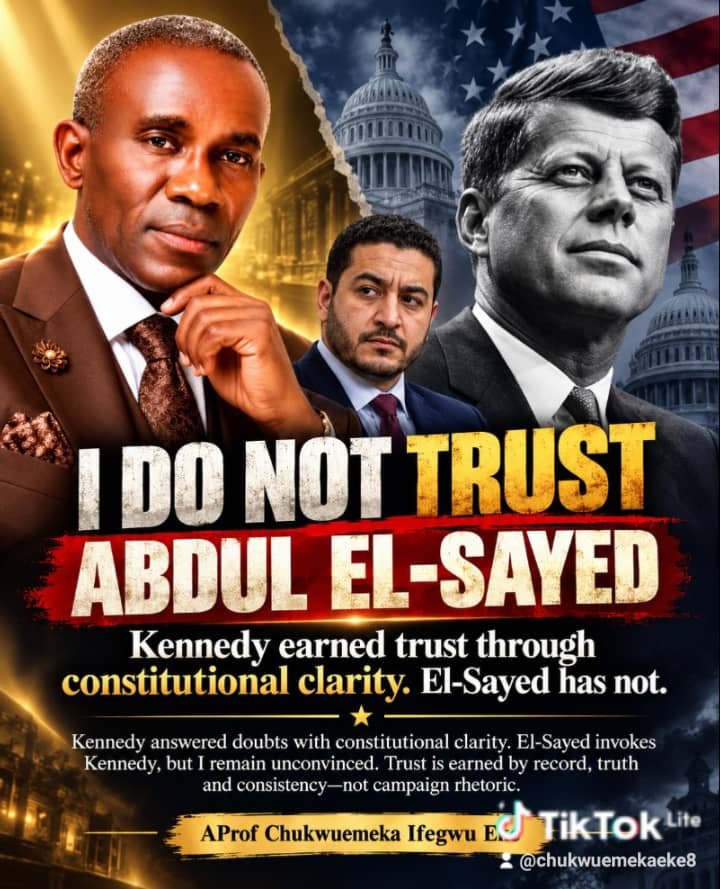
I DO NOT TRUST ABDUL EL-SAYED: POLITICAL PROMISES, THE KENNEDY COMPARISON AND THE QUESTION OF CONSTITUTIONAL LOYALTY
By AProf Chukwuemeka Ifegwu Eke
October 21, 2026
I believe political trust must be earned through a consistent record, not demanded through campaign speeches.
My scepticism of Abdul El-Sayed begins with that principle. I do not regard his public assurances as sufficient grounds for confidence in his political judgment.
Nor am I persuaded that invoking John F. Kennedy settles the questions surrounding his record.
KENNEDY’S NAME IS NOT A SUBSTITUTE FOR EVIDENCE
On September 12, 1960, President-to-be John F. Kennedy addressed concerns about whether his Catholic faith would compromise his independence as an American president.
He declared:
“I believe in an America where the separation of church and state is absolute.”
Kennedy expressly rejected the proposition that religious authorities should dictate his decisions as president.
I consider that a fundamental constitutional commitment.
When Abdul El-Sayed compared questions about his Muslim faith and political allegiance to those Kennedy faced, he invoked a genuinely important chapter in American history.
But I remain sceptical of the political use of that comparison.
Kennedy’s speech cannot provide automatic credibility to another politician decades later.
I want El-Sayed judged on his own record.
“Source: Kennedy’s September 12, 1960 address” (https://millercenter.org/the-presidency/presidential-speeches/september-12-1960-address-greater-houston-ministerial)
EL-SAYED’S WORDS DO NOT SETTLE MY QUESTIONS
At a Michigan town hall on October 17, 2026, El-Sayed explicitly disavowed the Muslim Brotherhood.
He also invoked his allegiance to the American Constitution.
I acknowledge those statements.
Nevertheless, I do not regard a declaration made during a political campaign as the final test of a candidate’s judgment.
I want to know whether his policy proposals, prior positions and political decisions consistently reflect the constitutional principles he invokes.
I am particularly interested in his historical statements about political developments in Egypt.
In 2012, he joined other Egyptian Americans in supporting the electoral mandate of Mohamed Morsi, whose political affiliation was with the Muslim Brotherhood.
That statement does not prove El-Sayed was a Brotherhood member. But it forms part of the political history I believe deserves close examination.
What did he understand about the movement’s political programme?
How did he assess the conflict between Egypt’s competing constitutional and religious visions?
What lessons did he draw from the Morsi presidency?
I consider those questions legitimate, and I want substantive answers.
FRANCE, BELGIUM AND THE DUTY TO DEFEND CIVIL LIBERTIES
I remain concerned about the historical record of Islamist terrorism in Europe.
The Charlie Hebdo massacre, the November 2015 Paris attacks and the murder of Samuel Paty demonstrated the deadly consequences of violent extremism.
I condemn those crimes and the ideologies used to justify them.
I also recognise that responsibility for those atrocities belongs to their perpetrators, not to every practising Muslim, Middle Eastern immigrant or supporter of Palestinian rights.
Recent unrest in France and Belgium must likewise be examined according to its documented causes, rather than attributed to an entire community without evidence.
My concern is constitutional: I expect political leaders to defend freedom of expression, equal rights, public safety and the rule of law against every form of coercion.
WHY I REMAIN UNCONVINCED
I have heard El-Sayed’s public declarations about constitutional allegiance.
I have seen his comparison with Kennedy.
I have considered the controversy surrounding his earlier support for Morsi’s democratic mandate.
I remain unconvinced that his campaign statements alone establish the political confidence he seeks.
That does not mean I have established that he is dishonest or intends to impose religious law. I have not.
It means that I regard his previous political judgments, his explanations of those judgments and his proposed policies as essential subjects for scrutiny.
My distrust is political, not religious. I would ask the same questions of a Catholic, Protestant, Jewish, Muslim or nonreligious candidate.
MY CONCLUSION
I do not equate Abdul El-Sayed with John F. Kennedy merely because both faced questions about religious allegiance.
I recognise the historical parallel, but I reject the notion that it proves similarity in political judgment or public leadership.
I want documentary evidence, consistent constitutional commitments and a record capable of independent assessment.
I remain deeply sceptical of Abdul El-Sayed’s political assurances. His invocation of Kennedy does not resolve that scepticism.
For me, constitutional fidelity must be demonstrated, not simply declared.
AProf Chukwuemeka Ifegwu Eke