
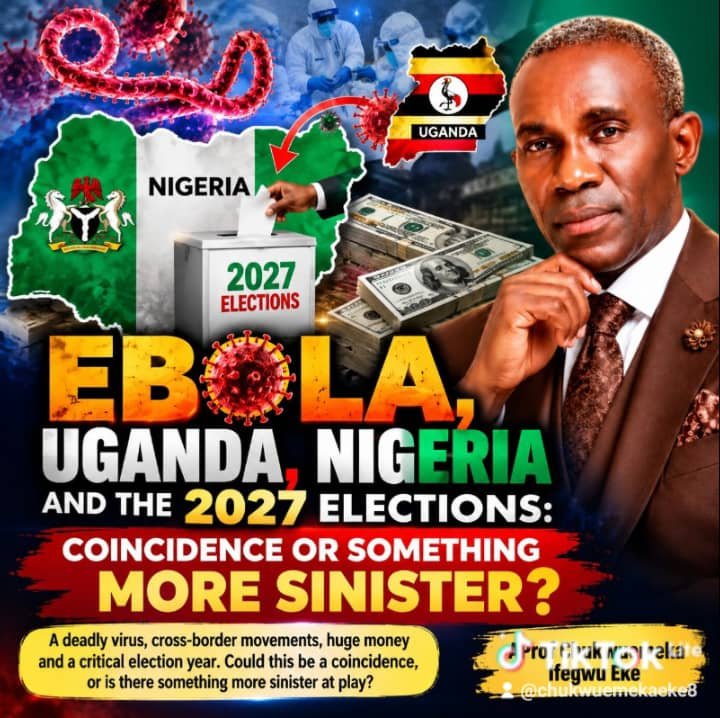
EBOLA, UGANDA, NIGERIA AND THE 2027 ELECTIONS: COINCIDENCE OR SOMETHING MORE SINISTER?
By Pastor AProf. Chukwuemeka Ifegwu Eke
Wednesday, October 21, 2026
I have been studying the recent developments surrounding the Ebola outbreak in Africa, particularly the reported movement of the disease through Uganda and its confirmed arrival in Nigeria.
I am disturbed, not merely by the public-health implications, but by the coincidence of these developments with Nigeria’s approaching 2027 general elections.
I have no evidence that the outbreak was politically engineered. But I believe the country must examine the potential political consequences of any prolonged health emergency.
Could a disease outbreak inadvertently disrupt election preparations? Could emergency health restrictions affect political mobilisation? Could fear change public participation in the democratic process?
And, perhaps most importantly, what safeguards are necessary to prevent a genuine health emergency from being exploited for political advantage?
THE TIMELINE THAT DESERVES ATTENTION
On May 15, 2026, an Ebola outbreak caused by the Bundibugyo virus was declared in the Democratic Republic of Congo.
Uganda subsequently reported imported infections, but on August 27, 2026, the World Health Organization and Africa CDC officially welcomed the end of Uganda’s outbreak after 42 days without a new confirmed case.
“WHO — Uganda Ends Ebola Outbreak, August 27, 2026” (https://www.afro.who.int/countries/uganda/news/uganda-ends-ebola-outbreak-following-completion-42-day-countdown)
Then came Nigeria.
On October 20, 2026, the World Health Organization announced that Nigeria had confirmed an imported case of Ebola Bundibugyo virus disease in Abuja.
According to WHO, the patient had recently travelled through Uganda, developed symptoms on October 7, sought medical attention on October 11 and received laboratory confirmation on October 20.
At the time of that announcement, Nigerian authorities had identified 44 contacts for monitoring.
“WHO — Nigeria Confirms Imported Case, October 20, 2026” (https://www.afro.who.int/countries/nigeria/news/nigeria-confirms-imported-case-ebola-bundibugyo-virus-disease?form=FUNKUKTZPCK)
I find this timeline worthy of close examination.
It demonstrates how a health emergency originating outside Nigeria can quickly become a national concern.
But it also raises another question.
If the disease spreads and restrictive measures become necessary, how might those measures interact with the political calendar?
WHEN HEALTH EMERGENCIES MEET POLITICAL AMBITIONS
I remember how COVID-19 transformed political activities, movement, commerce and public administration across the world.
Public-health emergencies can affect large gatherings, transportation, government expenditure and the ability of citizens to participate in ordinary social activities.
Political campaigns are not insulated from those realities.
What happens if Nigeria experiences a wider Ebola outbreak during the months preceding the 2027 elections?
Would campaign rallies be affected?
Would restrictions apply equally to every political party?
Would opposition candidates retain reasonable access to voters?
Would the Independent National Electoral Commission have sufficient operational independence and resources to adapt?
And who would scrutinise emergency decisions to ensure that health protection does not become an excuse for unnecessary restrictions on democratic participation?
I am not suggesting that these outcomes are inevitable.
I am asking whether the necessary safeguards exist before circumstances make them urgently relevant.
## COULD THERE BE SOMETHING SINISTER?
This is where I believe careful reasoning becomes indispensable.
A coincidence does not prove a conspiracy. The arrival of Ebola in Nigeria shortly before an election year does not establish that anyone deliberately introduced the disease.
Indeed, the documented outbreak in Congo, cross-border movement of infected persons and laboratory confirmation in Nigeria provide a plausible epidemiological explanation for the case.
Nevertheless, a genuine emergency can create opportunities for political abuse even when the emergency itself has entirely natural origins.
I therefore distinguish between two different questions.
First, was the outbreak deliberately created or introduced to influence Nigeria’s elections?
At present, I have seen no credible evidence supporting that allegation.
Second, could individuals or institutions exploit the consequences of an outbreak to influence electoral activity?
That is a legitimate governance question deserving advance scrutiny.
I would be concerned if health restrictions were imposed selectively, if emergency expenditure escaped oversight, or if an epidemic became a justification for weakening lawful democratic processes.
Those are risks to guard against, not accusations I am making against any particular government or political actor.
MY QUESTIONS TO THE FEDERAL GOVERNMENT AND INEC
I want the Federal Government, the Nigeria Centre for Disease Control and Prevention, and INEC to explain how they would manage a serious epidemic during the electoral period.
Would emergency restrictions be based on published medical evidence?
Would epidemiologists, rather than political officeholders alone, advise on the necessity and duration of such measures?
Would independent courts remain available to review restrictions that affect constitutional rights?
Would campaign regulations be applied uniformly?
Would emergency procurement and funding remain subject to transparent accounting?
I ask these questions because citizens should not have to choose between protection from a deadly disease and protection of their democratic rights.
Both are obligations of the state.
LET THE SCIENCE SPEAK, AND LET DEMOCRACY REMAIN PROTECTED
I also caution against allowing political suspicion to interfere with the response to Ebola.
Ebola is a serious infectious disease. Delays in diagnosis, unsafe exposure and failures in contact tracing can cost lives.
Nigeria must therefore support its medical professionals, protect healthcare workers, monitor contacts and communicate reliable information to the public.
I do not want unfounded political speculation to discourage testing, treatment or cooperation with health authorities.
At the same time, I want every extraordinary government measure to be lawful, proportionate, time-limited and open to independent review.
These principles become even more important when a country approaches a major election.
MY FINAL QUESTION: COINCIDENCE OR WARNING?
I return to the coincidence that prompted this examination.
An Ebola outbreak has expanded beyond its original location. Nigeria has confirmed an imported case. The country is approaching the 2027 elections.
These are established developments, but their simultaneous occurrence is not evidence of a coordinated political design.
For me, the more important warning concerns preparedness.
Will Nigeria be capable of containing the outbreak without unnecessarily disrupting political competition?
Will public-health decisions remain guided by medical evidence?
Will institutions protect both public safety and electoral fairness?
And if extraordinary powers become necessary, who will ensure that those powers are not misused?
I will not call an outbreak a conspiracy without evidence. But neither will I accept that the existence of a genuine emergency automatically places every government decision beyond scrutiny.
The real test is whether Nigeria can confront a deadly disease while preserving the constitutional safeguards on which its democracy depends.
That is the question I want answered before 2027.
Pastor AProf. Chukwuemeka Ifegwu Eke
October 21, 2026