
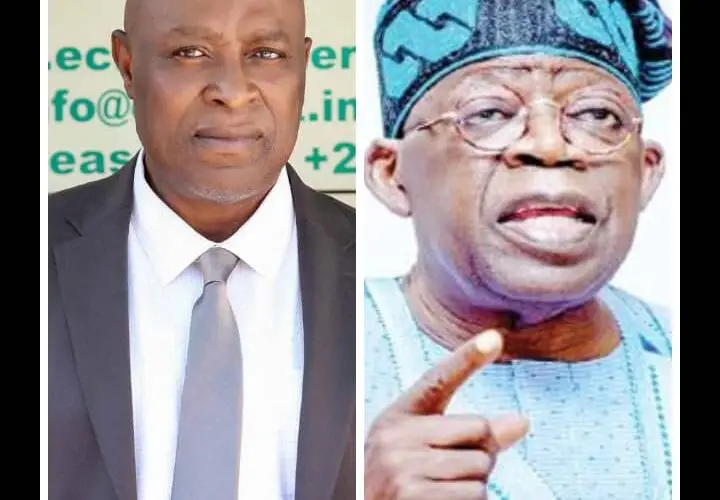
The 2027 Re-election Question: Can Tinubu Defy the Odds?
Charles Ude, Esq.
Legal Practitioner and Author
charlesude2014@gmail.com
Introduction
Nigeria is a country of two stories. Read the papers and you will see growth, rising revenues, new roads. Walk the streets and you will meet a different country, the trader counting coins for bread, the graduate sending CVs into silence, the mother stretching one pot of soup to feed five children.
President Bola Ahmed Tinubu sits right in the middle of this contradiction. His people say he is the surgeon who arrived when the patient was dying and made the cuts nobody else dared to make. His critics say he is a man who cannot feel the pain he has caused. As 2027 comes closer, the question is no longer whether he deserves another four years. It is whether he can win them.
A new poll from Oxford–Metro Analytics, which closed on September 7, 2026, gives us something to think about. Out of 69,110 responses, Tinubu came first with 35.41%. Peter Obi followed closely at 33.86%. Atiku Abubakar was third with 26.67%. The gap between first and second was just 1,067 responses. That is not a mandate. That is a photo finish.
The Case for Re-election
He Stopped the Bleeding
Let us be fair. When Tinubu took over, the treasury was leaking badly. Fuel subsidies were eating billions. The naira was falling. Government revenue could not cover the bills. His team moved fast, maybe too fast, to scrap the subsidy and let the naira find its true value.
The numbers since then are hard to argue with. Non-oil revenue climbed from about ₦12.3 trillion in 2023 to over ₦20 trillion. The debt service-to-revenue ratio dropped from a choking 97% to under 50%. Real GDP grew by 4.43% in the second quarter of 2026. The stock market moved from 53,000 points to 250,000. These are not small things.
Even more telling, many states that once could not pay salaries on time, states that lived on federal bailouts or piled up arrears, have now turned the corner. Monthly FAAC allocations have grown. In April 2026 alone, the three tiers of government shared ₦2.257 trillion. Governors who once begged for help now clear backlogged wages, settle minimum wage arrears, and break ground on new projects. For the president, this is proof that his reforms, however painful, are starting to work.
He Is Actually Building Things
Nigerians have heard endless promises about infrastructure. Tinubu’s government seems determined to turn the country into one big construction site. The Lagos–Calabar Coastal Road is taking shape. The Sokoto–Badagry Super Highway is moving forward. He signed Local Government Autonomy into law. The State Police bill, debated for decades, is finally before the National Assembly.
His Political Machine Is Second to None
This is where Tinubu truly towers. He has 31 of the 36 state governors behind him. That is not luck. That is years of political work. As Professor Femi Otubanjo said, “Today Tinubu has 31 governors behind him.” Those governors control state resources, local government chairmen, and the kind of grassroots network that decides elections. In Nigerian politics, that is like owning the battlefield before the first shot is fired.
The Oxford–Metro poll supports this. Tinubu led in 20 states and the FCT—up from the 12 he won in 2023. He swept the South-West (43.53%), the North-West (43.10%), and the North-Central (36.97%). He even led in Kano, where Kwankwaso won in 2023, and in Kaduna, Katsina, and Gombe—states that once belonged to Atiku.
The Case Against Re-election
The Cost of Living Has Become Crushing
Let us not pretend otherwise. The removal of the fuel subsidy and the floating of the naira hit ordinary Nigerians like a thunderbolt. Prices exploded. Food became a luxury. The United Nations warns that 35 million Nigerians could face acute hunger. Labour unions rejected a proposed ₦100,000 minimum wage and are threatening strikes. When a man cannot afford bread, GDP figures mean nothing to him.
The SBM Intelligence Voter Sentiment Tracker paints a grim picture. Tinubu’s net favourability stands at minus 58.5,the worst of any candidate. Across five policy areas, his scores never exceeded 2.1 out of 4. That is not disapproval. That is rejection.
Insecurity Has Not Improved—It Has Worsened
Yes, the military has grown. But try telling that to the families of the more than 10,000 people killed by armed groups since 2023. Try telling it to communities still living under the shadow of bandits. Try telling it to parents who cannot send their children to school without fearing the next mass abduction, 15 of which have happened under this watch. The opposition says the state is “steadily losing its monopoly over security.” That is not rhetoric. It is what people live with every day.
Corruption Scandals Keep Mounting
The Auditor-General could not account for ₦33.75 billion in cash transfers meant for poor households. The former Humanitarian Minister was investigated over ₦585 million. The 2025 capital budget reportedly achieved less than 10% implementation. Atiku Abubakar called this administration “one of the most fiscally reckless governments in Nigeria’s democratic history.” Harsh words. But are they wrong?
The Absent President
Tinubu has made 52 foreign trips and spent about 261 days abroad since taking office, at a reported cost of ₦37.64 billion. Yet he has been conspicuously absent from the world’s biggest stages. He skipped the 2026 BRICS Summit in New Delhi, sending Vice President Shettima. He reportedly shelved his trip to the 81st UN General Assembly, his third consecutive UNGA absence, again leaving Shettima to lead Nigeria’s delegation. The reported reason: fears of an anti-Tinubu protest in New York linked to US efforts to obtain FBI records. Meanwhile, he was in Paris on holiday. A president who travels constantly, yet disappears when the cameras of global scrutiny are rolling, sends its own message.
The EFCC: A Double-Edged Sword
The Economic and Financial Crimes Commission has posted impressive figures, ₦1.23 trillion, $684.48 million, and forfeiture orders on over 10,000 assets between October 2023 and June 2026. Some of that money went to student loans, consumer credit, and housing. That is real.
But here is the problem: the EFCC must live up to the expectations of Nigerians by focusing on fraudulent and corrupt politicians, and less on naira mutilation. When President Tinubu intervened in the EFCC’s freezing of Osun State government accounts, civil society groups warned that such interference “weakens institutional independence.” If the EFCC is seen as hunting opponents while shielding allies, it loses the moral high ground. Nigerians want to see the big fish caught. Not just the minnows.
Local Government Autonomy: A Promise Unfulfilled
Tinubu signed Local Government Autonomy into law. He said, “Let us give them. There is no autonomy without a funded mandate.” Yet critics say implementation has crawled. Atiku Abubakar accused him of “using the funds as a bargaining chip with state governors to keep them under his control.”
Tinubu must persuade governors to release local government funds, otherwise, local government autonomy means nothing. The Supreme Court judgment is clear. Implementation is not optional. If autonomy remains a paper tiger, voters will see through the charade.
The Nnamdi Kanu Factor
The continued detention of Mazi Nnamdi Kanu is a ticking time bomb for Tinubu’s fortunes in the South-East. The Ohanaeze Youth Council has warned that he “risks a significant political backlash in the 2027 general elections if he does not release” Kanu.
Early release of Mazi Nnamdi Kanu will help boost the president’s electoral fortunes in the South-East. It would be a gesture of reconciliation. It would also take a rallying cry away from the opposition.
The Oxford–Metro poll shows Obi dominating the South-East with 63.97% and leading the South-South with 41.48%. These are exactly the zones where Kanu’s release could change the conversation.
Does Tinubu Actually Have a Chance of Winning?
By every measure of public feeling, Tinubu should be staring at defeat. Yet the Oxford–Metro poll puts him in front, leading in 20 states and the FCT. CellHub, another data firm, also predicts he would win 20 states if the vote were held today.
How can both things be true? The answer is in Nigeria’s electoral arithmetic. Under Section 134 of the Constitution, you do not need a majority. You need the highest number of votes, plus 25% in at least 24 states. In 2023, Tinubu won with just 36.61% because the opposition split three ways. As CellHub’s Mohammed Aliyu put it: “A unified bloc beats a divided one almost regardless of mood.”
History teaches the same lesson. Only one elected president has ever lost a re-election bid in Nigeria—Goodluck Jonathan. And that was because the opposition finally united in 2015.
Who Are His Closest Rivals?
Atiku Abubakar (ADC) – At 80, he says 2027 will be his last dance. The Oxford–Metro poll shows him dominating the North-East with 55.46%. But his campaign has been riddled with internal squabbles. FCT Minister Nyesom Wike dismisses him as a “voodoo economist.”
Peter Obi (NDC) – His net favourability of plus 58.3 stands in stark contrast to Tinubu’s minus 58.5. He leads in voter sentiment in every zone except the North-East. The Oxford–Metro poll shows him winning the South-East and South-South. But his massive online following does not automatically convert into votes. Social media skews young, urban, and connected. It leaves out the rural North, where elections are decided. He is projected to win only eight states.
The Opposition’s Greatest Enemy Is Itself – Atiku runs on the ADC ticket. Obi runs on the NDC ticket. A PDP faction has floated Goodluck Jonathan. Kwankwaso and Amaechi are in the mix. They talk of unity. But personal ambition keeps getting in the way. Kenneth Okonkwo, speaking for Atiku’s camp, accuses the APC of trying to weaken opposition parties before 2027. But accusations do not win elections. Unless all the opposition parties unite behind a single candidate, it is a runaway victory for President Tinubu. A divided opposition hands the ruling party victory on a platter. It does not matter how unpopular the incumbent may be.
A Final Word on Reno Omokri’s Interview
I watched Reno Omokri on Channels TV’s Politics Today with Seun Okinbaloye yesterday. In my opinion, it was a waste of time. He recycled the same old defenses — the FBI “subject vs. associate” technicality, the Chicago State University records, the macro-economic figures, the governor count. When pressed on the cost of living, he challenged the World Bank’s indicators instead of answering the question. His entire performance reinforced this article’s central tension: structure versus sentiment. Omokri brought the full toolbox of the “structure camp.” And to a mother counting coins to buy bread, it all sounded like exactly what it was — a waste of time.
Conclusion: Structure vs Sentiment
Tinubu’s re-election prospects are a paradox. By almost every measure of public opinion, he should lose. Yet by the cold arithmetic of Nigeria’s electoral system and the opposition’s chronic inability to unite, he remains the man to beat. The Oxford–Metro poll confirms it. A narrow lead, but a lead nonetheless.
The old political adage holds true in Nigeria: structure defeats sentiment, and organisation trumps outrage. Tinubu has the structure. The opposition has the sentiment. The question is whether the opposition can finally bridge that gap before 2027.
Unless all the opposition parties unite behind a single candidate, it is a runaway victory for President Tinubu. For now, the smart money, however reluctantly, rests on Tinubu. But as any Nigerian knows, politics is unpredictable. A week is a long time. And 2027 is still a lifetime away. The race is far from over.
CU
September 2026