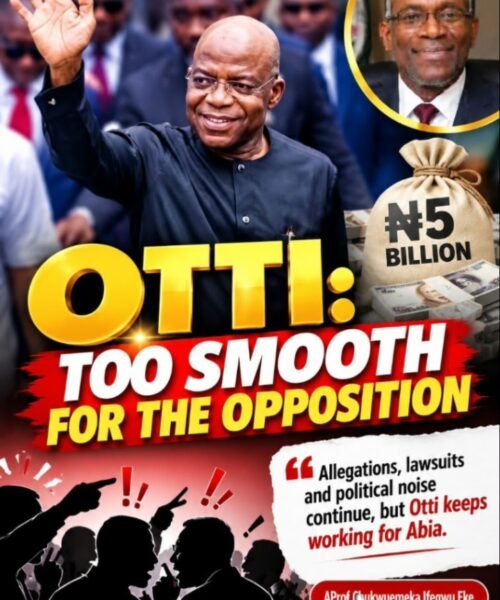


😂😂😂 THIS ONE REALLY MADE ME LAUGH!
Just look at the roll call of people and institutions tagged under this post!
BBC, Channels Television, Harvard Business School, University of Cambridge, World Bank, European Union, Amnesty International, Ngozi Okonjo-Iweala, Tinubu, Peter Obi, Soludo, Sowore, Davido, Burna Boy—and practically anybody else whose name could possibly help this allegation travel!
At this rate, perhaps the United Nations Security Council, FIFA and the International Space Station should also be tagged. 😂
And the irony is even richer: in this frantic attempt to give the allegation maximum circulation, political actors associated with periods Abians themselves remember very differently are being summoned as though they are now the emergency jury on the governance of Abia State.
But hashtags, celebrity tags and an impressive distribution list cannot rescue a weak interpretation of public accounts.
NOW, TO THE ISSUE.
The central weakness of this latest argument is the attempt to transform an accounting description into proof of personal expenditure.
The post repeatedly presents the alleged ₦23.5 billion expenditure under the Governor’s Office and then dramatically reduces the Governor’s Office to “1 person.”
That is the sleight of hand upon which the entire argument rests.
The Governor’s Office is not Alex Otti’s pocket.
An expenditure recorded administratively under the Governor’s Office does not, merely because of its location in the accounts, mean that the money was spent on the Governor personally. Government accounting structures contain offices, departments, operations, personnel and responsibilities that cannot reasonably be collapsed into the biological person occupying the office.
So this:
“₦23.5 BILLION ON 1 PERSON!”
may make a wonderful Facebook headline, but it is not serious public-finance analysis.
The author himself describes the expenditure line as “Security Vote—including Operations.”
Those last two words matter enormously: INCLUDING OPERATIONS.
You cannot quote an expenditure classification that expressly includes operations and then conveniently rewrite the entire amount as money spent protecting one man.
That is not what the description quoted in the allegation says.
There is another contradiction.
We are told that because the Federal Government funds the Police, military, DSS and Civil Defence, Abia State should somehow have little reason to spend substantial resources on security.
Really?
Since when did federal funding of security agencies eliminate the security responsibilities of state governments?
Who supports joint security operations? Who provides logistics at state level? Who deals with local intelligence requirements, emergency interventions and other state-specific security needs? Who responds when communities demand increased security presence?
A Governor would be condemned tomorrow if insecurity exploded and his answer was: “The Federal Government funds the Police, therefore Abia State did not spend money supporting security operations.”
You cannot demand effective security from a state government and simultaneously pretend that security has no state-level financial implications.
Then comes the comparison with youth expenditure.
Again, we are invited to compare selected capital expenditure on Youth and Sports with a security-related expenditure classification and conclude that youths were abandoned.
That comparison is analytically defective.
Government expenditure benefiting young people is not confined to the budget of a ministry carrying the word “Youth.” Roads used by young entrepreneurs, education, healthcare, skills programmes, digital infrastructure, agriculture, SME interventions, public employment and improvements in the wider business environment do not suddenly cease to benefit young people because they are recorded under other ministries and agencies.
If the intention is genuinely to determine whether Otti’s government has served Abia youths, then conduct the analysis properly: identify every youth-targeted programme across government, establish budgeted amounts, actual releases, beneficiaries and measurable outcomes.
That would be analysis.
But adding stadium expenditure, tournaments and ceremonies together and declaring that “Abia youths got ceremonies” is rhetoric masquerading as accounting.
As for Governor Otti’s 2023 statement on security votes, there is a legitimate question worth asking: how does the administration reconcile that campaign statement with the expenditure classifications subsequently appearing in the state’s accounts?
Ask it.
Demand the reconciliation.
Demand explanations of the accounting classifications.
That is what democratic accountability requires.
But there is a considerable distance between asking that legitimate question and declaring that ₦23.5 billion was spent “ON 1 PERSON.”
Evidence must bridge that distance—not capital letters, emojis, hashtags or celebrity tags.
And this is perhaps the most interesting part of the entire exercise.
The figures being relied upon are said to come from financial reports published by the Accountant-General of Abia State itself.
Think about that.
The government supposedly determined to conceal everything is simultaneously publishing the financial material being mined daily by its critics to attack it.
There is an important accountability point there which this narrative conveniently overlooks.
Public accounts exist precisely so citizens, journalists, analysts, opposition politicians and supporters can interrogate government expenditure.
And once those figures enter the public domain, nobody owns their interpretation.
If you can examine them and accuse Governor Alex Otti, another Abian can examine the same material and challenge your conclusions.
That person does not have to work for Otti.
He does not have to receive one naira from the Abia State Government.
And asking him, “HOW MUCH CAME TO YOU AS YOU ATTACK ME?” does not answer his argument.
Produce evidence that he was paid—or debate the substance.
It cannot be that criticism of Otti represents courageous citizenship while defending Otti automatically represents payment.
That is not accountability. That is an attempt to monopolise public debate.
Governor Alex Otti’s administration should be scrutinised. Every naira of Abia’s resources should be accounted for. Where explanations are necessary, officials should provide them.
But scrutiny must be intellectually honest.
A Governor’s Office is not “one person.”
An expenditure heading is not proof of personal enrichment.
Security operations are not synonymous with the personal security of the Governor.
Youth development cannot be measured solely from one ministry’s capital-expenditure column.
And a campaign quotation, however important, does not by itself establish that money subsequently reported under a security-related accounting heading was stolen, diverted or personally consumed.
So, after tagging half the planet, we are still exactly where serious analysis should have started:
Show what the ₦23.5 billion classification actually comprises.
Separate security operations from any component properly describable as a discretionary security vote.
Establish who received what, for what purpose, and what evidence demonstrates wrongdoing.
Then we can have a serious conversation.
Until then, the hashtags may travel faster than the evidence—but they cannot become the evidence.
Abia has moved beyond government by propaganda.
Its opposition and critics should move beyond opposition by propaganda too.
Let the public records speak. Let explanations be demanded where necessary. Let evidence confront evidence.
And let Abians—not a forest of celebrity tags—decide whether Alex Otti is rebuilding their state.