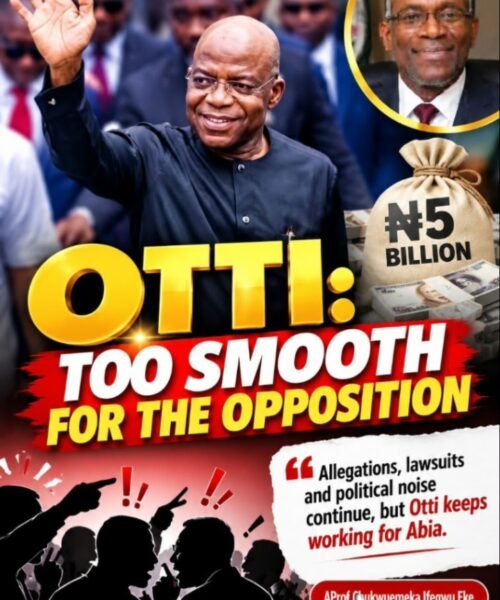



POLITICAL PSYCHOLOGY OF OPPOSITION IN TODAY’S ABIA
Opposition is indispensable to democracy because government becomes less careful when it is never questioned and less accountable when it is never challenged. Every serious democratic society needs people who interrogate budgets, test official claims, examine the cost and quality of projects, scrutinise procurement, expose waste and insist that public office remains answerable to the public. Abia is no exception. Governor Alex Otti’s administration should be scrutinised, challenged and criticised where necessary, not because criticism is an act of hostility, but because criticism is one of the disciplines that keeps democratic government from becoming self-satisfied. The danger begins, however, when opposition gradually ceases to function as a democratic responsibility and becomes instead a psychological identity. At that point, judgment can become less about what government has actually done and more about who has done it. A road is no longer assessed simply as a road, a hospital is no longer examined simply as a hospital, a school renovation is no longer judged simply by its quality, cost or impact. Everything begins to pass through a partisan filter, and once that happens, political identity starts to determine the meaning of evidence.
The political psychology of opposition is therefore not about diagnosing opponents or suggesting that people who disagree with government are psychologically unwell. That would be both inaccurate and offensive. It is about examining how identity, emotion, memory, loyalty, group belonging and cognitive habits influence the way citizens interpret political events. In today’s Abia, this question has become particularly important because the political atmosphere is highly charged. The present administration represents a break with an older political order, and that break has generated both enthusiasm and resentment. For some citizens, the debate around Otti is about roads, schools, hospitals, markets, salaries, public finance and administrative reforms. For others, it is also about political displacement, old loyalties, loss of influence, changing networks of power and the emotional difficulty of watching a rival political order consolidate itself. When these factors enter the public conversation, criticism can easily become more emotional than analytical.
One of the clearest features of this psychology is confirmation bias. People naturally prefer information that supports what they already believe and are more suspicious of information that challenges those beliefs. In politics, this tendency can become especially strong because political opinions are often tied to identity. Two Abians can look at exactly the same project and reach opposite conclusions before asking any factual questions. One sees a newly completed road and interprets it as evidence of progress. The other sees the same road and describes it as political theatre, overpricing or propaganda. Neither reaction is automatically illegitimate, because a road can indeed be useful and still be overpriced, and a visible project can still raise questions about procurement or value for money. The problem begins when the conclusion is already fixed before the evidence is considered. If the road is completed, the critic says that it is merely the governor’s job. If the road is not completed, the same critic says the government is incompetent. If a school is renovated, the response is that taxpayers funded it anyway. If it is neglected, the government is accused of abandoning education. If a hospital is upgraded, the achievement is dismissed as routine. If the hospital deteriorates, the deterioration is treated as proof of total failure. What emerges is an asymmetry in which failure counts as evidence but success does not.
This asymmetry matters because no government can be fairly evaluated under a system in which every negative development is treated as meaningful while every positive development is neutralised as obligation. Government should not be applauded merely for performing routine responsibilities, but performance must still count as performance. If failure is admissible as evidence, achievement must also be admissible as evidence. Otherwise, political evaluation becomes a ritual in which the verdict is permanent and only the supporting arguments change. A road completed today is dismissed as ordinary government duty, but the absence of the same road yesterday was treated as proof of incompetence. That is not balanced scrutiny. It is evidence being forced to serve a pre-existing political conclusion.
Closely related to confirmation bias is motivated reasoning. This occurs when a person does not begin by asking what the evidence shows, but begins instead with a preferred conclusion and searches for material that can support it. There is a major intellectual difference between asking, “How well has the Otti administration performed?” and asking, “What can I find to prove that Otti has failed?” The first question leaves open the possibility of both praise and criticism. The second has already reached judgment. Social media makes this form of reasoning exceptionally easy because there is always something available to reinforce an existing belief. Somewhere there will always be a pothole, an angry citizen, a delayed project, a disputed contract figure, a badly worded official statement, an old photograph, an uncompleted building or an unverified allegation. A person determined to find evidence of failure will usually succeed in finding something that can be presented as evidence. The same tendency exists among government supporters, who may rationalise every mistake, dismiss every allegation and treat every critic as malicious. The deeper democratic problem is therefore not whether one belongs to government or opposition, but whether one is still capable of allowing evidence to change one’s mind.
Cognitive dissonance adds another layer to the problem. It refers to the discomfort that arises when new information conflicts with a belief in which a person has already invested emotionally. In politics, this can be especially powerful. Suppose a person has spent years describing a governor as completely incompetent. If visible improvements begin to appear, acknowledging those improvements may require that person to revise earlier statements. That revision can carry emotional and reputational costs, so it becomes easier to redefine the achievement. What was once declared impossible becomes, after completion, unimportant. The project can be dismissed as cosmetic, its motive can be questioned, its relevance can be minimised or attention can be shifted immediately to another unresolved issue. Yesterday, the argument was that the government could never do it. Today, the argument is that it does not matter that the government did it. This is one of the clearest ways political dissonance operates: yesterday’s impossible achievement becomes today’s irrelevant achievement.
The moving goalpost is another familiar pattern. Before a project begins, critics may say that it will never happen. When construction starts, the response becomes that it will never be completed. When the project is completed, the question shifts to cost. When the cost is explained, attention moves to procurement. When procurement is defended, the argument shifts to whether the project should have been prioritised in the first place. Every one of these questions can be legitimate. Cost matters. Procurement matters. Priority matters. Value for money matters. The problem begins when no answer is ever allowed to alter the original verdict. At that point, scrutiny has stopped functioning as inquiry and has become prosecution. A genuine critic must retain the right to revise an opinion in the light of better evidence. If no possible evidence can change a political judgment, then the judgment was never really based on evidence.
Social media has intensified these tendencies because it rewards emotion more readily than nuance. A careful statement that an administration has performed well in one sector but poorly in another may attract little attention. A dramatic accusation that the government has failed completely is more likely to be shared, debated and amplified. Anger travels fast, while nuance travels slowly. This has created an environment in which political actors and commentators are rewarded for keeping their audiences emotionally activated. Today the outrage may concern a road contract, tomorrow an appointment, the next day a foreign trip, a speech, a photograph or a rumour. Once political communities become organised around permanent anger, every new issue has to be converted into fresh evidence of betrayal. The danger is that if everything is presented as a scandal, citizens may eventually lose the ability to recognise a genuine scandal when one appears.
Group loyalty also plays a powerful role in political judgment. Political communities provide belonging, solidarity and identity, but they can also impose pressure. An opposition supporter who acknowledges that government has done something well may immediately be accused of having been bought, compromised or persuaded to cross over. Such accusations are not trivial. They discipline the group by signalling that certain conclusions are unacceptable. Over time, citizens may become reluctant to express independent judgments because doing so carries social consequences. This creates a closed political environment in which information is judged less by whether it is true and more by whether it strengthens or weakens the group. A healthy democracy cannot thrive when citizens require partisan permission to acknowledge reality.
None of this means that distrust of government is irrational. Abians, like Nigerians generally, have lived through years of abandoned projects, exaggerated claims, opaque contracts, poor public services and political propaganda. Governments themselves have trained citizens to be sceptical. A ribbon-cutting ceremony does not prove value for money. A beautiful road does not answer procurement questions. A new building does not establish that public funds were efficiently used. Government publicity is not an audit, and official photographs are not independent verification. Every administration, including Otti’s, must therefore be willing to explain expenditure, debt decisions, procurement processes, project timelines, maintenance arrangements and measurable outcomes. The argument is not that opposition should become silent. The argument is that opposition should become more rigorous.
Abia needs better opposition, not less opposition. The strongest opposition is not necessarily the loudest. It is the opposition that can produce evidence. It should be capable of saying that government has performed well in one sector but poorly in another, that one contract appears justified while another requires explanation, that one project is of high quality while another is already deteriorating. This kind of criticism is far more useful to democracy than indiscriminate condemnation because it forces government to improve, educates citizens and gives the opposition credibility. If a political movement insists that everything government does is bad, citizens may eventually conclude that the movement is not evaluating government at all but merely waiting for its own turn to govern.
There is also a zero-sum temptation in democratic politics. Opposition parties want to defeat incumbents, and the more successful an incumbent appears, the harder that task becomes. This can create a psychological incentive to minimise success because acknowledging success may appear politically costly. Yet the logic becomes contradictory when examined carefully. If Abia succeeds, Abians benefit. Better roads benefit opposition families. Improved hospitals treat supporters and critics alike. Better schools educate children regardless of party. Improved security protects everyone. It therefore makes little democratic sense for opposition to desire governmental failure merely because failure weakens the incumbent. The proper objective should be to make government better through scrutiny while persuading citizens that an alternative government could do better still.
There is a simple test every citizen can apply to political judgment. Would I assess this action the same way if it had been carried out by the politician I support? If the answer is no, then partisan identity may be exerting more influence than evidence. A second question is even more revealing: what evidence would make me change my mind? If the honest answer is nothing, then the argument is no longer about evidence. It is about identity. This test should apply equally to government supporters. If nothing could ever persuade a supporter that government has failed, support has become devotion. If nothing could ever persuade an opponent that government has succeeded, opposition has become fixation.
The healthiest political culture is one in which citizens can say, without embarrassment, “I oppose this government, but they got this one right,” and also, “I support this government, but they got this one wrong.” Those two sentences are simple, but they represent a high level of democratic maturity. They demonstrate that political judgment remains independent of political loyalty. An Abia in which opposition supporters can acknowledge genuine progress and government supporters can acknowledge genuine failure will be far more politically sophisticated than an Abia divided into two rigid camps of absolute condemnation and absolute praise.
The central question in today’s Abia is therefore not whether Governor Alex Otti should be criticised. He should be, because every governor should be. The deeper question is whether criticism remains grounded in evidence or whether partisan rivalry gradually develops into a condition in which nothing done by the other side can ever be acknowledged. Government must never be allowed to define truth simply because it controls official communication, but opposition must also never be allowed to define falsehood simply because it opposes government. There must remain a territory in public life where evidence stands independently of both. A road either meets standard or it does not. A hospital either functions or it does not. A school either improves learning conditions or it does not. A contract either offers value for money or it does not. A budget either adds up or it does not. Political interpretation may follow, but facts must come first.
Abia deserves an opposition that is fearless enough to criticise failure and confident enough to acknowledge progress. It also deserves a government secure enough to accept criticism and transparent enough to answer difficult questions. That is the kind of democratic culture that produces better governance because it prevents both blind loyalty and blind hostility from taking control of public judgment. Opposition is a democratic responsibility, but blindness is not. Question Otti, challenge Otti and demand more from Otti, but never allow opposition to become so total that truth itself begins to look like betrayal.