
OTTI’S GRATUITY PAYMENT: LET US DEBATE THE FACTS, NOT OPPOSITIONIZE BASIC ARITHMETIC
I have read the latest attack on Governor Alex Otti over the commencement of gratuity payments in Abia State. Accountability is necessary. Opposition is legitimate. But figures must be interpreted correctly. You cannot demand accountability while simultaneously abusing percentages, treating capital expenditure as missing money and pretending that visible public projects do not exist.
Let us interrogate the claims one after another.
- ₦7.2 BILLION IS NOT BEING PRESENTED AS THE ENTIRE ₦61.8 BILLION LIABILITY
The Abia State Government itself disclosed the total gratuity liability of approximately ₦61.8 billion. It did not hide it. The government gave the breakdown:
📌 ₦7.2 billion — retirees from 2001–2010
📌 ₦43.6 billion — liabilities accumulated from 2011 to 29 May 2023
📌 about ₦10.9 billion — liabilities arising from 30 May 2023 onward.
The government further announced that payment would proceed in batches, beginning with verified retirees from 2001–2010, and that the remaining liability would be incorporated into the state’s Medium-Term Expenditure Framework from 2026–2031.
Therefore, saying, “₦7.2 billion is only 12%, therefore 88% has disappeared,” is intellectually misleading.
Nobody announced that ₦7.2 billion had extinguished the entire ₦61.8 billion liability. It is the first identified tranche of a disclosed multi-year settlement programme.
There is a legitimate question about how quickly the remaining gratuities will be paid. Ask it. But do not convert a phased payment programme into evidence that the balance has vanished.
- THE 0.005% CLAIM IS MATHEMATICALLY WRONG
This is where the propaganda argument runs into elementary arithmetic.
The writer claims that if Abia received approximately ₦1.4 trillion, then spending ₦7.2 billion on gratuities amounts to 0.005% of revenue.
That calculation is simply false.
₦7.2 billion ÷ ₦1.4 trillion × 100 = approximately 0.51%.
Not 0.005%.
Indeed, 0.005% of ₦1.4 trillion is only ₦70 million.
The error is roughly a factor of 100.
If we are going to place figures boldly on social media, we should at least calculate them correctly.
- THE QUESTION “WHERE IS THE REMAINING 90%?” RESTS ON A FALSE ACCOUNTING ASSUMPTION
This is perhaps the most serious analytical problem.
Government revenue is not divided simply into:
10% = salaries and pensions
90% = missing money.
That is not how public finance works.
Government expenditure includes personnel costs, overheads, capital expenditure, debt service, transfers, grants, counterpart funding and other statutory commitments.
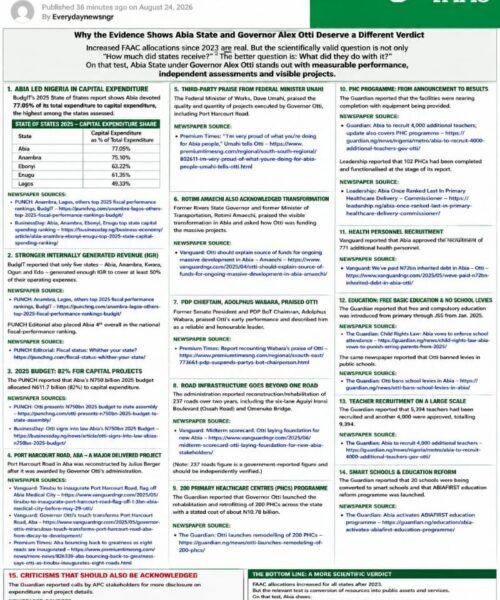
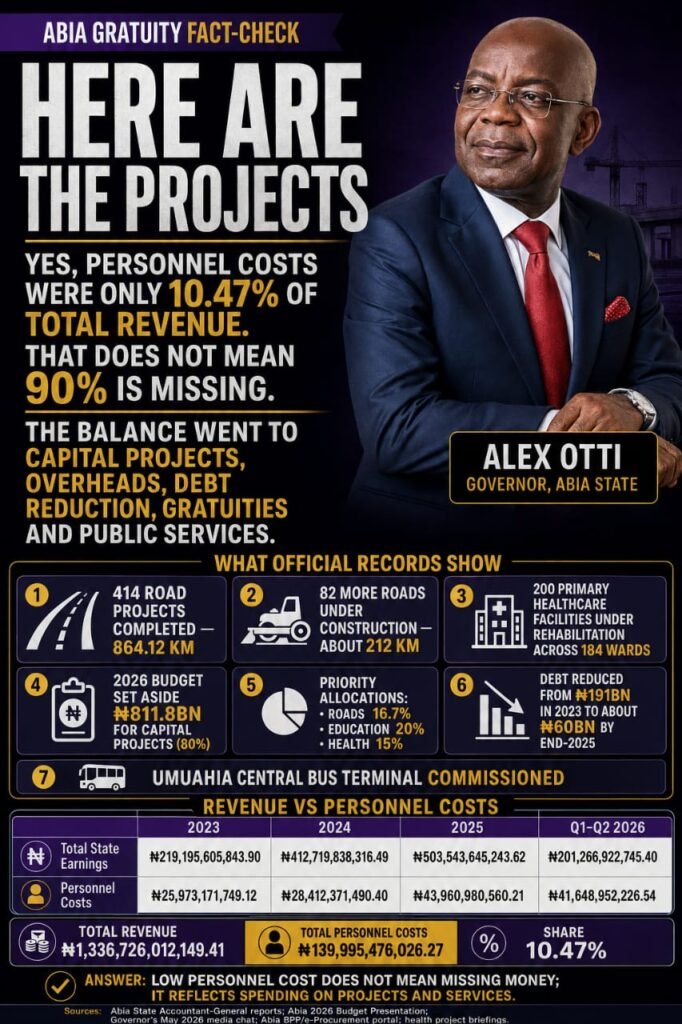
The state’s own 2025 Budget Implementation Report recorded ₦409.56 billion in actual expenditure, including approximately ₦322.02 billion in capital expenditure. Personnel expenditure was approximately ₦62.26 billion.
So, in 2025 alone, documented capital expenditure was more than five times personnel expenditure.
That single official table destroys the narrative that everything outside salaries somehow disappeared.
For 2024, the Accountant-General’s audited report recorded approximately ₦215.46 billion in actual capital expenditure.
Combine just those two years and you already have roughly:
₦215.46bn + ₦322.02bn = ₦537.48 BILLION IN RECORDED CAPITAL EXPENDITURE.
How then can somebody seriously write, “Where is the money?”, as though the financial statements contain nothing except salaries?
Scrutinise the contracts. Question value for money. Investigate procurement. Compare expenditure with physical delivery. Those are proper accountability questions.
But pretending hundreds of billions of documented capital expenditure do not exist is not accountability.
- “WHERE ARE THE PROJECTS?” — PERHAPS WE SHOULD FIRST OPEN OUR EYES
The article asks:
“Where are the roads?”
Governor Otti reported in May 2026 that his administration had completed 414 road projects covering approximately 864.12 kilometres, with another 82 road projects under construction. That claim has been independently reported by national media.
One may audit that number road by road. That would be useful.
But one cannot reasonably move from “I want the projects independently verified” to “there are no projects.”
The Umuahia Central Bus Terminal has been unveiled, alongside the reconstructed Ossah Expressway/Aguiyi-Ironsi Boulevard. This is documented on the Abia State Bureau of Public Procurement platform.
The government has also embarked on rehabilitation, remodelling and retrofitting of 200 Primary Healthcare Centres across Abia’s 184 wards.
The Federal Ministry of Information reported the programme involving the Abia Medical City, 11 rural roads and three agro-markets.
There is also the 15MVA injection substation project in Umuahia, officially documented by the Abia State House of Assembly.
So when someone asks dramatically, “Where are the hospitals? Where are the roads? Where is electricity? Where are the projects?”, the proper response is:
Do you mean you disagree with their cost, quality, geographical spread or priority? Fine. Let us debate those. But saying they do not exist is plainly different from questioning whether they represent value for money.
- EDUCATION AND HEALTH SPENDING CANNOT BE REDUCED TO “PAINTING BUILDINGS”
Abia’s fiscal strategy has deliberately shifted expenditure toward capital development. The 2025 approved budget placed approximately ₦611.7 billion—82% of the original budget—under capital expenditure, while recurrent expenditure accounted for about 18%.
Even more importantly, the independent BudgIT 2025 State of States assessment ranked Abia 4th nationally on fiscal performance. The state government reported that BudgIT’s assessment recognised Abia’s strong capital-expenditure orientation.
BudgIT is not Alex Otti’s media team.
Therefore, criticism should confront the fiscal data rather than pretending the state has been consuming virtually all its resources on salaries and publicity.
- THE ₦1.4 TRILLION FIGURE ITSELF NEEDS PROPER DEFINITION
Another methodological problem is repeatedly saying:
“Abia earned ₦1.4 trillion.”
Earned from what?
FAAC?
IGR?
Capital receipts?
Opening balances?
Grants?
Loans?
All inflows aggregated over different fiscal periods?
These categories are not interchangeable.
For example, Abia’s official Q2 2025 Budget Implementation Report separately identified FAAC, IGR and capital receipts precisely because responsible fiscal analysis does not lump every inflow into one giant number and then ask why it was not sitting in a bank account.
If ₦1.4 trillion is being presented as a cumulative figure, publish the year-by-year schedule and its components. Then compare it against total expenditure, not merely salaries.
Anything else is accounting theatre.
- YES, GOVERNOR OTTI MUST STILL BE HELD ACCOUNTABLE
Supporting the visible progress in Abia does not mean issuing the government a blank cheque.
The administration should publish clear beneficiary numbers for gratuity payments, maintain the promised timetable through 2031, disclose project costs, strengthen procurement transparency and continue publishing audited financial statements.
Those are legitimate demands.
But accountability must work both ways.
Those attacking government also owe the public honesty with arithmetic.
You cannot say ₦7.2 billion is 0.005% of ₦1.4 trillion when it is approximately 0.51%.
You cannot subtract salaries from total revenue and pronounce every other naira missing while ignoring ₦215.46 billion in 2024 capital expenditure and ₦322.02 billion in 2025 capital expenditure.
You cannot ask “Where are the projects?” while simultaneously driving on reconstructed roads, seeing new transport infrastructure, health-centre rehabilitation and major projects under construction.
And you cannot condemn a government for publicly identifying a ₦61.8 billion gratuity liability, beginning payment and establishing a multi-year framework to settle it, as though disclosure itself constitutes evidence of concealment.
THE REAL QUESTION IS NOT “WHERE IS ₦1.2 TRILLION?”
The serious questions are:
What was Abia’s total verified revenue? What was its total expenditure? How much went to capital projects? What assets were produced? Were they delivered at reasonable cost? And what measurable outcomes followed?
Those are questions economists, accountants and serious citizens should ask.
Anything less is politics wearing a calculator.
Let us criticise Alex Otti where criticism is deserved.
But let us not OPPOSITIONIZE THE TRUTH.