

ABIA AIRPORT AND THE POLITICS OF HALF-TRUTHS: WHAT THE PUBLIC RECORD ACTUALLY SAYS
There is nothing wrong with criticising Governor Alex Otti. There is nothing wrong with interrogating the Abia Airport project, questioning its cost, examining the acquisition of land at Nsulu, demanding compensation for affected landowners, or asking whether government is obtaining value for money.
What is wrong is criticism built by removing inconvenient parts of the public record and presenting the remainder as the whole truth.
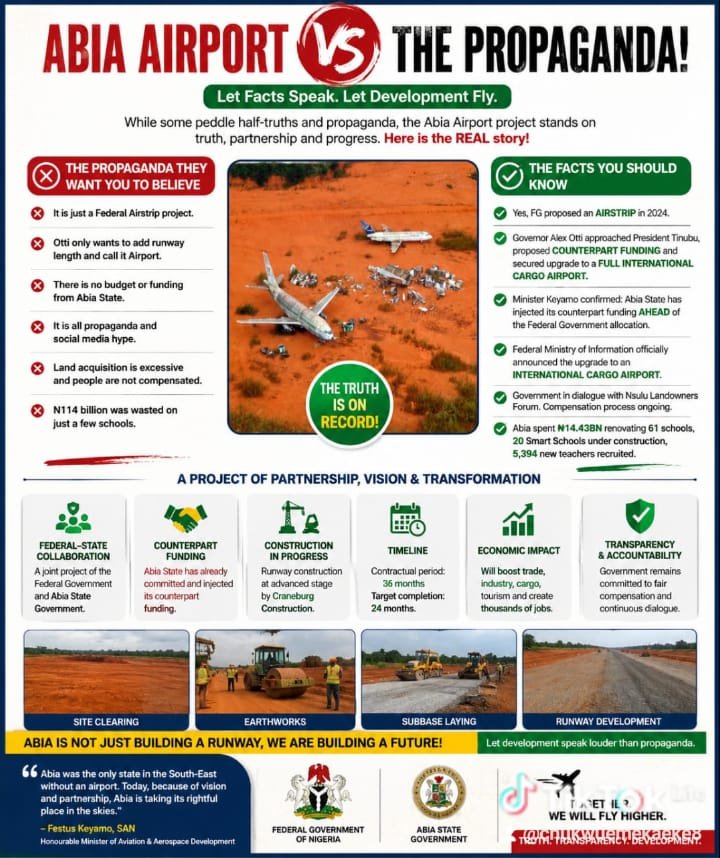
That distinction has become important following claims circulated by Mr Obinna Oriaku concerning the Abia Airport project. His central proposition is simple: the Federal Government planned an airstrip for Abia; therefore, Governor Otti has done little more than extend a federal runway while his media team allegedly transformed the project into an “international airport” for propaganda purposes.
Unfortunately for that narrative, the principal witness against it is neither an Abia State Government spokesman nor an Otti supporter.
It is Festus Keyamo, SAN, Minister of Aviation and Aerospace Development.
Yes, the Federal Government originally proposed an airstrip
This part of the story is true and should be acknowledged.
The Federal Government included an airstrip for Abia in the 2024 federal budget. Abia was the only state in the South-East without an operational airport or airstrip, and the Tinubu administration decided that this infrastructure gap should be addressed.
The Guardian reported at the groundbreaking ceremony of 17 December 2024 that Keyamo said President Bola Tinubu had provided for an airstrip for Abia in the 2024 budget.
Read The Guardian report here:
“Keyamo performs groundbreaking for Abia Airport project — The Guardian” (https://guardian.ng/news/keyamo-performs-ground-breaking-for-abia-airport-project/)
But stopping the story there is precisely where the distortion begins.
What happened after the airstrip was approved?
According to Keyamo himself, Governor Otti did not simply accept the limited airstrip proposal.
The Aviation Minister explained publicly in June 2026 that Otti took the matter further, approached President Tinubu and proposed that Abia would provide counterpart funding so that the planned airstrip could be expanded into a full international airport.
THISDAY reported Keyamo’s account.
In substance, Keyamo said that after the Federal Government had scheduled the airstrip project, Otti approached the President and proposed bringing Abia State resources into the project to transform it into a full international airport.
Even more importantly, Keyamo disclosed that Abia State’s counterpart funding had been injected ahead of the Federal Government’s allocation and that work had advanced considerably.
Read the report yourself:
“Keyamo Reiterates FG’s Support as UNA Unveils Aircraft — THISDAY, June 19, 2026” (https://www.thisdaylive.com/2026/06/19/keyamo-reiterates-fgs-support-for-domestic-operators-as-una-unveils-additional-aircraft-to-its-fleet/)
That testimony creates a serious difficulty for the claim that Otti merely decided to “add extra length to the runway.”
A government that provides counterpart funding, negotiates an expansion in project scope, acquires land, handles critical components of construction and participates in transforming a proposed airstrip into a substantially larger airport project is plainly doing considerably more than casually extending a runway.
One may debate the wisdom, cost or implementation of that decision.
One cannot honestly pretend the decision never occurred.
Who called it an International Cargo Airport? Otti’s propagandists—or the Federal Government?
Perhaps the most easily disproved allegation is that the expression “International Airport” was manufactured by Governor Otti’s media machinery.
The Federal Ministry of Information and National Orientation published a report on 18 December 2024 with the unmistakable headline:
“President Bola Ahmed Tinubu has upgraded the Abia State Airport to an International Cargo Airport.”
That is a Federal Government website.
Not an Abia Government blog.
Not an Otti campaign platform.
Not a Labour Party social-media account.
The Federal Ministry reported that the project was being executed as a Federal Government project in collaboration with the Abia State Government and that the original airstrip had been upgraded to an International Cargo Airport following Abia’s willingness to provide counterpart funding.
Read the Federal Government’s own record:
“President Bola Ahmed Tinubu has upgraded the Abia State Airport to an International Cargo Airport — Federal Ministry of Information” (https://fmino.gov.ng/president-bola-ahmed-tinubu-has-upgraded-the-abia-state-airport-to-an-international-cargo-airport/)
The Guardian independently reported the same thing.
Its account of the groundbreaking states unequivocally that Keyamo said the project had been upgraded from an airstrip to an international cargo airport and that Abia State had expressed willingness to participate through counterpart funding.
“Read The Guardian’s report” (https://guardian.ng/news/keyamo-performs-ground-breaking-for-abia-airport-project/)
So the obvious question arises:
If Festus Keyamo calls it an international cargo airport and the Federal Ministry of Information calls it an international cargo airport, how does repeating that official designation suddenly become Otti’s propaganda?
Criticism should at least survive contact with documentary evidence.
The project is federal-state collaboration—not an ownership beauty contest
Another rhetorical trick is to insist that because the original appropriation came from the Federal Government, Abia State must therefore receive virtually no credit for what followed.
That is not how collaborative infrastructure works.
The Federal Ministry of Information describes the project explicitly as one undertaken in collaboration with the Abia State Government.
The Guardian records Abia’s counterpart-funding commitment.
And in June 2026, Keyamo said Abia had already put its counterpart contribution into the project ahead of the federal allocation.
There is nothing intellectually difficult about holding two facts simultaneously:
President Tinubu’s Federal Government deserves credit for initiating and funding the original airstrip proposal.
Governor Otti’s government deserves credit for pushing for its expansion, supplying counterpart funding and participating materially in its transformation into a larger airport project.
One does not erase the other.
Indeed, federalism works best when governments cooperate rather than spend their time fighting over who owns the photograph at the commissioning ceremony.
Was the completion date simply invented for social media?
No.
At the December 2024 groundbreaking, the publicly announced project duration was 36 months. The Guardian reported that timeline directly.
Later political statements have referred to efforts to accelerate delivery.
A target can, of course, be missed. Construction delays occur. Financing can change. Regulatory certification can take additional time.
Government must therefore be held accountable against actual milestones.
But presenting the existence of a completion timetable as some spontaneous social-media fabrication ignores the documented project schedule.
And the project has continued beyond the ceremonial groundbreaking
This is also important.
The project did not disappear once the microphones were packed away.
By June 2026, Keyamo was publicly describing construction as having advanced rapidly and discussing the possibility of United Nigeria Airlines positioning an operational hub around Abia when the airport became functional.
A Federal Ministry of Information report from June 2026 also described the ongoing Abia International Airport project at Nsulu as a landmark initiative jointly executed by the Federal and Abia State governments and reiterated that it had evolved into an international airport project.
“Presidency hails Abia transformation during media tour — Federal Ministry of Information” (https://fmino.gov.ng/presidency-hails-abias-transformation-as-renewed-hope-media-tour-showcases-impact-of-federal-state-projects/)
The Guardian likewise reported in June 2026 that the airport was being developed as an international cargo and passenger airport, in partnership with the Federal Government and private-sector interests.
That does not mean citizens should stop asking questions.
It means criticism should address the project that actually exists, rather than an imaginary project created for political convenience.
The Nsulu land question: this is where government must be scrutinised seriously
Supporters of Governor Otti would make a mistake by pretending that every criticism surrounding Nsulu is propaganda.
It is not.
There have been substantial disputes involving landowners.
The Guardian’s original December 2024 report said officials disclosed that 1,325.86 hectares had at that stage been acquired from nine Nsulu communities and that compensation arrangements were being made.
Subsequent disputes arose over the amount of land required, representation of landowners, compensation, livelihood concerns and transparency.
In March 2025, Vanguard reported that some Nsulu landowners objected to the government’s proposed acquisition of 1,025 hectares, arguing that the size would seriously affect farming, housing and community livelihoods.
“Abia Airport project: Nsulu landowners reject takeover of 1,025 hectares — Vanguard” (https://www.vanguardngr.com/2025/03/abia-airport-project-nsulu-landowners-reject-govt-takeover-of-1025-hectares-of-land/amp/)
The landowners also demanded greater transparency regarding survey coordinates and community representation.
Vanguard subsequently reported continuing demands for disclosure about the acquisition and compensation process:
“Abia Airport: Landowners demand transparency — Vanguard” (https://www.vanguardngr.com/2025/04/abia-airport-landowners-demand-transparency-as-govt-intensifies-acquisition-of-nsulu-land/amp/)
This is not something responsible supporters of government should mock.
Every genuinely affected landowner deserves lawful treatment, fair compensation and transparent engagement.
Development cannot become an excuse for casually destroying livelihoods.
But even the land dispute has more than one side
It is equally misleading to write as though there has never been dialogue between government and representatives of the communities.
Vanguard reported in February 2025 that the Abia State Government inaugurated a joint technical committee following meetings involving government officials and representatives of a Nsulu landowners’ forum.
The report said concerns included the amount of land to be acquired and the consequences for farming and habitation.
“Abia Govt inaugurates committee to resolve Nsulu Airport issues — Vanguard” (https://www.vanguardngr.com/2025/02/abia-govt-inaugurates-committee-to-resolve-nsulu-airport-project-issues/)
Later reports also demonstrate that disagreements persisted, including disputes concerning compensation and representation.
That means the intellectually responsible position is neither:
“Nobody in Nsulu has any complaint”
nor
“Every resident of Nsulu has rejected the airport.”
The record shows support in some quarters and significant objections in others.
Government must keep resolving those disputes lawfully and transparently.
But—and this distinction is crucial—a dispute over compensation does not prove that the airport is merely an airstrip.
They are completely different propositions.
What about the claim of ₦114 billion spent on a handful of schools?
This allegation deserves special attention because numbers acquire a strange life on social media.
The claim presented was that approximately ₦114 billion had supposedly been swallowed by renovation of ordinary public schools, with little to show beyond a few buildings.
That should not simply be accepted because somebody typed it in bold letters.
The widely reported education-finance controversy involving the Otti administration has centred on other figures and allegations.
For example, PUNCH reported in September 2025 that an APC chieftain petitioned anti-corruption agencies over alleged expenditure involving more than ₦54 billion in education funds.
Crucially, that PUNCH story presented it as an allegation, alongside the Abia Government’s rejection of the allegation.
“Otti dismisses EFCC petition over ₦54bn education fund — PUNCH” (https://punchng.com/otti-dismisses-efcc-petition-over-n54bn-education-fund/)
That is how responsible journalism works.
An accusation is reported as an accusation.
A government response is reported as a response.
Neither becomes a judicial finding merely because political opponents repeat it loudly.
Indeed, the PUNCH report itself contains competing calculations and claims concerning expenditure on schools between 2023 and 2025.
Therefore, anybody asserting categorically that ₦114 billion was spent on two or a few schools should provide:
the relevant budget-performance pages;
the specific expenditure codes;
the contractor identities;
payment certificates;
project locations;
and preferably the Auditor-General or other independently verifiable records establishing the claim.
Until then, repetition is not proof.
There is an even bigger problem with the “airport versus schools” argument
Infrastructure choices are legitimate subjects of political debate.
Someone may sincerely believe Abia should spend less on an airport and more on education.
Another person may argue that a cargo airport can support Aba’s manufacturing ecosystem, expand logistics capacity, attract investment and generate future employment.
Both are legitimate policy positions.
But policy disagreement is different from factual distortion.
The Aviation Minister’s argument for the airport has been that Abia occupies an important place in the South-East industrial ecosystem and that cargo connectivity could support the movement of locally manufactured goods. The Guardian recorded that rationale at the groundbreaking.
Whether that economic promise is ultimately realised should be judged after implementation using passenger volumes, cargo throughput, airline participation, operating costs, employment creation and private investment.
That is a far more useful debate than pretending the project is simply a longer village airstrip.
The land-size comparison also requires more intellectual caution
Comparing Nsulu’s proposed airport land requirement with an older airport and concluding automatically that excess land must therefore conceal some sinister purpose is not serious infrastructure analysis.
Airports differ enormously according to:
runway configuration;
terminal plans;
cargo facilities;
safety and obstacle-clearance requirements;
future expansion;
support infrastructure;
access roads;
aircraft maintenance areas;
commercial development;
security buffers;
and master-plan assumptions.
This does not mean 1,025 hectares—or any other figure—is automatically justified.
Government should publish sufficient elements of the airport master plan and acquisition schedule to explain the requirement.
That would be good governance.
But “Airport A occupies X hectares, therefore Airport B cannot legitimately require Y hectares” is not, by itself, a technical argument.
The proper question is:
What facilities and future requirements in the approved master plan justify the land being acquired?
Government should answer that transparently.
There is also a distinction between being called an international airport and commencing international operations
For the sake of accuracy, supporters should understand this distinction too.
The Federal Government has publicly described the project as an International Cargo Airport. That fact is well documented.
But an airport under construction does not begin international commercial operations simply because the word “international” appears in its project designation.
Before operations, the relevant infrastructure, safety, security, customs, immigration, regulatory and operational requirements have to be met.
Therefore the careful statement is:
Abia Airport is being developed and officially described by the Federal Government as an International Cargo Airport.
Its eventual operational status will depend upon completion and the applicable aviation approvals.
That is factual, defensible and requires no propaganda from anybody.
So what survives after the noise is removed?
Quite a lot becomes clearer.
The Federal Government initiated an airstrip for Abia.
That is true.
Governor Alex Otti subsequently pushed for expansion of that initiative.
According to Keyamo, that is true.
Abia State committed counterpart funding.
That is documented.
According to Keyamo, Abia’s counterpart contribution was at one point ahead of the Federal Government’s allocation.
That too is documented.
The Federal Government itself officially described the expanded project as an International Cargo Airport.
Documented.
The project is being executed through federal-state collaboration.
Documented.
There are genuine disputes involving some Nsulu landowners over land acquisition and compensation.
Also documented.
Those concerns deserve resolution.
But those disputes do not erase the federal-state airport partnership.
Nor do they transform an International Cargo Airport project back into a simple airstrip merely because somebody prefers that political description.
Criticism is healthy. Half-truth is not.
Governor Otti should be scrutinised.
His airport expenditure should be scrutinised.
The land-acquisition process should be scrutinised.
Compensation should be scrutinised.
Education expenditure should be scrutinised.
Every governor entrusted with public resources should expect exactly that.
But the critic must submit to the same standard of accountability he demands from government.
If you say the international-airport designation is propaganda, explain why the Federal Ministry of Information itself uses that designation.
If you say Otti merely extended a runway, deal honestly with Keyamo’s account of Otti’s counterpart-funding proposal and the upgrade to a full airport.
If you say ₦114 billion disappeared into a tiny number of schools, publish the underlying records establishing that exact allegation.
If you raise the legitimate concerns of Nsulu landowners, do so—and government must answer them—but do not convert their compensation dispute into proof of unrelated allegations.
The beauty of documentary evidence is that it does not need to shout.
It simply sits there.
And when official Federal Government records, Festus Keyamo’s own statements, THISDAY, The Guardian, PUNCH and Vanguard are placed side by side, the simplistic story of “Federal Government airstrip plus Otti propaganda” becomes very difficult to sustain.
Abians deserve criticism based on facts.
They also deserve development based on accountability.
There is room for both.
What there should be considerably less room for is the politics of half-truths.
Key Sources for Readers Who Want to Verify
Federal Ministry of Information and National Orientation:
“President Bola Ahmed Tinubu has upgraded the Abia State Airport to an International Cargo Airport” (https://fmino.gov.ng/president-bola-ahmed-tinubu-has-upgraded-the-abia-state-airport-to-an-international-cargo-airport/)
THISDAY — June 19, 2026:
“Keyamo explains Otti’s counterpart funding and upgrade from airstrip to full international airport” (https://www.thisdaylive.com/2026/06/19/keyamo-reiterates-fgs-support-for-domestic-operators-as-una-unveils-additional-aircraft-to-its-fleet/)
The Guardian — December 17, 2024:
“Keyamo performs groundbreaking for Abia Airport project” (https://guardian.ng/news/keyamo-performs-ground-breaking-for-abia-airport-project/)
Federal Ministry of Information — June 2026:
“Presidential media tour describes airport as jointly executed by Federal and Abia governments” (https://fmino.gov.ng/presidency-hails-abias-transformation-as-renewed-hope-media-tour-showcases-impact-of-federal-state-projects/)
Vanguard — March 18, 2025:
“Nsulu landowners challenge acquisition of 1,025 hectares” (https://www.vanguardngr.com/2025/03/abia-airport-project-nsulu-landowners-reject-govt-takeover-of-1025-hectares-of-land/amp/)
Vanguard — February 9, 2025:
“Abia Government inaugurates committee over Nsulu airport issues” (https://www.vanguardngr.com/2025/02/abia-govt-inaugurates-committee-to-resolve-nsulu-airport-project-issues/)
Vanguard — April 10, 2025:
“Landowners demand greater transparency in acquisition process” (https://www.vanguardngr.com/2025/04/abia-airport-landowners-demand-transparency-as-govt-intensifies-acquisition-of-nsulu-land/amp/)
PUNCH — September 3, 2025:
“The actual reported controversy over Abia education expenditure” (https://punchng.com/otti-dismisses-efcc-petition-over-n54bn-education-fund/)