

TERRORISM, WARNING FATIGUE AND THE SECURITY LESSONS OF LOCKERBIE: A DEEP PARAGRAPHIC ANALYSIS
The history of terrorism repeatedly shows that the decisive security failure is often not the total absence of warning, but the inability of institutions and societies to correctly interpret warning before catastrophe occurs. Lockerbie remains one of the clearest historical examples of how a terrorist act can expose weaknesses not only in physical security but also in intelligence coordination, international cooperation, political judgement and institutional preparedness. The bombing of Pan Am Flight 103 over Lockerbie in December 1988 demonstrated that terrorist violence is rarely a spontaneous act. It is usually the product of planning, concealment, logistical support, intelligence gaps and the exploitation of vulnerabilities that security systems either fail to see or fail to take seriously enough. The significance of Lockerbie therefore goes beyond the tragedy itself. It raises a larger question that remains relevant today: why do states with sophisticated intelligence systems, security agencies and enormous surveillance capabilities still find themselves surprised by determined terrorist actors?
One answer lies in the complexity of modern intelligence. Governments receive enormous quantities of information every day from security agencies, border services, police commands, diplomatic missions, financial institutions, telecommunications surveillance, informants and ordinary citizens. The difficulty is no longer simply how to obtain information; it is how to distinguish meaningful intelligence from noise. Terrorist groups understand this problem. They know that states are flooded with warnings, rumours, false leads, political allegations, anonymous reports and competing assessments. By operating carefully within this crowded information environment, terrorists can hide dangerous intentions among thousands of harmless signals. In this sense, terrorism exploits not only physical weakness but cognitive overload. A state may possess the necessary information and still fail because it has not identified which information matters most.
This creates what can be described as warning fatigue. When security institutions repeatedly receive threats that do not materialise, officials gradually become less responsive to future warnings. The psychology is understandable. If a security officer responds urgently to ten alerts and none produces an attack, the eleventh may receive less attention. If a government repeatedly announces that danger is imminent and nothing happens, citizens may begin to dismiss such warnings as routine. Terrorists benefit enormously from this erosion of sensitivity. Their strategic advantage lies partly in patience. They can allow governments to become accustomed to false alarms, knowing that one day a genuine operation may pass through the same channels already weakened by complacency.
The deeper danger is that warning fatigue can become institutionalised. It is one thing for an individual officer to become tired; it is far more dangerous when entire organisations develop cultures in which intelligence reports are received mechanically, filed bureaucratically and forgotten operationally. This is where terrorism gains its greatest advantage. A report may move from one desk to another without producing action. A suspicious individual may appear in one database but not another. A financial transaction may be noticed by one agency while a travel pattern is noticed by another, yet the two pieces of information are never connected. In such situations, the state is not necessarily ignorant. It is fragmented.
Fragmentation is one of the most persistent weaknesses in national security systems. Security agencies often compete for jurisdiction, recognition, budgets and political access. Information becomes institutional property rather than national property. One agency may hesitate to share intelligence because it fears another agency will take credit for a successful operation. Another may suppress information because of bureaucratic rivalry. Yet terrorism does not respect administrative boundaries. Terrorist networks move across ministries, borders, financial systems, communication platforms and communities. A threat that is dispersed across several institutions can only be understood through cooperation. When agencies operate in silos, the terrorist enjoys freedom within the spaces between them.
For Nigeria, this lesson is particularly important. The country faces multiple and overlapping security threats, including terrorism, insurgency, kidnapping, banditry, organised crime and communal violence. In such an environment, intelligence coordination becomes more important than the sheer number of security agencies. The presence of many institutions does not automatically produce security. Indeed, duplication without integration can create additional confusion. Effective national security requires a central capacity to bring together information from the military, police, intelligence services, immigration authorities, customs, financial regulators and local communities. The goal must be to create one evolving picture of threat rather than multiple disconnected pictures.
The Lockerbie experience also demonstrates that terrorism must be understood as an adaptive phenomenon. Terrorist organisations observe how governments respond to previous attacks and then change their methods. When airport screening improves, terrorists shift attention to other transport systems. When banking controls become stricter, financing moves through informal channels. When communications are intercepted, networks adopt encryption or alternative technologies. When heavily protected government facilities become difficult to attack, softer civilian targets become more attractive. Terrorism is therefore an adversarial learning process. The state learns, but so does the terrorist. The question is which side learns faster.
This adaptive contest explains why security procedures cannot remain static. A checkpoint that was effective five years ago may be useless against a contemporary threat. A surveillance system that once provided an advantage may become predictable. Security routines themselves can become vulnerabilities because repetition creates familiarity. Guards begin recognising faces instead of checking credentials. Airport workers perform searches mechanically. Drivers are waved through because they are known. Procedures originally designed to prevent intrusion gradually become ceremonial rather than operational. Terrorists study exactly these habits.
The danger of routine is especially severe because human beings naturally become less attentive to repeated stimuli. The first unusual incident attracts intense attention. The twentieth may not. The first abandoned bag in a public building causes alarm. After numerous harmless incidents, the next one may be ignored. Terrorism exploits this tendency toward normalisation. Consequently, good security systems deliberately disrupt routine. They retrain personnel, rotate duties, conduct simulations, test procedures and introduce independent inspections. The purpose is to ensure that vigilance does not become performance without substance.
The political management of terrorism introduces another complication. Governments have legitimate reasons to avoid unnecessary panic, but this can sometimes produce excessive reassurance. Political leaders may hesitate to acknowledge serious threats because they fear damaging tourism, investment, public confidence or electoral support. This creates a dangerous temptation to understate intelligence. The opposite problem is equally destructive: governments may exaggerate threats to justify extraordinary measures or political objectives. In either case, intelligence becomes distorted by political incentives.
Professional intelligence must therefore remain analytically independent. Security agencies must be able to tell governments uncomfortable truths. They must be permitted to say that a threat is credible even when political leaders prefer reassurance, or that evidence is weak even when leaders want dramatic conclusions. The quality of national security depends heavily on whether intelligence professionals are rewarded for accuracy or for telling powerful people what they want to hear. A system in which career advancement depends on political conformity will eventually produce dangerous blind spots.
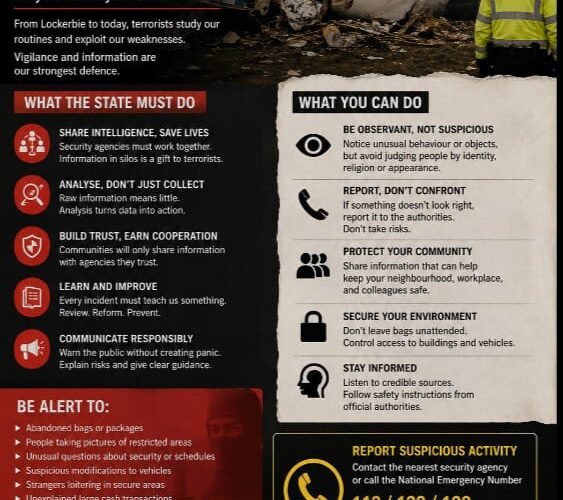
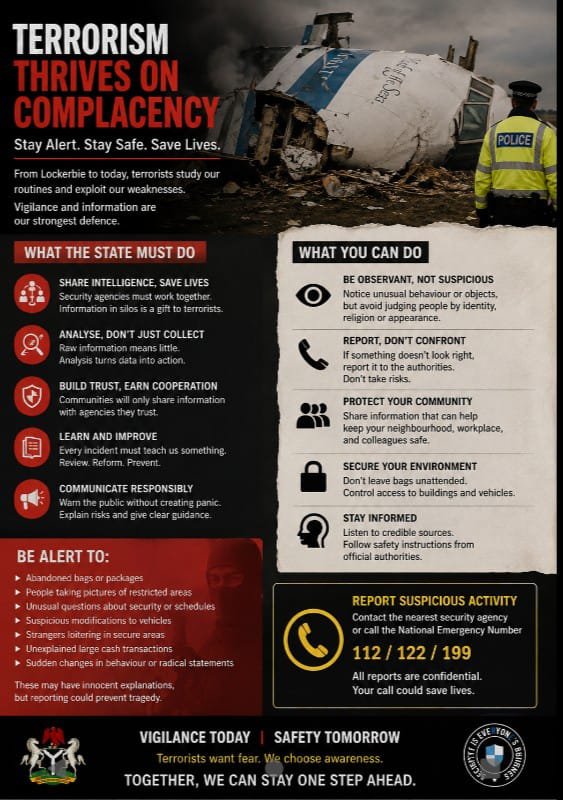
For the ordinary citizen, the lessons are equally important but more delicate. Governments sometimes encourage citizens to “be vigilant,” yet that phrase can easily become misunderstood. Vigilance does not mean treating unfamiliar people as enemies. It does not mean converting religious identity, ethnicity, nationality, dress or accent into evidence of criminality. Such behaviour can create social hostility and weaken cooperation between communities and security institutions. In diverse societies, indiscriminate suspicion can become a security problem of its own.
True vigilance is behavioural rather than prejudicial. It involves noticing unusual circumstances, not stereotyping people. An unattended package in a sensitive area deserves attention because of its location and condition, not because of who may have left it. Repeated attempts to obtain restricted information may justify concern because of the behaviour involved. Unusual surveillance of critical infrastructure may require reporting because of the activity itself. This distinction matters greatly. When societies confuse vigilance with profiling, innocent people suffer and extremist organisations gain propaganda material.
The common man on the street also occupies an intelligence position that governments can never completely replicate. Security agencies cannot be everywhere. Residents know what is normal in their neighbourhoods. Traders know the rhythms of markets. Transport workers notice unusual patterns of movement. Hotel staff see guests and luggage. Landlords observe tenants. Teachers recognise changes in students. Mechanics see vehicle modifications. None of these people should become investigators, but collectively they possess enormous observational capacity.
This is why community-based intelligence is indispensable. Yet citizens will only share information when they trust the institutions receiving it. A person who fears that reporting suspicious behaviour will expose him to retaliation may remain silent. Someone who believes police officers will reveal his identity may decide that silence is safer. Communities that have experienced abuse from security personnel may refuse cooperation altogether. The result is that distrust produces intelligence blindness.
For this reason, good policing and counterterrorism cannot be separated from human rights and professionalism. A government that abuses entire communities in the name of security may gain temporary control but lose long-term intelligence cooperation. Terrorist organisations often exploit narratives of injustice, humiliation and exclusion. Heavy-handed security responses can unintentionally strengthen those narratives. The most effective security system is therefore not necessarily the most brutal one. It is the one that citizens regard as credible, disciplined and worthy of cooperation.
Another major lesson concerns emergency communication. Governments must learn how to warn citizens without creating permanent fear. Constant alerts eventually lose their force. If every announcement is presented as an imminent catastrophe, people become psychologically exhausted. At the same time, vague warnings can be practically useless. Effective communication should tell citizens what the threat means, what behaviour is expected and what reporting channels are available.
This is where Nigeria’s unified emergency number, 112, becomes relevant. A national emergency system is useful only if citizens know that it exists, trust that calls will be answered and understand when to use it. Emergency numbers are not merely technical conveniences; they are part of national security architecture. They connect ordinary observation with institutional response. But the number itself is only as effective as the system behind it. If calls are unanswered, poorly routed or not acted upon, public confidence will decline. The real test is not whether a country has an emergency number, but whether the emergency system works consistently.
The role of technology must also be treated carefully. Modern governments have access to facial recognition systems, surveillance cameras, biometric databases, digital financial tracking, artificial intelligence and vast telecommunications data. These tools can strengthen counterterrorism, but technology does not eliminate the need for judgement. A sophisticated system can produce enormous amounts of data and still fail if analysts cannot interpret it. Technology can increase both capability and overload.
Artificial intelligence may help identify patterns across large datasets, but algorithms can also generate false positives or reproduce flawed assumptions. The future of counterterrorism will therefore require a combination of technological capability and human analytical discipline. States that rely blindly on machines may become vulnerable in new ways. Terrorists themselves are also adopting emerging technologies, making the contest even more complex.
A deeper structural lesson from Lockerbie is that terrorism is often transnational. The planning of an attack may occur in one country, financing in another, communications through a third and execution somewhere else entirely. Domestic security systems therefore cannot operate in isolation. International intelligence sharing, extradition arrangements, financial monitoring and diplomatic cooperation remain essential. Terrorist networks exploit jurisdictional gaps just as they exploit institutional gaps.
This international dimension also explains why investigations can continue for decades. Terrorist attacks often involve evidence scattered across borders and political systems. Governments change, regimes collapse and witnesses disappear. Yet persistent investigation remains important because terrorism seeks not only to kill but also to demonstrate that perpetrators can escape consequences. Long-term accountability sends the opposite message: time does not automatically erase responsibility.
For states, therefore, the lessons are interconnected. Intelligence must be collected, but also analysed. Agencies must exist, but also cooperate. Technology must be acquired, but also intelligently used. Citizens must be encouraged to report, but also protected. Warnings must be issued, but not trivialised. Security must be strong, but also lawful. Every failure in one area can weaken the entire system.
For the common man, the lessons are equally practical. Awareness should become part of daily life without becoming a source of paranoia. Citizens should notice what is unusual, avoid spreading unverified rumours, report genuine concerns through legitimate channels and resist attempts to turn security anxieties into ethnic or religious hatred. The citizen’s responsibility is not to confront suspected terrorists. It is to provide information and allow trained authorities to assess it.
The most profound lesson, however, concerns complacency. Terrorism feeds on the assumption that because nothing happened yesterday, nothing will happen tomorrow. It exploits institutional tiredness, political distraction and public forgetfulness. Every society eventually becomes accustomed to danger if the danger persists long enough. That psychological adjustment is understandable, but it is also dangerous.
The task of a serious state is therefore to institutionalise vigilance so that security does not depend on temporary fear. Fear rises after an attack and fades with time. Institutions must remain effective after headlines disappear. Training, coordination, intelligence sharing, emergency response and community trust must continue when there is no immediate crisis.
Ultimately, Lockerbie teaches that terrorism is not merely an attack on people or infrastructure. It is an attack on systems of confidence. Terrorists seek to make citizens doubt government, make communities distrust one another and make ordinary life feel unsafe. The most effective response is therefore not simply military. It is institutional resilience.
A resilient society is one in which security agencies learn faster than terrorists, citizens cooperate without panic, political leaders respect evidence and institutions retain memory from previous failures. Such a society may never eliminate all risk, but it can drastically reduce the opportunities terrorists seek to exploit.
The final lesson is simple but demanding: repeated alarms must not make the state deaf, and genuine danger must not make society irrational. Between complacency and panic lies the discipline of intelligent vigilance. That is where effective national security begins.