
ONE PHOTOGRAPH, MANY FALSE CLAIMS: DISMANTLING THE PROPAGANDA AGAINST GOVERNOR ALEX OTTI
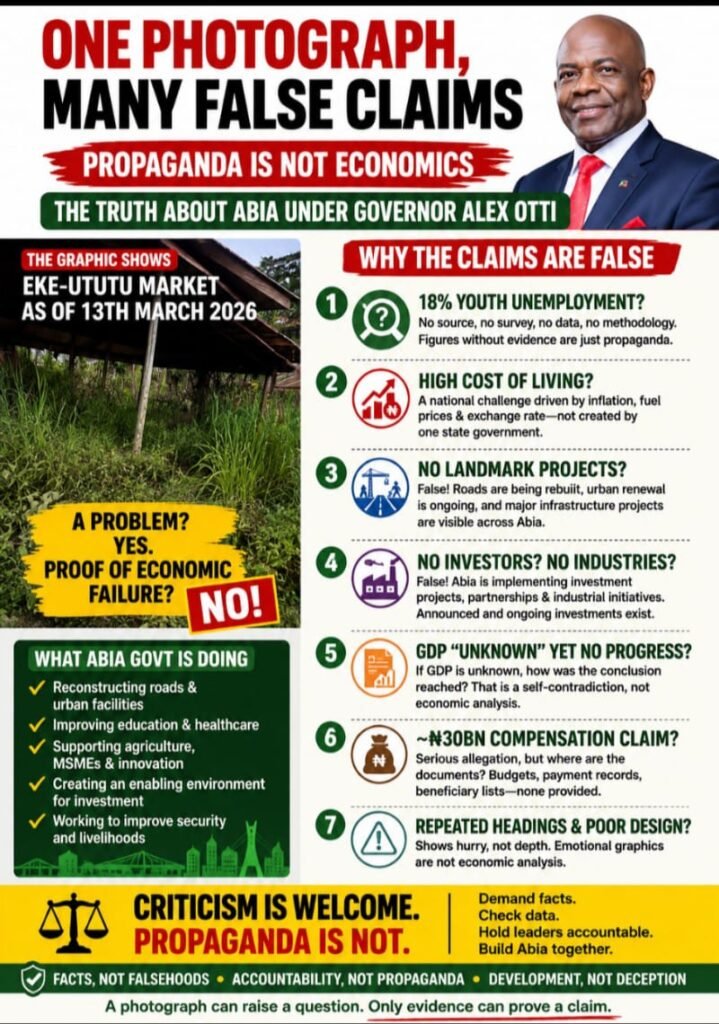
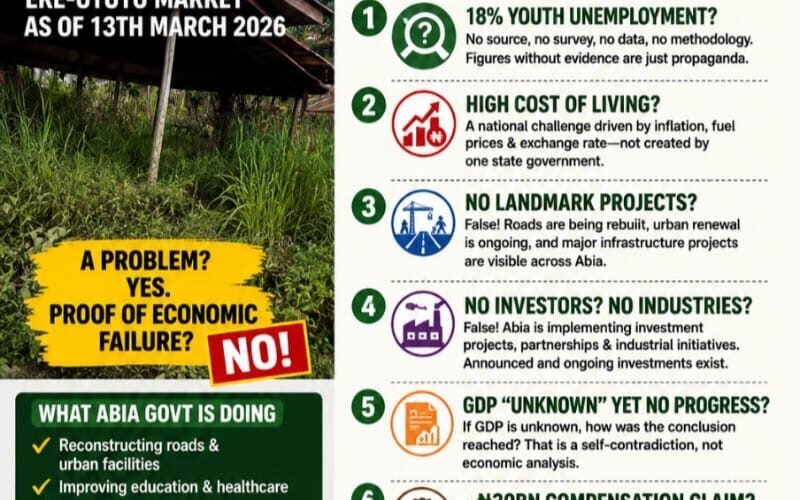
A political graphic currently circulating on social media attempts to reduce the economic performance of Governor Alex Otti’s administration to a photograph of an overgrown section of Eke-Ututu Market and several unsupported economic claims.
Although every abandoned or underdeveloped public facility deserves government attention, one photograph cannot constitute a credible assessment of an entire state economy.
The graphic is a classic example of how political propaganda attempts to imitate economic analysis. It presents figures and categorical conclusions without identifying the sources, dates, definitions or methods through which they were obtained.
Serious economic assessment requires measurable indicators, comparable periods and independently verifiable data—not colourful boxes designed to produce a predetermined political verdict.
AN ABANDONED MARKET IS A DEVELOPMENT CONCERN, NOT AN ECONOMIC INDEX
The condition of Eke-Ututu Market should not be dismissed. The government should clarify the market’s ownership, current status, rehabilitation plan and expected completion date.
However, the existence of an overgrown market does not prove that there has been no economic progress in Abia State.
A state economy consists of agriculture, manufacturing, trade, transportation, construction, public services, household consumption and private investment. It cannot reasonably be measured through a photograph of one location.
By that logic, a photograph of one bad road would prove that no road had been constructed anywhere, while a photograph of one completed road would supposedly prove that every road in the state was good.
Both conclusions would be intellectually dishonest.
WHERE DID THE “18 PER CENT YOUTH UNEMPLOYMENT” FIGURE COME FROM?
The graphic claims that youth unemployment in Abia is 18 per cent but provides no source, reference period, sample size or definition of “youth.”
It does not state whether the figure came from the National Bureau of Statistics, an independent household survey or merely from the imagination of its designer.
Anyone presenting an Abia-specific unemployment figure must answer some basic questions:
- Who conducted the survey?
- When was it conducted?
- How many households or individuals were sampled?
- What age group was classified as youth?
- Was the figure measuring unemployment, underemployment or general labour underutilisation?
Until these questions are answered, the advertised 18 per cent figure is not reliable evidence. It is merely an unsupported political claim.
NIGERIA’S COST-OF-LIVING CRISIS CANNOT BE ATTRIBUTED TO ONE GOVERNOR
The graphic also cites high food and transportation costs as evidence of failure by the Abia State Government.
This deliberately ignores the wider national economic environment.
Food and transportation costs throughout Nigeria have been affected by fuel-price increases, exchange-rate depreciation, rising energy costs, insecurity in food-producing areas and nationwide inflation.
A governor may introduce measures to cushion these pressures, but no state governor independently determines Nigeria’s exchange rate, petroleum-pricing framework or monetary policy.
A fair assessment should compare Abia with similarly situated states and examine what the administration has done within its constitutional and fiscal powers.
Simply attaching Nigeria’s national cost-of-living crisis to Governor Alex Otti is economically misleading.
“NO LANDMARK PROJECTS” CANNOT SURVIVE BASIC SCRUTINY
The graphic declares that approximately ₦600 billion has been spent without any landmark project.
This is not economic analysis. It is a sweeping conclusion presented without defining either “spent” or “landmark project.”
Public expenditure includes salaries, pensions, healthcare, education, security, debt obligations, road construction, drainage, waste management and numerous projects spread across different communities.
Comparing total government expenditure with one preferred physical project is therefore methodologically defective.
The proper questions should be:
- How much revenue was actually received?
- How much was spent on recurrent expenditure?
- How much was devoted to capital expenditure?
- Which projects were completed?
- Which projects are still ongoing?
- What amounts were paid to contractors?
- What do the audited financial statements and budget-performance reports show?
Until these components are properly separated, the ₦600 billion slogan explains very little.
The assertion that there are no visible infrastructure projects also ignores the road rehabilitation, reconstruction and urban-renewal works undertaken in Aba and other parts of the state.
Citizens are free to debate their cost, quality, distribution and durability. However, it is inaccurate to pretend that such projects do not exist.
“GDP UNKNOWN” DESTROYS THE GRAPHIC’S OWN CONCLUSION
One of the most revealing claims in the graphic is:
“GDP unknown—no new industries.”
If the author admits that the state’s economic output is unknown, how was the definite conclusion of “no real economic progress” reached?
Economic progress should ordinarily be assessed with evidence relating to output, employment, business activity, investment, internally generated revenue, household welfare and productivity.
The graphic provides none of these.
It first admits that an important economic indicator is unavailable and then proceeds to pronounce a definite economic verdict.
That is not a minor error. It is a fundamental contradiction.
The absence of conveniently available state-level GDP figures may limit the conclusions both supporters and opponents of the government can responsibly draw.
It does not give anyone permission to replace missing data with political imagination.
THE CLAIM OF “NO MAJOR INVESTORS” REQUIRES EVIDENCE
The assertion that Abia has attracted no major investors is equally absolute and unsupported.
Investment announcements must certainly be examined critically. Government declarations and memoranda of understanding are not automatically equivalent to operational factories, completed projects or new jobs.
Nevertheless, the proper approach is to examine each announced investment according to:
- The identity of the investor
- The value of the proposed project
- The source of financing
- The implementation stage
- The land allocation
- The expected employment opportunities
- The commencement date
- The current operational status
The responsible conclusion is not that every announced investment has succeeded.
It is that the categorical claim of “no major investors” cannot be accepted without a comprehensive review of actual investment commitments, ongoing projects and operational enterprises.
THE COMPENSATION ALLEGATION REQUIRES DOCUMENTS, NOT THEATRICS
The lower section of the graphic alleges that nearly ₦30 billion was paid as compensation between 2023 and 2025, while only about ₦3 billion can supposedly be traced.
This is a serious allegation, but serious allegations require serious evidence.
The relevant documents should include:
- Approved state budgets
- Budget-performance reports
- Payment schedules
- Property valuation reports
- Beneficiary registers
- Land-acquisition notices
- Bank-payment records
- Audited financial statements
A political graphic offering a cash bounty is not a substitute for any of these documents.
The government should publish sufficient information to permit public scrutiny.
At the same time, those making allegations must distinguish between budgeted amounts, approved allocations, released funds, actual payments and accounting classifications.
These terms are not interchangeable.
Accountability must operate in both directions: the government must disclose, while its accusers must provide evidence.
EVEN THE DESIGN EXPOSES THE WEAKNESS OF THE ARGUMENT
The graphic repeats the headings “Industries,” “Investment Inflow” and “Infrastructure.”
This obvious duplication suggests that the material was hurriedly assembled for political impact rather than subjected to careful economic review.
The design error alone does not disprove every concern raised.
However, it reinforces the broader problem: the material prioritises visual impact and emotional reaction over analytical rigour.
GOVERNOR OTTI IS NOT ABOVE SCRUTINY
Rejecting propaganda does not mean declaring the government perfect.
Eke-Ututu Market deserves attention. Citizens are entitled to demand explanations concerning public expenditure, compensation payments, project costs, employment outcomes and the geographical distribution of development.
The government should respond with documents, timelines and measurable results rather than slogans.
Projects should be judged by their value for money, durability and effects on ordinary residents—not merely by commissioning ceremonies.
However, criticism becomes credible only when it is anchored in facts.
Unsupported percentages, isolated photographs and repeated political assertions cannot replace evidence.
CONCLUSION
One neglected market may reveal a problem requiring government intervention.
It cannot, by itself, establish the failure of an entire state economy.
The circulating graphic provides no reliable source for its unemployment figure, no household-income survey, no state-output data, no meaningful comparative analysis and no detailed examination of government expenditure.
Its conclusion appears to have been determined before the evidence was gathered.
Abia deserves robust opposition, transparent government and fact-based public debate.
What it does not need is propaganda masquerading as economic analysis.
A photograph may provoke a question. Only evidence can sustain a verdict.