
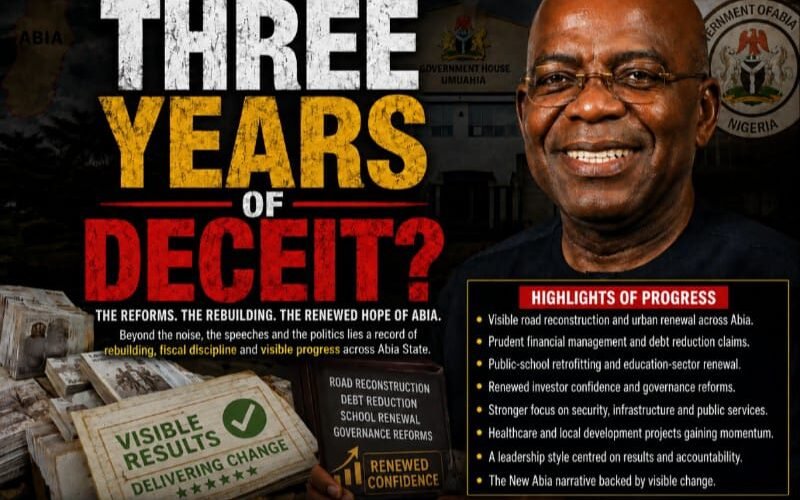
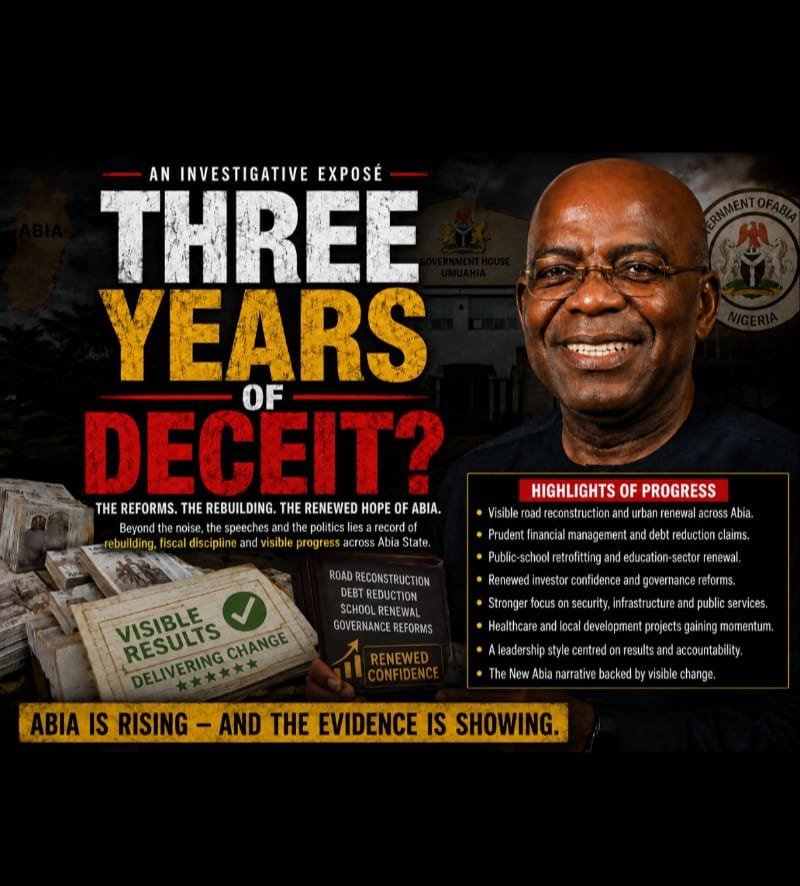
THREE YEARS OF DECEIT?
How Political Propaganda, Distorted Figures and Selective Outrage Have Tried—and Failed—to Conceal Governor Alex Otti’s Transformation of Abia State
An investigative defence of the “New Abia” record
For three years, Governor Alex Otti has governed Abia State under an extraordinary burden. He has not merely had to reconstruct broken roads, rehabilitate abandoned schools, revive decaying hospitals, restore confidence in government and confront inherited financial liabilities. He has also had to govern against a coordinated political industry whose survival increasingly depends on convincing Abians that what they can see with their own eyes does not exist.
That industry has produced alarming headlines, breathtaking figures and accusations framed to create outrage before the facts can be examined. Expenditure across the entire state government becomes “Governor Otti’s feeding bill.” A broad education-sector budget classification becomes “₦54 billion missing from school renovation.” An audit covering a year divided between two administrations becomes proof of looting “under Otti.” A clerical error in a budget description becomes evidence of an intended ₦210 million photocopier purchase. Security expenditure in a state confronting armed violence becomes a “secret vote.” Roads that residents use daily are dismissed as propaganda because the opposition has not received a list in its preferred format.
This is not accountability. It is political storytelling dressed as financial investigation.
A proper investigation must begin by distinguishing what was alleged from what was established; what was budgeted from what was spent; what was inherited from what was created; and what belongs to the whole machinery of government from what can reasonably be attributed personally to the governor.
Once those distinctions are made, the accusation of “three years of deceit and mass looting” begins to collapse. What emerges instead is the record of a government that has rebuilt infrastructure at speed, reduced domestic debt substantially, committed an unusually large proportion of its budgets to capital development and submitted itself to a level of financial scrutiny that previous administrations rarely encouraged.
The real deceit may therefore not be inside Government House, Umuahia. It may lie in the calculated attempt to portray visible reconstruction as fraud, fiscal discipline as reckless expenditure and transparent reporting as evidence of corruption.
THE ₦1.86 BILLION AUDIT REPORT: EVIDENCE AGAINST OTTI OR EVIDENCE THAT OTTI’S SYSTEM IS WORKING?
The most frequently cited allegation concerns approximately ₦1.86 billion in financial irregularities identified in the Abia State Auditor-General’s report for the year ended 31 December 2023. The audit reportedly raised questions about contracts awarded without due process, payments that bypassed established procedures, goods paid for but allegedly not delivered, and money insufficiently accounted for.
Presented without context, the figure sounds like proof that the Otti administration was caught looting. But that interpretation is both premature and deeply misleading.
The first crucial fact is that the audit covered the entire 2023 financial year. Dr Okezie Ikpeazu governed Abia until 29 May 2023, while Governor Otti took office on that date. The audit therefore covered almost five months of the previous administration and approximately seven months of the new one. The mere appearance of Governor Otti’s photograph in an official report published during his tenure does not transfer responsibility for every transaction from January to December to him.
Each queried payment must be dated. Each responsible ministry must be identified. Each accounting officer must be connected to the transaction. Any attempt to place the complete ₦1.86 billion at Otti’s feet without this transaction-level attribution is not investigation; it is political misrepresentation.
The second and even more important point is that the report exists because the audit system was permitted to function.
A government intent on concealing financial wrongdoing does not normally make an official audit trail available for journalists to examine. The publication of uncomfortable audit findings is evidence of institutional openness. It demonstrates that the Auditor-General was able to scrutinise government accounts, raise queries and document suspected violations.
The opposition cannot logically argue that Otti operates an entirely secret government while simultaneously using documents released through the state’s own accountability framework to accuse him. The existence of the document defeats the claim of total concealment.
It is also necessary to understand what an audit query means. An audit observation is not automatically a final declaration of theft. Some queries may be resolved by the production of missing vouchers, delivery notes, procurement approvals or retirement documents. Others may lead to recovery or disciplinary action. Still others may relate to transactions initiated before a new administration took office.
It is therefore reckless to convert every queried amount into money conclusively stolen.
The positive counter-narrative is powerful: Governor Otti inherited a system with longstanding weaknesses in procurement, documentation and financial control. Instead of burying those weaknesses, his administration allowed them to be documented. That is what institutional reform looks like in its early stages. Reform does not mean that every civil servant becomes incorruptible on inauguration day. It means that irregularities are detected, recorded, investigated and corrected.
The correct conclusion is not that the audit proves Otti looted ₦1.86 billion. It proves that Abia now possesses an audit record capable of exposing questionable transactions—including transactions that may embarrass the government of the day.
The outstanding responsibility of the administration is to publish the resolution status of the queries and identify sanctions or recoveries where appropriate. But that legitimate demand must not be distorted into a false conviction of the governor.
THE ₦927 MILLION “FEEDING BILL”: HOW AGGREGATE GOVERNMENT EXPENDITURE WAS TURNED INTO A PERSONAL SCANDAL
Few allegations demonstrate the mechanics of political misinformation more clearly than the claim that Governor Otti spent ₦927 million feeding himself within three months.
The available government explanation was explicit: the governor did not spend ₦927 million on his personal meals. The figure was assembled from different expenditure categories across the entire government, including refreshments and meals, honoraria, sitting allowances and welfare packages covering ministries, departments and agencies. Channels Television reported that the actual amount recorded for refreshments and meals across the government during the period was approximately ₦223.39 million—not ₦927 million personally consumed by the governor.
This difference is not cosmetic. It changes the entire meaning of the story.
Abia State Government comprises ministries, agencies, boards, departments, committees, training programmes, official meetings and thousands of employees. Aggregating several expenditure headings across that entire structure and presenting the result as “Otti’s feeding” is analogous to taking the annual stationery, welfare and meeting expenses of a large corporation and announcing that its chief executive personally consumed the entire amount.
It is a deliberate category error.
The allegation also ignored the economic environment in which the expenditure occurred. Governor Otti took office at the same time the Federal Government removed the petrol subsidy. Nigeria subsequently experienced sharp inflation, exchange-rate depreciation and steep increases in transportation, accommodation, food and logistics costs. Nominal government expenditure rose across the federation because the price of nearly every input increased.
This does not mean every expenditure should escape examination. It means that responsible analysis must consider the number of institutions covered, the activities undertaken, the inflationary environment and the distinction between the governor and the whole government.
The positive counter-narrative is straightforward: Otti’s opponents converted a government-wide recurrent-expenditure report into a sensational accusation against one man. When the figures were properly disaggregated, the famous ₦927 million personal feeding claim disappeared.
A government may still be asked to provide detailed beneficiary schedules and ensure value for money. But that is different from accusing the governor of eating nearly ₦1 billion worth of meals. The original framing was false, and repeating it after the clarification becomes propaganda rather than misunderstanding.
THE ₦54 BILLION EDUCATION CONTROVERSY: BUDGET IGNORANCE MASQUERADING AS INVESTIGATION
The education allegation follows the same pattern. A large number is extracted from a financial document, stripped of its accounting classification and presented as money that was withdrawn for school renovation but could not be traced.
Critics alleged that approximately ₦54 billion—or, in some versions, ₦58 billion—had been spent repairing schools without visible evidence. Governor Otti rejected the allegation as baseless and rooted in ignorance of budgeting and expenditure processes.
The government subsequently provided a concrete figure: approximately ₦14.43 billion spent retrofitting 61 public schools as of June 2025.
That disclosure is central. It means that the administration did not claim to have spent ₦54 billion solely renovating 61 schools. The larger figure being circulated by critics therefore cannot responsibly be compared directly with the ₦14.43 billion retrofitting expenditure without first establishing what the larger budget classification included.
Education expenditure is broader than plastering walls and replacing roofs. It can include new construction, smart-school development, furniture, laboratories, digital equipment, instructional materials, teacher recruitment, training, planning, consultancy, examinations, education administration and counterpart funding. A programme code may also contain approved expenditure that is not identical to cash released or work completed.
A budget is not a bank withdrawal slip.
An appropriation authorises spending up to a stated amount. It does not prove that the full amount was released. A budget-performance report may contain commitments, payments, broad programme headings or cumulative figures that require accounting interpretation. To take an appropriation or sector-wide classification and declare that the money was stolen because one cannot see an equivalent amount in freshly painted classrooms is financially unserious.
The positive counter-narrative is supported by identifiable output. The administration reported the retrofitting of 61 schools at a cost of ₦14.43 billion. These are physical facilities in identifiable communities. Teachers, pupils and residents can inspect them. The work is not an abstract media claim.
More importantly, the administration’s education programme must be assessed against the extent of decay inherited. Abia’s public-school infrastructure was not allowed to deteriorate for three years. It deteriorated over decades. Reversing that damage requires phased investment, procurement, structural assessment, redesign and construction. Some expenditure necessarily precedes visible completion.
There is nothing wrong with requesting a school-by-school project schedule. Indeed, publishing one would strengthen the government’s case. But there is a vast difference between requesting fuller documentation and announcing that ₦54 billion is missing.
The evidence presently available supports the government’s explanation more strongly than the opposition’s accusation. The administration has identified completed or ongoing school interventions and supplied a lower, specific retrofitting figure. Critics have largely relied on a disputed reading of budget classifications and then demanded that the government disprove the conclusion they prematurely reached.
That is not how the burden of proof works. Anyone alleging theft must demonstrate that money was released, received by a named beneficiary, diverted and not applied to its authorised purpose. A controversial spreadsheet interpretation is not proof of looting.
THE ₦210 MILLION PHOTOCOPIER: A CORRECTED ERROR, NOT A CORRUPTION CONVICTION
The reported ₦210 million photocopier provision in the 2026 budget generated understandable surprise. The government explained that the description resulted from a clerical or coding error and that the correct provision related to approximately ₦12 million for a photocopier and associated office equipment.
Critics immediately treated the error as a window into alleged budget inflation. But a typographical or coding error is not proof that ₦210 million was withdrawn, awarded to a contractor or paid for a photocopying machine.
For the accusation to become evidence of corruption, critics would need to establish that a procurement process was initiated at the incorrect amount, a contract was awarded, money was released or a beneficiary received funds. Without such evidence, the controversy remains what the government said it was: an error in a complex budget document.
Every large public budget is compiled from thousands of entries contributed by multiple ministries and departments. Errors should be detected before passage, and the incident justifies stronger quality control. But the willingness to correct the item is evidence against, not in favour of, a deliberate scheme.
A government attempting to hide an inflated photocopier purchase would be expected to defend the amount, obscure the supplier or quietly execute the transaction. The Otti administration acknowledged the error and corrected the description.
The pro-government conclusion is therefore clear: the episode exposed an administrative weakness in documentation, not a demonstrated act of looting. Turning it into proof of criminal intent is political exaggeration.
SECURITY EXPENDITURE: GOVERNMENT CANNOT PROTECT ABIA WITH PRESS RELEASES
Opposition commentary on security votes often proceeds as though insecurity is imaginary and security infrastructure is free.
Governor Otti took office in a region confronting kidnapping, violent separatist enforcement, attacks on security personnel, organised criminality and serious threats to commerce. In May 2024, soldiers were killed at Obikabia Junction near Aba, illustrating the grave operational environment confronting the state. The government offered a financial reward for information leading to the arrest of those responsible and worked with security agencies during the investigation.
In this context, expenditure on surveillance, vehicles, communications equipment, intelligence support, personnel logistics, joint operations and emergency response cannot honestly be portrayed as inherently suspicious.
Security is a precondition for development. Investors will not establish factories in communities controlled by kidnappers. Traders cannot operate in markets where armed groups dictate movement. Contractors cannot work where personnel and equipment are unsafe. Every road, school, hospital and private investment depends on a minimum level of order.
The Otti administration’s security expenditure must therefore be evaluated against the seriousness of the threats it confronted and the improvements residents experience—not merely against the emotional effect of a large naira figure.
Complete public disclosure of intelligence operations would be irresponsible. It could expose informants, operational methods and vulnerable facilities. The reasonable accountability model is confidential legislative and audit oversight, accompanied by public disclosure of broad expenditure categories and security outcomes.
Critics cannot demand that government reveal sensitive operations and then blame it when the same disclosure compromises security.
The positive counter-narrative is that Governor Otti has treated security as essential infrastructure. The relevant question is not why money was spent, but whether the spending strengthened operational capacity. Given the scale of threats and the administration’s continuing investment in rebuilding commerce and urban life, security expenditure is not evidence of looting. It is a necessary cost of restoring a state that cannot develop under fear.
LOCAL-GOVERNMENT FUNDS: A SERIOUS ALLEGATION BUILT AROUND A BILL THE GOVERNMENT SAYS NEVER EXISTED
The allegation that the Otti administration sent a bill to the House of Assembly seeking to seize 90 per cent of local-government allocations was explosive. It was also specifically denied.
The state government stated that the executive never transmitted such a bill and urged the Nigeria Labour Congress and the public to verify the facts.
That denial matters because legislation leaves a documentary trail. A bill allegedly sent by the executive should have a title, date, sponsor, covering letter, first-reading record, committee reference and official copy. Those alleging its existence should produce it.
Politics cannot be conducted through the invention of documents.
The wider allegation that local governments are being financially “suffocated” has largely come from opposition figures, including former officials associated with the displaced political establishment. These claims deserve scrutiny, but they are not self-proving merely because they are repeated on television.
Local-government finance is complicated by shared salary obligations, primary healthcare responsibilities, pensions, traditional institutions, joint services and inherited liabilities. Coordination between state and councils is not automatically theft. It may be required to eliminate ghost workers, standardise procurement, complete inter-council projects and prevent local funds from being captured by small political networks.
The Otti administration’s reforms should be judged by actual grassroots outcomes: functioning health centres, roads, sanitation, schools, salaries and local projects. If funds are reaching development needs, the allegation of “mopping up” allocations requires more than political assertion.
The government can strengthen its position by publishing monthly receipts and expenditure schedules for each council. But the absence of a preferred disclosure format does not prove appropriation by the governor.
The strongest available conclusion is that the sensational 90 per cent bill allegation was directly denied and has not been substantiated with an identifiable executive bill. The wider claim of local-government strangulation remains a partisan allegation requiring bank-level and council-level evidence.
THE 414 ROADS: THE OPPOSITION’S WAR AGAINST VISIBLE REALITY
Governor Otti reported in May 2026 that his administration had completed 414 road projects covering approximately 864.12 kilometres in three years. He also identified major projects, including Port Harcourt Road and Ohanku Road in Aba, Aguiyi Ironsi Boulevard in Umuahia, Omenuko Bridge and the Umuahia–Uzuakoli–Abiriba–Ohafia corridor.
The opposition’s response was to demand proof.
Demanding a project register is legitimate. Pretending that the roads do not exist until an opposition party approves the list is absurd.
Infrastructure is the least abstract area of government performance. Roads occupy physical space. Residents drive on them. Businesses operate around them. Drainage systems can be inspected. Communities know whether access has improved. In Aba especially, the transformation of important corridors cannot be erased by a press statement from a rival party.
The opposition’s argument also depends heavily on a semantic trick. The governor referred to road projects and interventions, but critics often restate the claim as though government asserted that it had constructed 414 completely new highways from untouched land. Road intervention can include reconstruction, rehabilitation, resurfacing, drainage work, emergency repairs and completion of inherited projects.
These are all legitimate public works. A rehabilitated urban road that restores commerce and mobility is not less real because it was not built on virgin soil.
The positive counter-narrative is overwhelming: the administration has provided a quantified claim—414 projects and more than 800 kilometres—and has named major examples. Independent residents, journalists and visitors have observed substantial changes in road conditions and urban appearance. The opposition has challenged the total but has not demonstrated that the named flagship projects are imaginary.
A complete register would remove any remaining ambiguity, and government should publish it. But the burden on critics is equally important. They must identify which roads on the government’s list do not exist, which project classifications are duplicated and which completion claims are false.
Until then, the attack resembles an attempt to debate away asphalt.
DEBT AND FISCAL DISCIPLINE: THE FIGURES THE CRITICS PREFER NOT TO DISCUSS
The most damaging evidence against the narrative of reckless looting is Abia’s debt trajectory.
Official Debt Management Office publications provide the authoritative framework for comparing state debt. The DMO maintains quarterly and annual records of domestic and external obligations across states.
Governor Otti has stated that his administration reduced Abia’s debt burden by more than 70 per cent by March 2026. Reports on the administration’s third-year record repeated that claim alongside the state’s infrastructure achievements.
This is not the profile of a government engaged simply in reckless consumption.
A looting administration typically expands liabilities while producing little durable infrastructure. The Otti administration’s record points in the opposite direction: visible capital projects alongside a substantial claimed reduction in domestic indebtedness.
Critics sometimes shift the argument by pointing to external debt or proposed borrowing. But borrowing is not corruption. The relevant distinctions are whether the loan is approved, whether the terms are sustainable, whether the funds finance productive infrastructure and whether repayment is supported by future economic benefits.
Governor Otti has publicly maintained that borrowing should be directed toward investment rather than consumption. That principle is economically sound. A long-term facility used to reconstruct transport corridors, expand power infrastructure or modernise healthcare can generate benefits for decades. Rejecting all borrowing regardless of purpose would condemn developing states to permanent infrastructural stagnation.
Moreover, Abia’s high capital-expenditure allocations reinforce the administration’s development orientation. A government devoting the large majority of its budget to capital formation is signalling that roads, schools, hospitals, power and productive infrastructure—not routine consumption—are its priorities.
The positive fiscal story is therefore difficult to dismiss: debt has been reduced substantially, capital expenditure has been prioritised and visible assets have been created. Critics alleging mass looting must explain how such extensive infrastructure and debt reduction coexist with their claim that the treasury has simply been emptied.
PENSIONS: FROM YEARS OF ABANDONMENT TO A PRACTICAL SETTLEMENT
The pension controversy is another area where inherited failure is repackaged as an Otti-created scandal.
The administration inherited enormous arrears accumulated over many years. Pensioners had endured delayed or unpaid entitlements long before May 2023. Any new government confronting such liabilities had limited options: continue the cycle of promises and non-payment, or negotiate a financially sustainable settlement that would put actual money into the hands of retirees.
Critics have alleged that pensioners were compelled to forfeit part of their entitlements. But this allegation must be examined against the reality that an inherited liability can exceed the immediate fiscal capacity of a state. A negotiated settlement is not automatically exploitation. In commercial and public finance, discounted settlement is a recognised method of resolving old obligations where full immediate payment is impracticable.
The moral test is whether the terms were communicated, accepted and followed by real payment. A retiree who receives an agreed settlement after years of receiving nothing may consider that outcome far better than another decade of empty assurances.
The Otti administration should continue publishing the number of pensioners verified, amounts paid and outstanding liabilities. But opponents who participated in or defended the political order under which those arrears accumulated have limited moral authority to condemn the government attempting to resolve them.
The positive counter-narrative is that Otti did not create the pension mountain. He inherited it and chose to confront it. Political critics now treat the difficulty of cleaning up their legacy as proof that the cleaner caused the mess.
REVENUE: WHY LARGE INFLOWS DO NOT MEAN FREE MONEY IN THE GOVERNOR’S POCKET
Opposition figures have repeatedly circulated estimates of Abia’s federal receipts, sometimes presenting combined state and local-government inflows as though the entire amount were a discretionary monthly payment to Governor Otti.
This is misleading.
FAAC distributions contain distinct allocations for the state and its 17 local governments. They may include VAT, statutory allocation, exchange-rate gains and other components. Gross receipts are also not the same as cash freely available for new projects. Government must meet salaries, pensions, debt obligations, counterpart funding, security requirements, recurrent services and inherited commitments.
Combining every inflow over three years, announcing a dramatic cumulative total and asking “Where is the money?” is not financial analysis unless expenditure obligations and completed assets are also counted.
Where is the money? A substantial portion is visible in reconstructed roads, drainage systems, schools, health facilities, security equipment, urban renewal and debt reduction.
The administration’s critics often count every naira received but assign zero value to every kilometre of road completed, every facility rehabilitated and every debt obligation reduced. That method guarantees a predetermined conclusion because expenditure is treated as disappearance rather than conversion into public assets.
The correct assessment is value-for-money analysis: compare project cost, quality and economic impact. It is not enough to shout a cumulative revenue figure while pretending government had no salary bill, no inherited debt and no development deficit.
WHY THE “MASS LOOTING” NARRATIVE FAILS
The case against Governor Otti is loud, but loudness is not evidence.
The ₦927 million personal feeding allegation was constructed by combining multiple government-wide expenditure categories and attaching them to the governor personally.
The ₦54 billion education allegation rests on a disputed interpretation of broad budget classifications and ignores the government’s specific disclosure that ₦14.43 billion had been used to retrofit 61 schools.
The ₦210 million photocopier story concerns an acknowledged and corrected budget error, with no cited evidence that the amount was paid for a photocopier.
The local-government 90 per cent allegation referred to an executive bill the government says it never submitted—and whose accusers have not publicly produced the required legislative trail.
The road controversy asks citizens to distrust hundreds of physical interventions because opposition politicians dispute the aggregate count.
The security-vote allegation ignores the violent threats the administration must confront.
The 2023 audit is misrepresented without separating the months and transactions attributable to two different administrations, while the publication of the audit itself demonstrates greater institutional openness.
Above all, the mass-looting narrative is contradicted by substantial infrastructure delivery and a significant claimed reduction in debt.
None of this means government should be exempted from scrutiny. Pro-government analysis does not require the abandonment of standards. The administration should publish detailed project registers, procurement records, audit-query resolutions and local-government financial schedules. Such disclosure would strengthen its achievements and suffocate misinformation.
But a demand for further documentation is not evidence that existing achievements are fraudulent. Accountability must not be confused with a licence to make allegations without proof.
THE REAL THREE-YEAR STORY
The real three-year story is not one of a governor entering office and quietly dismantling Abia’s treasury. It is the story of an administration entering a state burdened by infrastructure decay, damaged public confidence, pension arrears, debt and weak institutions—and beginning the difficult work of reconstruction.
It is the story of roads in Aba and Umuahia that residents can use.
It is the story of more than 800 kilometres of reported road interventions and 414 completed projects.
It is the story of 61 public schools reported as retrofitted through a ₦14.43 billion programme.
It is the story of capital budgets designed around infrastructure rather than political consumption.
It is the story of a state debt burden the government says has fallen by more than 70 per cent.
It is the story of a government confident enough to permit audit findings to enter the public domain.
It is also the story of a displaced political establishment attempting to survive by converting every spreadsheet into a scandal and every clerical error into an alleged criminal conspiracy.
Governor Otti should not be defended merely because he is popular. He should be defended where the facts support him. On the central accusation of three years of deceit and mass looting, the facts presently available do not support the prosecution’s rhetoric.
There are audit queries, but no public finding that Otti personally stole the queried money.
There are disputed education figures, but there are also 61 identified school-retrofitting projects and a specific expenditure figure.
There was a misleading feeding headline, but the underlying expenditure covered the government rather than the governor personally.
There was a budget error, but no demonstrated ₦210 million photocopier purchase.
There are opposition challenges to the road count, but the roads and urban renewal are visible.
There are borrowing accusations, but the administration reports a dramatic decline in the inherited debt burden.
This is not a government without imperfections. No serious administration is. It is a government whose imperfections are being magnified while its structural achievements are deliberately minimised.
CONCLUSION: THE MASK THAT HAS FALLEN IS THE MASK OF PROPAGANDA
After three years, the central allegation against Governor Alex Otti fails the test of evidence.
The claim of mass looting relies heavily on distorted accounting categories, unproven inferences, disputed political statements and the strategic omission of government explanations. It asks the public to assume criminality whenever a figure is large, even when the figure represents statewide expenditure, a budget authorisation, an inherited liability or a corrected error.
Meanwhile, the physical and fiscal record points in another direction: roads reconstructed, schools retrofitted, urban centres renewed, public confidence revived and debt reduced.
The proper conclusion is not that Alex Otti must never be questioned. He must be questioned because he holds public office. But questions must be answered with evidence—and accusations must also be supported by evidence.
So far, the opposition has produced more suspicion than proof, more headlines than forensic trails and more political arithmetic than credible financial analysis.
The Otti administration’s strongest defence is not a slogan. It is the accumulating body of visible work.
The roads are speaking.
The schools are speaking.
The revived urban corridors are speaking.
The debt figures are speaking.
The growing confidence of residents, investors and visitors is speaking.
The real deception of the past three years is the attempt to persuade Abians that transformation is theft, that accountability documents prove concealment and that a state visibly rising remains trapped in the failure from which it is being rescued.
Alex Otti’s government should continue to publish, explain and open its records. But it should not apologise for rebuilding Abia, nor permit politically interested actors to define development as fraud simply because development has weakened their campaign message.
Three years later, the mask is indeed falling.
But it is not the mask of the “New Abia.”
It is the mask of a propaganda machine increasingly unable to reconcile its allegations with the roads, schools, reforms and renewed confidence standing before the people.