
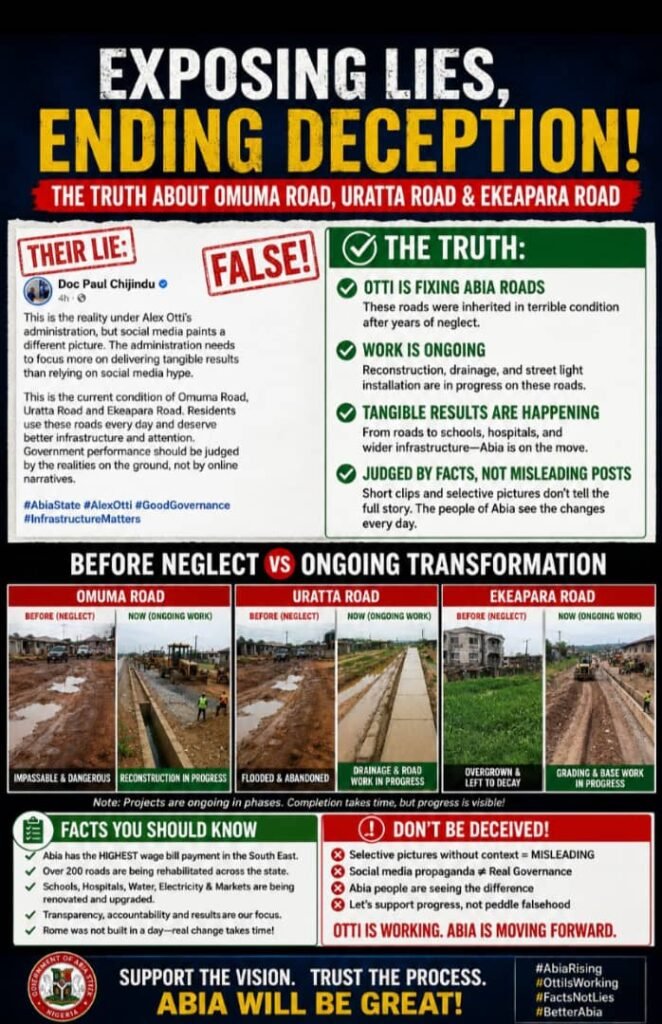
EXPOSING THE DECEPTION: OTTI IS FIXING THE ROADS
The Truth About Omuma Road, Uratta Road and Ekeapara Road
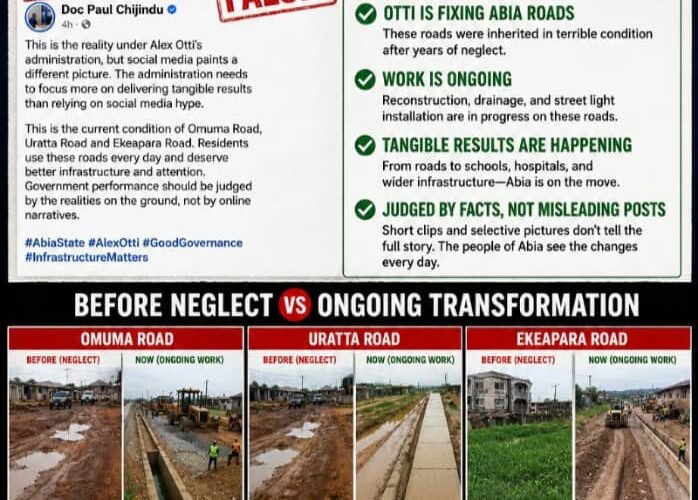
A recent social media post attempted to present the present condition of Omuma Road, Uratta Road and Ekeapara Road as evidence of failure under Governor Alex Otti’s administration. The post relied heavily on selected photographs of deteriorated sections of the roads while ignoring the most important fact: these roads were inherited in terrible condition, and reconstruction work is already ongoing.
It is misleading to photograph an inherited problem while rehabilitation is in progress and then present the situation as though the current government created it. Responsible public commentary must distinguish between long-standing infrastructural decay and the genuine efforts being made to correct it.
THESE ROADS WERE INHERITED IN TERRIBLE CONDITION
The deplorable state of many roads across Abia did not begin with the present administration. For years, residents endured collapsed drainage systems, flooded streets, erosion, overgrown surroundings and roads that became nearly impassable during the rainy season.
Governor Alex Otti’s administration inherited these accumulated problems. The government did not create the mud, flooding, abandoned drainage channels or structural deterioration now being displayed online. What the administration inherited was a state requiring extensive reconstruction after years of neglect.
The fair question should therefore not be whether the roads were bad when the administration came into office. The proper question is whether the government has acknowledged the problems and commenced meaningful intervention.
The evidence is clear: work is ongoing.
OTTI IS FIXING ABIA ROADS
Across Abia State, road reconstruction, rehabilitation, drainage development and related infrastructure projects are being undertaken in phases. Omuma Road, Uratta Road and Ekeapara Road form part of the wider infrastructural challenge confronting the administration.
Road construction is not achieved through social media announcements alone. It involves surveying, drainage design, earthworks, grading, stabilisation, base preparation, asphalt laying and the installation of supporting infrastructure.
In some locations, drainage must be completed before the main carriageway can be reconstructed. In others, contractors must first address flooding, erosion or encroachment before visible road surfacing begins.
Therefore, photographs taken during the early stages of construction do not prove abandonment. In many cases, they simply show the condition of the road before or during intervention.
WORK IS ONGOING
The appropriate comparison is not between a completed highway and a road still undergoing reconstruction. The proper comparison is between the inherited condition and the progress being made.
On roads previously characterised by flooding, collapsed drainage and muddy surfaces, there are now visible signs of grading, drainage construction, earthworks and preparation for further rehabilitation.
Projects are being executed in phases, and each phase requires time. Reconstruction cannot be completed merely because critics demand instant results on social media.
Real development follows engineering procedures, procurement requirements, funding schedules and construction timelines. While residents have every right to demand speed and quality, it is dishonest to deny the existence of ongoing work.
SELECTIVE PICTURES DO NOT TELL THE FULL STORY
A photograph can show what is wrong, but it may not explain why it is wrong, how long it has been wrong or what is currently being done about it.
The pictures circulated online show portions of roads requiring attention. They do not establish that the government has abandoned the roads. They also do not disclose the inherited state of the infrastructure or the stages of work already undertaken.
Selective images without context can easily become instruments of political propaganda. A truthful assessment must include the previous condition of the roads, the scope of intervention, the current stage of work and the expected completion process.
The public should therefore be cautious about narratives designed to convert inherited decay into an indictment of a government actively trying to repair it.
DEVELOPMENT IS HAPPENING ACROSS ABIA
The road rehabilitation programme forms part of a broader effort to rebuild public infrastructure across Abia State.
The administration’s interventions extend beyond roads to schools, healthcare facilities, markets, water supply, electricity and other essential services. The objective is not merely to beautify selected urban centres but to restore public infrastructure and improve the quality of life of residents.
The transformation of a state that suffered prolonged infrastructural decline cannot be completed overnight. However, the direction of government policy, the visibility of projects and the scale of ongoing intervention indicate that Abia is moving forward.
GOVERNANCE MUST BE JUDGED BY FACTS
Government performance should certainly be judged by realities on the ground. That principle is correct. However, realities on the ground must be presented honestly.
The reality is that many roads were inherited in poor condition.
The reality is that reconstruction and rehabilitation are ongoing.
The reality is that drainage, grading and base work usually come before asphalt.
The reality is that major infrastructure projects require time, funding and proper engineering.
The reality is also that taking photographs of an ongoing project and presenting them as evidence of total abandonment is deceptive.
Accountability must not become an excuse for misinformation. Citizens can demand faster delivery without denying visible progress. They can criticise delays without pretending that nothing is being done.
ABIANS ARE SEEING THE DIFFERENCE
Across the state, residents are witnessing road rehabilitation, improved public facilities and renewed attention to long-neglected communities.
The administration should continue to communicate project timelines clearly, supervise contractors strictly and ensure that every approved project is completed to standard. At the same time, political actors and social media commentators must stop manipulating inherited problems for partisan advantage.
Constructive criticism strengthens governance. Deliberate misrepresentation weakens public trust.
Abia deserves an informed public conversation based on evidence, context and fairness.
OTTI IS WORKING, ABIA IS MOVING FORWARD
Governor Alex Otti’s administration should be judged by the roads completed, the projects under construction, the quality of execution and the long-term impact on communities.
The current condition of a road awaiting or undergoing reconstruction cannot erase the fact that the government has commenced the difficult task of rebuilding infrastructure across the state.
Rome was not built in a day, and Abia cannot be completely reconstructed within a moment. What matters is that the state is no longer standing still.
The work has started.
The process is ongoing.
The results are becoming visible.
SUPPORT THE VISION. TRUST THE PROCESS.
Abians should continue to demand accountability, quality construction and timely project delivery. However, they must also reject falsehood, selective reporting and politically motivated deception.
Let the truth speak.
Let the work continue.
Let development show.
Otti is working.
Abia is rising.
Abia is moving forward.
#AbiaRising
#OttiIsWorking
#FactsNotLies
#BetterAbia
#InfrastructureDevelopment
Published by Prof. Chukwuemeka Ifegwu Eke