
THE FALL OF SIR KEIR STARMER: THE FREE SUITS, BROKEN PROMISES AND POLITICAL GHOSTS THAT FOLLOWED HIM OUT OF DOWNING STREET
Britain was promised stability.
After years of Conservative chaos, Sir Keir Starmer presented himself as the calm adult entering a disorderly room: disciplined, respectable, legally trained and almost painfully serious.
No drama. No scandals. No circus.
Then the gifts began to surface.
The expensive clothes.
The football tickets.
The concert hospitality.
The access enjoyed by a wealthy Labour donor.
The painful welfare decisions.
The abandoned promises.
The policy reversals.
The revolt inside his own party.
And finally, on 22 June 2026, the man who had entered Downing Street with an overwhelming parliamentary majority announced that he was leaving.
How did a prime minister who appeared politically untouchable become politically homeless in less than two years?
The answer did not arrive in one explosion.
It came in instalments.
THE PRIME MINISTER WHO ACCEPTED THE FREEBIES
Starmer had campaigned as the antidote to Conservative entitlement. His message was built around integrity, restraint and public service.
Then came the disclosures.
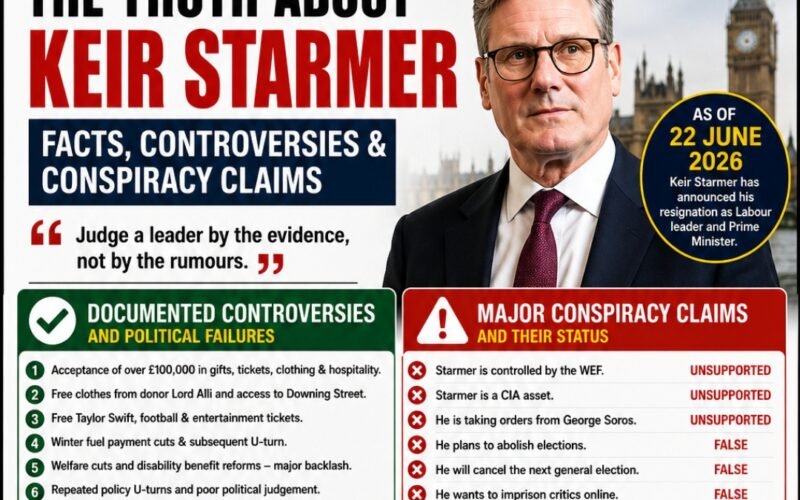
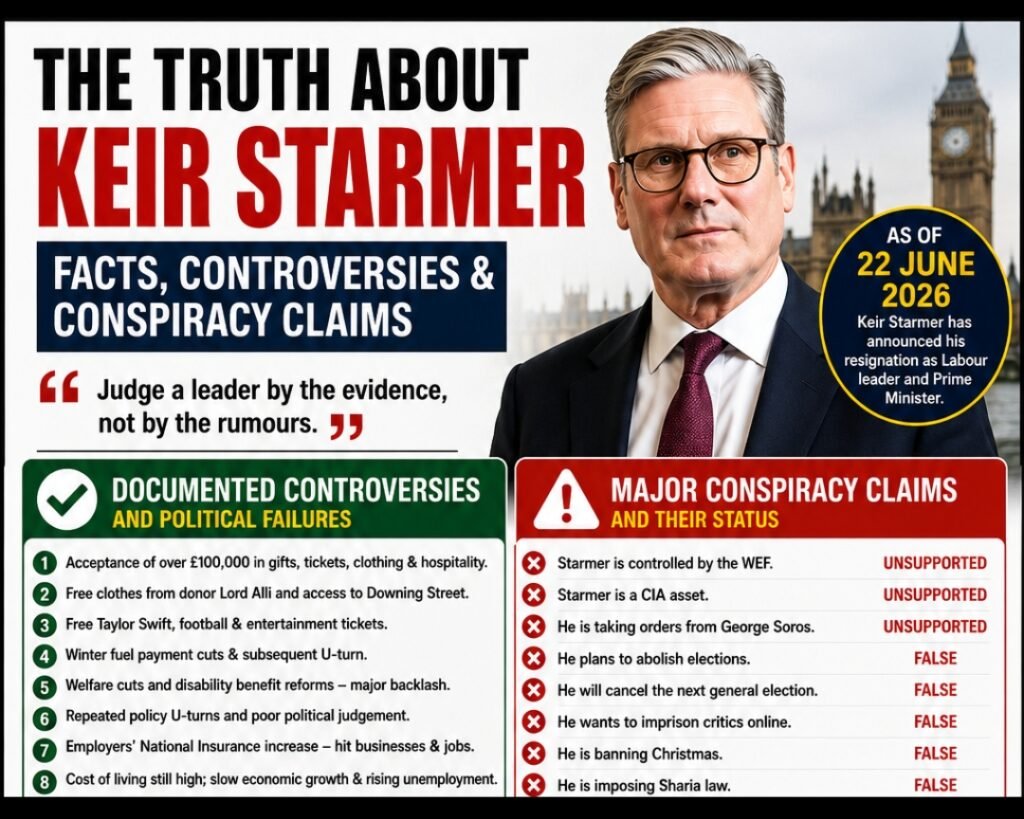
He had accepted expensive gifts, hospitality, clothing and entertainment tickets. Labour donor Lord Alli funded clothes connected to Starmer and his wife. Starmer also accepted football and concert tickets, including hospitality linked to Arsenal and Taylor Swift.
Every gift may have been declared according to the rules, but politics is not judged by technical compliance alone.
It is judged by appearance.
For a government preparing to tell pensioners, disabled citizens and struggling employers that difficult sacrifices were necessary, the sight of its leader enjoying donated clothing and premium hospitality was politically poisonous.
The public heard austerity.
The prime minister appeared to receive accessories.
That contradiction never completely disappeared.
THE DOOR THAT OPENED FOR LORD ALLI
The controversy deepened when questions emerged about Lord Alli’s access to Downing Street.
Why had a significant Labour donor received a temporary security pass?
Was it ordinary administrative convenience, or evidence that financial supporters could obtain unusual proximity to power?
No criminal exchange was established. No proven bribery emerged.
But once trust begins to crack, unanswered questions become louder than official explanations.
The government had promised to close the era of privileged access.
Instead, it found itself explaining why a donor appeared to have entered through the front door.
THE WINTER-FUEL GAMBLE
Then came the decision that transformed unease into anger.
Starmer’s government restricted winter-fuel payments to millions of pensioners.
The argument was fiscal discipline. Ministers said the public finances required difficult choices.
But the political image was devastating: a Labour government withdrawing support from elderly people preparing for winter.
The policy united opponents, charities, pensioners and rebellious Labour MPs.
Eventually, the government retreated and restored eligibility to millions.
But the damage had already been done.
The reversal raised an even more troubling question:
If the original policy was necessary, why abandon it?
And if abandoning it was correct, why impose it in the first place?
The government looked harsh when it announced the measure—and weak when it reversed it.
WELFARE REFORM AND THE REVOLT WITHIN
The same pattern appeared in proposed reforms to disability and sickness benefits.
The government argued that Britain’s welfare system required reform and that more people should be supported into employment.
Critics heard something different: savings being extracted from people with disabilities and serious health conditions.
Labour MPs rebelled.
Campaign groups mobilised.
The government diluted parts of its proposals.
Once again, Downing Street appeared to announce before persuading, threaten before consulting and retreat only after rebellion.
A government elected with a historic majority began behaving like one afraid of its own backbenchers.
THE TAX THAT WAS NOT SUPPOSED TO TOUCH “WORKING PEOPLE”
Labour had insisted that it would not increase key taxes on working people.
Then employers’ National Insurance contributions rose.
Technically, the tax was imposed on employers.
Economically, businesses warned that the consequences would reach workers through reduced recruitment, weaker wage growth, higher prices and fewer opportunities.
The government defended the measure as necessary to fund public services and repair inherited financial pressures.
But the political argument was simpler:
A tax does not stop affecting working people merely because the invoice is initially sent to their employer.
THE ECONOMY REFUSED TO COOPERATE
Starmer had promised growth.
Instead, Britain experienced weak and uneven expansion, pressure on household budgets and increasing anxiety among businesses.
Not every difficulty was created in Downing Street. Starmer inherited high debt, damaged public services, Brexit complications and a fragile international economy.
But governments are rarely judged only by the problems they caused.
They are judged by the problems they failed to solve.
As public confidence weakened, economic disappointment became attached to Starmer personally. The careful lawyer who had promised competence increasingly appeared unable to generate momentum.
THE MAN WITHOUT A STORY
Starmer’s deepest problem may not have been one particular policy.
It was the absence of a compelling explanation of what his government was for.
Was he rebuilding the welfare state—or restricting benefits?
Was he governing from the left—or pursuing fiscal conservatism?
Was he repairing relations with Europe—or refusing to reconsider Brexit?
Was he defending vulnerable people—or demanding sacrifices from them?
Was he offering transformation—or simply better management?
The public could see decisions.
It struggled to see a destination.
Starmer could explain a process.
He rarely inspired a movement.
THE TEN PLEDGES THAT FADED
When Starmer sought the Labour leadership, he presented ten pledges that appealed strongly to the party’s progressive membership.
They included support for public ownership, stronger trade-union rights, social justice, opposition to austerity and greater taxation of the wealthy.
Over time, several commitments were abandoned, diluted or reinterpreted.
The promise to abolish university tuition fees disappeared.
The original £28 billion annual green-investment ambition was reduced.
Policies once used to win the Labour leadership were replaced by arguments about changed economic circumstances.
To Starmer’s supporters, this was pragmatism.
To his critics, it was political misrepresentation: campaign from the left, govern from the centre and discipline anyone who complained.
THE CORBYN SHADOW
Jeremy Corbyn remained the ghost at Labour’s banquet.
Starmer had once served in Corbyn’s shadow cabinet. He later transformed Labour, excluded Corbyn from the parliamentary party and marginalised much of the party’s socialist wing.
Supporters said he had made Labour electable.
Critics said he had used promises of unity to obtain power before purging the people who helped him get there.
The quarrel never truly ended.
It waited quietly beneath every policy reversal, every suspension and every accusation that Downing Street was controlling internal dissent.
GAZA: THE WOUND THAT WOULD NOT CLOSE
Starmer’s early comments after the 7 October attacks generated intense controversy, particularly remarks interpreted as supporting Israel’s right to restrict essential supplies to Gaza.
He later clarified his position and eventually supported a ceasefire.
But for many Muslim voters, human-rights campaigners and Labour activists, the clarification came too late.
The Gaza war cost Labour support in several communities and contributed to a growing belief that Starmer applied legal and moral principles inconsistently.
A former human-rights lawyer had become vulnerable on the very territory where many expected him to be strongest.
IMMIGRATION AND THE “ISLAND OF STRANGERS”
On immigration, Starmer was trapped between two political fires.
The right accused him of failing to stop small boats and control Britain’s borders.
The left accused him of borrowing the language of Reform UK.
His warning that Britain risked becoming an “island of strangers” provoked outrage and historical comparisons that Downing Street struggled to contain.
The phrase was intended to demonstrate firmness.
Instead, it intensified the perception that Starmer was chasing Reform voters while alienating parts of Labour’s own coalition.
When a government begins speaking in the vocabulary of its opponents, it may gain their language without gaining their voters.
PRISONS, PROTESTS AND “TWO-TIER JUSTICE”
Britain’s overcrowded prisons forced the government to release some offenders earlier than planned.
Ministers said the inherited prison system was nearing collapse.
Opponents asked why ordinary criminals were being released while protesters and rioters received rapid sentences.
The slogan “two-tier justice” spread widely.
There is no established evidence that Starmer created a formal system of partisan justice. But the accusation became politically effective because it connected with a broader suspicion that institutions treated different groups differently.
The government answered legally.
Its critics communicated emotionally.
Emotion travelled faster.
THE APPOINTMENTS THAT BECAME LIABILITIES
Sue Gray’s appointment as Downing Street chief of staff had already generated controversy because of her former role as a senior civil servant.
Her departure reinforced reports of dysfunction and rivalry inside government.
Then Peter Mandelson’s appointment created further questions about judgement, vetting and what Downing Street knew before placing him in a sensitive position.
Each controversy strengthened the same narrative:
The administration that promised superior competence was repeatedly surprised by foreseeable problems.
THE MAJORITY THAT CONCEALED WEAKNESS
Labour’s 2024 victory delivered a commanding majority in Parliament.
But the party secured roughly one-third of the national vote.
The electoral system transformed limited popular enthusiasm into overwhelming parliamentary power.
That distinction mattered.
Starmer possessed a huge majority but not necessarily a huge reservoir of public affection.
When approval ratings began to collapse, the size of Labour’s parliamentary majority could not manufacture emotional loyalty.
The government had seats.
It was losing believers.
REFORM UK WAITED AT THE DOOR
As Labour struggled, Reform UK attracted voters angry about immigration, economic stagnation, national identity and the political establishment.
Starmer’s response often appeared defensive.
Move right on immigration, and progressive voters became angry.
Remain cautious, and Reform accused him of weakness.
Promise change, and financial markets demanded restraint.
Offer restraint, and voters asked what had changed.
He became surrounded by contradictions from which there was no easy escape.
THEN CAME THE CONSPIRACIES
As Starmer’s real political difficulties grew, false and unsupported stories multiplied online.
He was described as a CIA operative.
A puppet of the World Economic Forum.
An agent of George Soros.
A secret dictator.
A man planning to abolish elections.
A politician preparing to ban Christmas, meat, private cars and criticism on social media.
Some posts falsely accused him of protecting Jimmy Savile or personally preventing Savile’s prosecution.
Others circulated fake videos, fabricated headlines and manipulated images claiming that Starmer had been arrested, secretly dismissed or exposed as part of a criminal network.
These claims were not needed to criticise him.
They weakened legitimate criticism by mixing verifiable failures with fantasy.
Starmer’s actual record offered more than enough material for serious scrutiny.
The gifts were real.
The winter-fuel controversy was real.
The welfare rebellion was real.
The abandoned pledges were real.
The Gaza backlash was real.
The immigration crisis was real.
The decline in public confidence was real.
The conspiracy theories merely allowed his defenders to dismiss every criticism as extremism.
THE FINAL HOURS
By June 2026, Starmer’s authority had drained away.
Approval ratings had collapsed.
Labour had suffered electoral setbacks.
Ministers and MPs increasingly questioned whether he could lead the party into another general election.
Andy Burnham’s return to Parliament intensified the pressure and offered Labour an obvious alternative centre of power.
The question was no longer whether Starmer had problems.
It was whether he still possessed enough authority to survive them.
On 22 June 2026, Britain received its answer.
Sir Keir Starmer announced his resignation, remaining temporarily in office while Labour selected his successor.
The man elected to end Britain’s revolving door of political chaos had himself become another prime minister walking through it.
THE VERDICT
Starmer’s supporters will argue that he inherited a broken country, restored seriousness to government, repaired relations with Europe and stood firmly with Ukraine.
His critics will remember something else:
A prime minister who promised integrity but became trapped by gifts.
A Labour leader who promised protection but cut winter support.
A progressive candidate who abandoned progressive pledges.
A cautious administrator who repeatedly announced policies and retreated from them.
A leader with an enormous majority who could not build an enduring public connection.
Keir Starmer was not defeated by one scandal.
He was defeated by accumulation.
One gift.
One reversal.
One broken promise.
One angry constituency.
One falling opinion poll.
One internal rebellion at a time.
The conspiracy theories were often false.
The political collapse was not.
And in the end, the most damaging story about Keir Starmer required no secret cabal, no fabricated video and no imaginary plot.
It required only his record.