
WHEN QUESTIONS BECOME CONCLUSIONS: THE TRUTH ABOUT OTTI, MEDICAL CITY, OWAZA INDUSTRIAL PARK AND ABIA’S INVESTMENT FUTURE
There is nothing wrong with asking questions.
In fact, every serious government deserves to be questioned. Every project must be interrogated. Every investment claim must be tested. Every public statement must be measured against timelines, evidence and delivery.
But there is a difference between asking questions and arriving at a political conclusion before the facts are examined.
That is the problem with the latest criticism against Governor Alex Otti’s presentation at Invest Lagos 3.0.
The argument sounds strong on the surface, but once it is tested against the nature of investment projects, the project cycle, the available records and the wider economic direction of Abia State, it begins to weaken.
Let us start with the Medical City.
Governor Alex Otti did not go to Invest Lagos 3.0 to say that $1.3 billion had already landed in Abia State Government’s account. He did not say investors had carried dollars in Ghana-Must-Go bags into Isiala Ngwa. He went to an investment summit to pitch Abia’s healthcare vision to local and international investors.
That is exactly what investment summits are for.
Investment summits are not commissioning ceremonies.
They are platforms for pitching bankable projects, attracting partners, deepening investor conversations and showing the world that a state is ready for capital.
So, when Governor Otti said Abia needs about $1.3 billion to develop the proposed Medical City, he was not announcing completed funding. He was presenting a capital requirement for a major healthcare investment ecosystem.
That distinction is important.
A Medical City is not a dispensary. It is not a renovated ward. It is not a village health centre. It is a complex healthcare, training, research, diagnostic, specialist-treatment and medical-tourism platform. Such a project requires land, planning, infrastructure, development partners, regulatory alignment, finance, technical competence and phased execution.
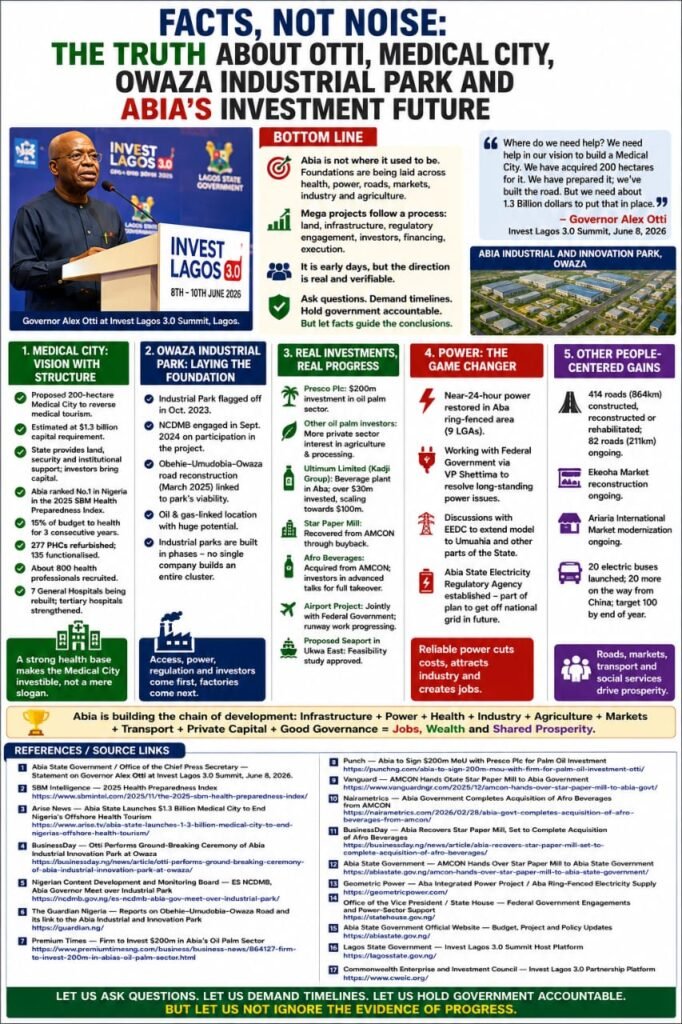
The records already show that the proposed Abia Medical City has been reported as a 200-hectare project designed to reverse medical tourism and attract high-end medical services into Abia. Reports also show that the State’s expected role is to provide land, security and institutional support, while development partners and investors are expected to drive the heavy capital component.
So, the correct question is not: “Has $1.3 billion entered Abia’s treasury?”
The correct question is: “Has Abia created a credible healthcare reform base that makes such a project investible?”
On that question, the evidence favours Otti.
Abia has committed 15% of its budget to health for three consecutive budget cycles. That is a serious fiscal signal. Only education, at 20%, receives more. A government that consistently places health second only to education is not playing politics with healthcare.
Beyond budget language, the State has refurbished hundreds of Primary Healthcare Centres. Many have been functionalised, while others are being brought on stream in phases. The administration has recruited hundreds of healthcare professionals, including professionals from outside the State. It is also rebuilding several General Hospitals and strengthening tertiary health facilities within the State.
That is not noise.
That is health-sector groundwork.
Most importantly, the 2025 SBM Health Preparedness Index ranked Abia as Nigeria’s most health-prepared state. That ranking did not come from Abia Government House. It came from an independent policy-intelligence organisation.
Therefore, when Otti speaks about a Medical City, he is not speaking from emptiness. He is speaking from a broader healthcare reform trajectory.
Now to the Abia Industrial and Innovation Park at Owaza.
Again, critics are free to ask: “What is the present status?” That is a valid question.
But to jump from that question to the conclusion that the project is “audio” is not analysis. It is politics.
Industrial parks are not built like campaign canopies. They are not created by putting one machine on a cleared field. They require land aggregation, access roads, power strategy, host-community engagement, environmental and technical studies, regulatory cooperation, anchor investors, industrial zoning, finance and phased development.
The Owaza project was publicly flagged off as an oil-and-gas-linked industrial platform. The Nigerian Content Development and Monitoring Board later confirmed engagement with Governor Otti over Abia’s request for participation in the Abia Industrial and Innovation Park. That is important because NCDMB participation is not social-media decoration; it is institutional engagement around industrial content, oil and gas, local capacity and development.
Again, the State has linked road infrastructure to the viability of the industrial park. The reconstruction of the Obehie–Umudobia–Owaza road was not just a road project. It was presented as part of the infrastructure needed to make the industrial park more accessible, more viable and more attractive to investors.
That is how industrial projects are built.
First, create access.
Then prepare the land and legal structure.
Then engage regulators and development institutions.
Then attract anchor investors.
Then build in phases.
Anybody who expects a full industrial city to rise overnight either does not understand industrial development or is deliberately pretending not to understand it.
The critic also mentioned that no single company can be the sole investor in an industrial cluster. That is correct. But that point actually supports the government’s approach. Industrial parks are usually developed through a combination of government facilitation, private tenants, anchor industries, infrastructure providers, development finance and regulators. That is why investment pitching matters.
Government must open the door.
Investors then enter in phases.
Now let us deal with the larger accusation that industrialisation and job creation are not in Otti’s plan.
That claim is false.
The evidence is already visible.
Presco Plc has announced a proposed $200 million investment in Abia’s oil palm sector. That is not road politics. That is agro-industrial capital.
The State has also attracted oil-palm investment discussions beyond Presco, including other private-sector interests in agriculture and processing. That is industrial agriculture.
Kadji Group, through Ultimum Limited, has already commissioned a major beverage production facility in Aba, with reported investment already above $30 million and scale-up plans toward $100 million. That is manufacturing.
Abia State Government has recovered Star Paper Mill from AMCON through a buyback arrangement. It has also completed the acquisition of Afro Beverages from AMCON and has begun receiving private-sector interest for their revival. That is industrial recovery.
These are not mere speeches. They are steps in rebuilding Abia’s productive base.
Nobody should pretend that moribund industries come back to life by magic. They require asset recovery, investor screening, private-sector operators, working capital, machinery, market strategy and management competence. The Otti administration has started by recovering the assets and opening them up for serious private-sector participation.
That is how sustainable job creation works.
The Aba power story also matters. Reliable electricity is not a side issue in industrialisation. It is the main issue. Manufacturers suffer when power is unstable. Energy cost can destroy competitiveness. If Aba has a ring-fenced power structure that gives manufacturers more reliable supply, then Abia has gained one of the strongest industrial advantages in the South-East.
That is why the Geometric Power/Aba Power ecosystem is crucial.
Aba is already known for enterprise, leather, garments, fabrication, trading and manufacturing capacity. Give Aba reliable power, better roads, modern markets and improved security, and the economy will respond.
That is not theory. That is common sense.
The rebuilding of Ariaria and Ekeoha should also not be dismissed as if markets are irrelevant. In Abia, markets are not ordinary trading spaces. They are production clusters. Ariaria is an industrial ecosystem. Ekeoha is an economic artery. Thousands of families depend on those markets. Modernising them improves trading conditions, production efficiency, sanitation, safety, access, logistics and revenue potential.
So, when someone says people should “focus on Ariaria and Ahia Ohuru,” the answer is simple:
Yes, we should focus on them because they are part of Abia’s industrial economy.
Markets create jobs.
Power creates jobs.
Roads create jobs.
Agro-processing creates jobs.
Recovered factories create jobs.
Healthcare investment creates jobs.
Industrial parks create jobs.
Transport reforms create jobs.
Airport and seaport planning create logistics-based jobs.
This is the real chain of industrialisation.
It is therefore unfair to look at one or two mega projects still moving through the development cycle and conclude that job creation is absent from the government’s plan.
That is not balanced criticism.
That is selective blindness.
Let us also address the comparison with Imo State.
Governor Hope Uzodinma has been in office for about seven years. Governor Alex Otti is in his third year. A governor in his seventh year will naturally have more mature projects to list than a governor in his third year. That does not mean one should not compare states, but comparison must be fair.
The fair question is not: “Who had more things to say on stage?”
The fair question is: “At comparable stages, who had laid stronger foundations for economic transformation?”
Otti inherited a state with decayed infrastructure, weak public-sector confidence, abandoned industrial assets, broken markets, unpaid obligations, struggling health institutions and an economy that had performed below its natural capacity for years.
In three years, Abia is now being discussed nationally as an investment destination. Roads are being built. Healthcare is being repositioned. Markets are being modernised. Power is becoming a competitive advantage. Moribund industries are being recovered. Private capital is showing interest. Agro-industrial investments are being announced. The State is pitching serious projects before local and global investors.
That is progress.
Not perfection.
Progress.
However, let us be clear. Government must also help itself. It must publish clearer project dashboards. It must update Abians on the Medical City, AIIP Owaza, the rice project, the airport, the proposed seaport and other major investment projects. It must show milestones, not just intentions. It must separate projects under study from projects under procurement, projects with investors from projects still being marketed, and projects already under construction from projects still at concept stage.
That will reduce suspicion.
That will strengthen public confidence.
That will prevent critics from filling information gaps with political conclusions.
But the presence of questions does not mean the absence of progress.
The Medical City is not dead because it is still being structured.
The Owaza Industrial Park is not fake because it has not yet become a fully built industrial city.
The recovery of Star Paper Mill is not media hype because AMCON handover was reported.
The acquisition of Afro Beverages is not audio because the acquisition was publicly reported.
The Presco investment conversation is not fiction because credible media reported it.
The Aba power advantage is not propaganda because Geometric Power is a real infrastructure platform.
The modernisation of Abia’s markets is not cosmetic because markets are the heartbeat of Abia’s economy.
So, let us ask questions.
But let us ask them honestly.
Let us demand timelines.
But let us not pretend that every project still in development has failed.
Let us insist on jobs.
But let us not ignore the foundations that produce jobs.
Let us hold Otti accountable.
But let us not use accountability as a cover for political dismissal.
Abia is not where it used to be.
The journey is not complete.
The expectations are high.
The questions are legitimate.
But the direction is clear.
And if this government sustains the link between roads, power, health, markets, private capital, industrial assets and investment promotion, then those calling everything “audio” today may soon discover that what they dismissed as noise was actually the early sound of a state returning to production.
REFERENCES / SOURCE LINKS
- Abia State Government / Office of the Chief Press Secretary — Statement on Governor Alex Otti at Invest Lagos 3.0 Summit, June 8, 2026.
- SBM Intelligence — 2025 Health Preparedness Index
https://www.sbmintel.com/2025/11/the-2025-sbm-health-preparedness-index/ - Arise News — Abia State Launches $1.3 Billion Medical City to End Nigeria’s Offshore Health Tourism
https://www.arise.tv/abia-state-launches-1-3-billion-medical-city-to-end-nigerias-offshore-health-tourism/ - BusinessDay — Otti Performs Ground-Breaking Ceremony of Abia Industrial Innovation Park at Owaza
https://businessday.ng/news/article/otti-performs-ground-breaking-ceremony-of-abia-industrial-innovation-park-at-owaza/ - Nigerian Content Development and Monitoring Board — ES NCDMB, Abia Governor Meet over Industrial Park
https://ncdmb.gov.ng/es-ncdmb-abia-gov-meet-over-industrial-park/ - The Guardian Nigeria — Reports on Obehie–Umudobia–Owaza Road and its link to the Abia Industrial and Innovation Park
https://guardian.ng/ - Premium Times — Firm to Invest $200m in Abia’s Oil Palm Sector
https://www.premiumtimesng.com/business/business-news/864127-firm-to-invest-200m-in-abias-oil-palm-sector.html - Punch — Abia to Sign $200m MoU with Presco Plc for Palm Oil Investment
https://punchng.com/abia-to-sign-200m-mou-with-firm-for-palm-oil-investment-otti/ - Vanguard — AMCON Hands Over Star Paper Mill to Abia Government
https://www.vanguardngr.com/2025/12/amcon-hands-over-star-paper-mill-to-abia-govt/ - Nairametrics — Abia Government Completes Acquisition of Afro Beverages from AMCON
https://nairametrics.com/2026/02/28/abia-govt-completes-acquisition-of-afro-beverages-from-amcon/ - BusinessDay — Abia Recovers Star Paper Mill, Set to Complete Acquisition of Afro Beverages
https://businessday.ng/news/article/abia-recovers-star-paper-mill-set-to-complete-acquisition-of-afro-beverages/ - Abia State Government — AMCON Hands Over Star Paper Mill to Abia State Government
https://abiastate.gov.ng/amcon-hands-over-star-paper-mill-to-abia-state-government/ - Geometric Power — Aba Integrated Power Project / Aba Ring-Fenced Electricity Supply
https://geometricpower.com/ - Office of the Vice President / State House — Federal Government Engagements and Power-Sector Support
https://statehouse.gov.ng/ - Abia State Government Official Website — Budget, Project and Policy Updates
https://abiastate.gov.ng/ - Lagos State Government — Invest Lagos 3.0 Summit Host Platform
https://lagosstate.gov.ng/ - Commonwealth Enterprise and Investment Council — Invest Lagos 3.0 Partnership Platform
https://www.cweic.org/