
414 ROADS, 864.12KM OF PROOF: OTTI IS TURNING ABIA’S DEVELOPMENT DEBATE FROM SOCIAL MEDIA NOISE TO VISIBLE PERFORMANCE
There is a point at which propaganda becomes tired. There is a point at which political bitterness loses its entertainment value. There is a point at which people who have made a career out of shouting “nothing is happening” must either open their eyes, leave their keyboards and inspect what is happening around them, or accept that they are no longer critics of government but prisoners of their own resentment.
That point has arrived in Abia State.
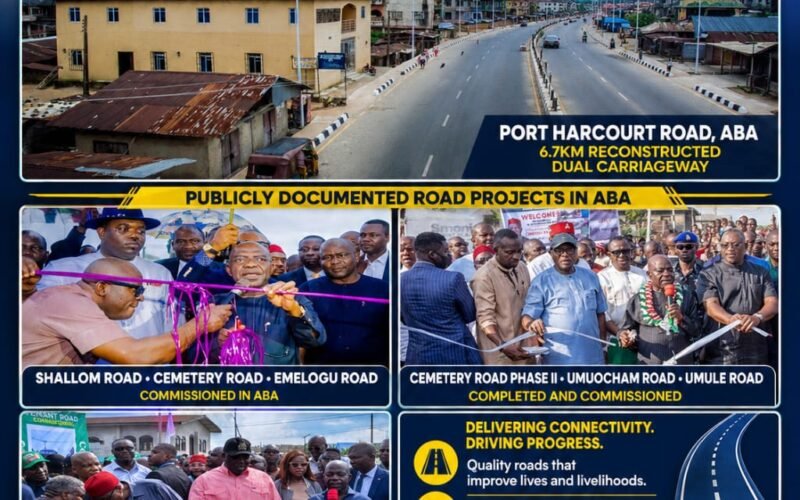
Governor Alex Otti has placed a figure before Abians and before history: 414 completed road projects covering 864.12 kilometres across Abia State in three years, with another 82 roads measuring about 212 kilometres currently under construction. These are not anonymous claims whispered in a beer parlour. They were presented during the May 2026 edition of Governor Alex Otti Speaks to Abians and reported publicly by national media.
For a state that was for years mocked as a graveyard of abandoned roads, failed streets, collapsed drainage systems and suffocating commercial corridors, this is not a casual statistic. It is a political earthquake. It is the sound of an old order losing control of the narrative it once manipulated with ease.
For years, Abians were taught to lower their expectations. A road patched today and washed away tomorrow was celebrated as governance. A project advertised repeatedly without meaningful execution was presented as achievement. In Aba, traders, transporters, manufacturers and ordinary families were left to calculate the cost of bad roads in damaged vehicles, lost business hours, flooded shops, medical emergencies and daily humiliation.
Now, the same state that became a painful reference point for infrastructural neglect is being compelled to confront a new reality: road construction is no longer a campaign chorus; it is becoming a visible, measurable and geographically expanding record.
That is why the noise has become louder.
When a government is doing nothing, serious opponents do not need to sweat. The evidence of failure speaks for them. But when a government begins to produce roads, drains, street lights, restored corridors and fresh confidence in places that once looked abandoned, the opposition faces a painful difficulty: it must either acknowledge progress or manufacture distraction.
In Abia today, many professional social media mourners have chosen distraction.
They wake up angry because another road has been announced. They become restless when photographs of completed projects appear. They treat every commissioning as a personal insult. They have built their political relevance around the belief that Abia must remain broken so that their old talking points can remain alive. Unfortunately for them, roads do not read propaganda posts. Asphalt does not tremble before insults. Drainage systems do not disappear because a bitter commentator has refused to acknowledge them.
A road completed in Aba remains a road completed in Aba, whether a partisan applauds it or abuses it. A reconstructed corridor serving traders, residents, transporters and businesses does not become imaginary because someone, desperate for political relevance, types “audio project” from the comfort of a phone screen.
Let those who doubt go and verify.
Let them travel through the communities where work has taken place. Let them speak to the market women who now move goods with reduced stress. Let them ask commercial drivers what improved access means to fuel consumption, vehicle maintenance and daily earnings. Let them speak to property owners, investors and residents whose neighbourhoods are regaining value because government has finally remembered that access roads are not luxuries; they are economic lifelines.
The argument is no longer whether Governor Otti talks well. The question is whether Abia is physically changing under his watch. On that question, 414 completed road projects and 864.12 kilometres are figures too significant to dismiss with lazy insults.
More importantly, the road programme is not presented as an isolated ribbon-cutting festival. Governor Otti stated that the roads are being delivered with drainage systems and street lights. That matters. Roads without proper drainage quickly become seasonal disappointments. Roads without visibility and urban support infrastructure fail to provide the full economic and security benefit required in growing commercial areas. If the administration continues to enforce quality, maintenance and transparency, the difference between cosmetic governance and durable development will become increasingly obvious.
Consider also the additional 82 road projects currently under construction, estimated at about 212 kilometres. That is where the panic of the political opposition becomes understandable. Their difficulty is not simply that roads have been completed. Their greater fear is that the transformation is still unfolding. They know that each additional completed road reduces the market for recycled anger. They know that people who experience improvement directly are harder to manipulate with online theatrics.
This is why some critics now behave as though every new road is a threat. It is a threat only to those whose politics depends on collective suffering.
A responsible opposition should ask legitimate questions: Were projects procured properly? Are costs reasonable? Are standards being maintained? Are rural communities receiving fair attention? Can the full list of completed roads be publicly published and independently verified? Those are democratic questions, and any serious government should welcome them.
But there is a clear difference between accountability and desperation.
Accountability demands evidence and improvement. Desperation denies everything, mocks everything and hopes that endless social media shouting will prevent citizens from noticing what is before them. Abians are not foolish. They understand the difference between a critic who wants roads to last and a political casualty who does not want roads to exist because their existence exposes years of previous failure.
The new Abia political debate must therefore become more intelligent. Government must continue to make the records accessible: names of roads, locations, lengths, contractors, costs, completion status and quality-assurance information. That is how performance becomes permanently protected from both propaganda and exaggeration. The best answer to political noise is not insult alone; it is documentation placed side by side with roads people can physically use.
But those who spent years presiding over decay or defending those who did should not suddenly pose as the exclusive owners of standards. They had their opportunity. They had public funds. They had time. They had the cries of Aba traders, Umuahia residents and rural communities before them. What did they make of it?
The comparison is now unavoidable. It is not Otti’s supporters who forced the comparison. It is the appearance of roads where excuses used to stand that has forced it.
In the past, Abia’s political discussions were dominated by complaints about what government refused or failed to do. Today, the loudest battle is increasingly about attempts to belittle what has been done. That shift alone tells a story. A state where the argument was once about abandonment is now arguing over the scale and recognition of delivery. That is not perfection. It does not mean every community road has been fixed or every citizen’s expectation has been met. It means the development conversation has moved forward because visible work is compelling everyone, including critics, to respond to a changed reality.
Governor Otti must not be distracted by those who have confused social media aggression with public mandate. He must continue to build. He must continue to extend attention to every Local Government Area. He must ensure that communities still waiting for intervention are brought into the road-renewal map. He must insist on durable quality, fiscal prudence and transparent disclosure. He must understand that the most powerful campaign message in 2027 will not be a slogan; it will be a citizen driving on a road that did not exist or was impassable before his administration.
For the opposition, the message is even simpler: screaming louder will not reverse 864.12 kilometres of road intervention. Insulting photographs will not block completed drainage. Calling everything propaganda will not make commuters deliberately return to potholes in order to satisfy partisan sadness.
The days when Abia could be held hostage by excuses are disappearing.
Performance is confronting propaganda.
Roads are confronting rumours.
Visible governance is confronting online bitterness.
And while the social media merchants of manufactured doubt continue their exhausted arguments, the people of Abia are beginning to see, use and judge a different kind of government: one that understands that development is not what leaders announce alone, but what citizens can touch, travel through and benefit from.
Four hundred and fourteen roads. Eight hundred and sixty-four point one two kilometres. Eighty-two additional roads under construction.
Those are not just numbers. They are a challenge thrown directly at the face of political mediocrity. They are a warning to those who want Abia to forget how badly it was failed. They are evidence that a state once buried under infrastructural embarrassment can rise again when leadership chooses work over noise.
Let the critics continue to type.
Governor Alex Otti continues to build.
Because in the final judgment of history, Abians will not vote by the volume of social media bitterness. They will vote by the roads beneath their feet, the communities connected again, the businesses revived, and the dignity restored to a state that had waited far too long for visible performance.
The roads are speaking. The noise is losing. And New Abia is moving forward.
SOURCES FOR VERIFICATION
PUNCH Newspaper, 23 May 2026:
https://punchng.com/my-govt-built-414-roads-cut-debt-by-60-in-three-years-otti/
Peoples Gazette report shared on its official Facebook platform:
https://www.facebook.com/GazetteNGR/posts/abia-state-governor-alex-otti-says-his-administration-has-completed-414-road-pro/1680296767431715/
Federal Ministry of Information and National Orientation report on Abia’s road development drive:
https://fmino.gov.ng/president-bola-tinubu-set-to-commission-aba-roads-as-otti-unveils-bold-new-development-drive/
Rural Access and Agricultural Marketing Project report on Abia rural road construction:
https://raamp.gov.ng/abia-state-government-flags-off-19-1-km-pilot-road-construction-under-the-rural-access-and-agricultural-marketing-project-raamp/