

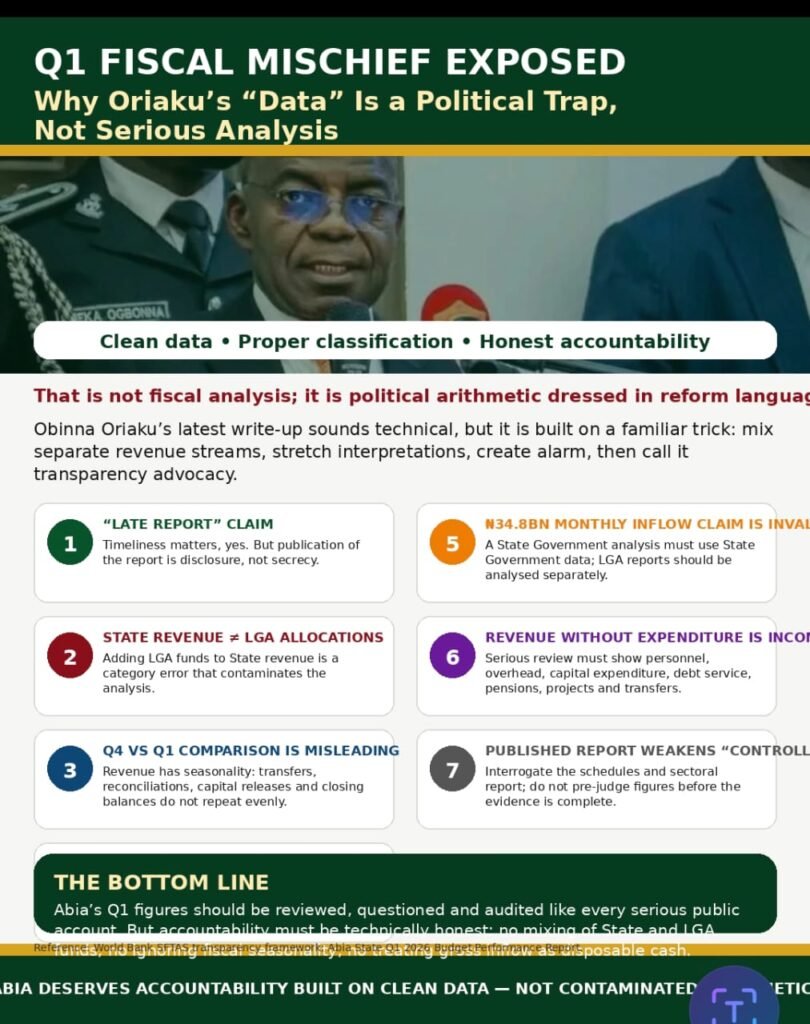
Q1 FISCAL MISCHIEF EXPOSED: WHY ORIAKU’S “DATA” IS A POLITICAL TRAP, NOT SERIOUS ANALYSIS
Obinna Oriaku’s latest write-up sounds technical, but it is built on a familiar trick: mix separate revenue streams, stretch interpretations, create alarm, then call it transparency advocacy. That is not fiscal analysis; it is political arithmetic dressed in reform language.
First, the claim that the Q1 report was “late” must be handled carefully. Under fiscal transparency frameworks, quarterly budget implementation reports are generally expected within a defined post-quarter window, commonly 30 days after the quarter ends. Yes, timeliness matters. But even if a report comes slightly late, the larger fact remains: the report was published. A government hiding its finances does not upload its budget performance report for public scrutiny. Publication itself is evidence of disclosure, not secrecy. The World Bank’s SFTAS framework emphasised online publication of state budgets and quarterly implementation reports as part of transparency reforms.
Second, the biggest deception is the way he combines State Government revenue with Local Government allocations as though they are one purse. They are not. State revenue belongs to the state budget framework. Local Government allocation belongs to the 17 LGAs through the JAAC system and has its own legal and administrative responsibilities. Adding average LGA allocation to state monthly revenue and then presenting it as one “Otti-controlled inflow” is a category error. It is like adding a university’s account to its staff cooperative account and accusing the Vice Chancellor of hoarding both.
Third, comparing Q4 2025 revenue of ₦149bn with Q1 2026 revenue of ₦83bn without explaining fiscal seasonality is misleading. Government revenue is not flat. Q4 often carries year-end movements, transfers, reconciliations, capital releases, closing balances, and accounting adjustments that do not repeat in Q1. Q1 is usually a fresh-cycle quarter, with implementation just beginning after budget approval. So shouting “₦149bn fell to ₦83bn” without explaining timing, opening balances, receipts classification, and expenditure cycle is not insight; it is manipulation.
Fourth, the phrase “peak monthly revenue of ₦60bn” is itself questionable unless the components are cleanly separated. Was it FAAC? IGR? opening balance? capital receipts? other receipts? internal transfer? If those are not separated, then the figure becomes a political weapon, not a financial fact. Serious public finance does not stop at headline totals. It asks: what is recurrent revenue, what is capital receipt, what is opening balance, what is actual cash, what is commitment, what is expenditure, and what is balance?
Fifth, the so-called ₦34.8bn monthly inflow claim is not a valid state-government number because it is created by adding state average revenue to LGA average allocation. That alone contaminates the dataset. If Oriaku wants to analyse the State Government, he should stay with the State Government report. If he wants to analyse LGAs, he should analyse LGA reports separately. Combining them to inflame suspicion is not transparency; it is fiscal mischief.
Sixth, he says his role is not to fabricate or inflame, but the method says otherwise. A neutral analyst would present both revenue and expenditure. He would show what was spent on personnel, overhead, capital expenditure, debt service, pensions, projects, and transfers. He would not stop at “money came in.” In government accounting, revenue without expenditure analysis is incomplete and often misleading.
Seventh, the report being published through the official portal weakens the claim of “controlled narratives.” The proper response to published data is to interrogate the schedules, not manufacture suspicion before the sectoral analysis is even released. If the sectoral report is expected next week, why pre-judge the numbers today? That is not scrutiny; that is preparing propaganda ahead of evidence.
The truth is simple: Abia’s Q1 figures should be reviewed, questioned and audited like every serious public account. But review must be technically honest. You cannot mix state and LGA funds, ignore fiscal seasonality, compare Q4 and Q1 without context, treat gross inflow as disposable cash, and then accuse government of manipulation.
That is not constructive opposition.
That is clever-by-half-accounting.
Abia deserves accountability, yes. But accountability must be built on clean data, not contaminated arithmetic.