

ABIA’S HEALTHCARE STANDARD REVOLUTION: OTTI’S BOLD MARCH FROM LOCAL CARE TO GLOBAL CERTIFICATION
Governor Alex Otti’s drive to secure Joint Commission International (JCI) certification for key public hospitals in Abia State is more than a policy move—it is a declaration that the era of substandard public healthcare must end. This is not about optics; it is about placing Abia’s health system on a global benchmark where quality, safety, and accountability are measurable and verifiable.
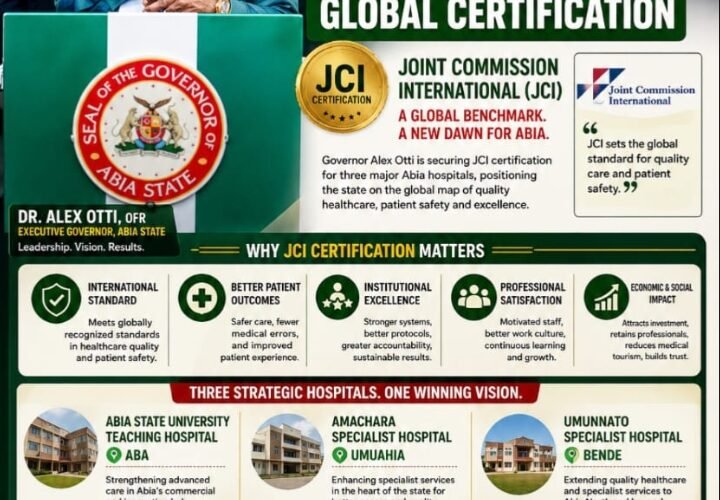
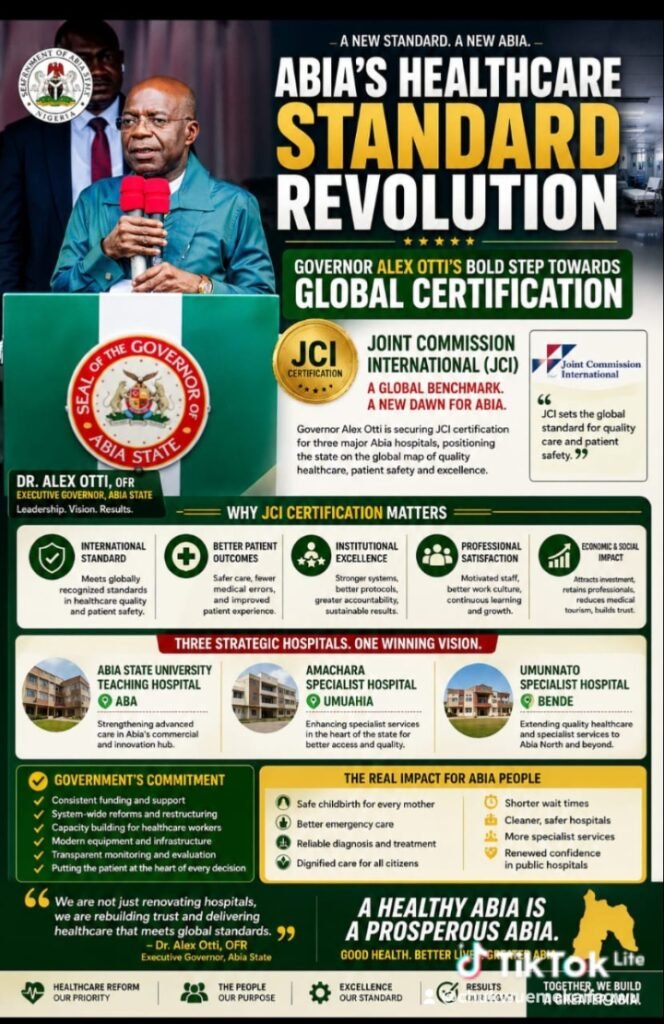
According to reports by Punch Newspapers, the certification effort covers major institutions including Abia State University Teaching Hospital (ABSUTH), Amachara Specialist Hospital, and Umunnato Specialist Hospital—a strategic spread that ensures regional balance and system-wide impact.
This initiative signals a fundamental shift. For decades, public hospitals across many states were judged by physical structures—buildings, wards, and equipment—without equal attention to systems, protocols, and patient safety. JCI certification changes that narrative completely. It requires strict compliance with international standards covering clinical governance, infection control, emergency preparedness, patient rights, medical documentation, and institutional accountability.
In simple terms, this is the difference between having hospitals and running a healthcare system.
JCI remains one of the most respected global accreditation bodies in healthcare, with hospitals across the United States, Europe, Asia, and parts of Africa striving to meet its standards.
By aligning Abia’s hospitals with these standards, the Otti administration is making a bold statement: healthcare in the state will no longer be defined by improvisation, but by structure, discipline, and excellence.
Reports also indicate that international stakeholders have acknowledged the seriousness of Abia’s healthcare reforms, particularly the government’s commitment to funding and institutional restructuring.
This matters because healthcare transformation is not sustained by announcements—it is sustained by consistent investment, leadership discipline, and system-wide reform.
Beyond the technical details, the real impact of this move lies in what it means for ordinary citizens. It means a pregnant woman in Umuahia can expect safer delivery conditions. It means a trader in Aba can access more reliable emergency care. It means a child in Abia North can receive treatment in a facility that meets internationally recognized safety standards.
It also has broader economic implications. A healthcare system that meets global standards attracts professionals, reduces outbound medical tourism, and restores confidence in public institutions. It signals to investors that the state is serious about human capital development.
Critics may reduce this to “another announcement,” but that misses the substance. You do not pursue JCI certification for headlines—you pursue it because you are ready to subject your system to independent global scrutiny.
That is the difference.
Governor Otti’s healthcare reform is not merely about fixing what is broken; it is about redefining what is possible. It is about moving Abia from a culture of maintenance to a culture of excellence.
The message is clear:
A hospital can be built with concrete, but a healthcare system is built with standards.
And with this push for global certification, Abia is choosing standards.