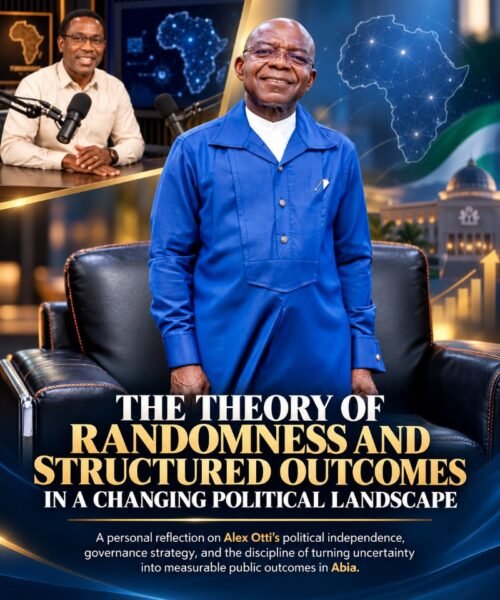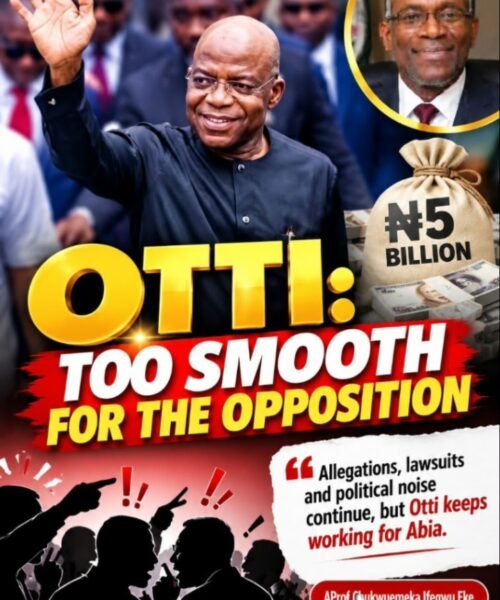


Reframing the Salary Narrative: A Government Perspective Rooted in Political Economy
The argument that salary payments in Abia State are being exaggerated as an achievement rests on a fundamental misunderstanding of governance, public finance, and institutional economics. It reduces a complex fiscal and administrative reform process into a simplistic arithmetic exercise—revenue minus salaries equals surplus. This is not only intellectually inadequate; it is philosophically flawed. Governance is not bookkeeping. It is the management of competing obligations under conditions of scarcity, institutional weakness, and inherited distortions.
From the standpoint of political economy, salary payment is not merely a line item—it is the foundation of state legitimacy. The social contract tradition—from Thomas Hobbes to John Locke—makes it clear that the authority of the state depends on its ability to fulfill basic obligations to its citizens. In modern governance, one of the most fundamental of these obligations is the timely payment of workers who sustain public institutions. When salaries are unpaid, the state weakens itself, encourages informal corruption, and erodes trust. Restoring regular salary payment, therefore, is not propaganda—it is a restoration of the social contract.
🔗 https://www.worldbank.org/en/topic/governance�
The claim that salaries constitute less than 10% of revenue and therefore should not be celebrated ignores a key principle in economics: the difference between gross revenue and fiscal space. Public finance theory makes it clear that government revenue is not free money available for discretionary spending. It is already encumbered by debt obligations, statutory transfers, capital commitments, and institutional expenditures. What is presented as “₦1 trillion remaining” is not idle surplus—it is structured and allocated across multiple competing needs. Treating it as free cash reflects a misunderstanding of how governments function.
🔗 https://www.imf.org/en/Publications/fandd/issues/Series/Back-to-Basics�
Furthermore, comparing personnel costs across administrations without analyzing the structure of the payroll is methodologically weak. Economics teaches us that aggregates can conceal structural change. A similar wage bill can exist alongside major reforms such as elimination of ghost workers, salary adjustments, pension integration, and targeted recruitment in key sectors like health and education. These are not cosmetic changes; they represent a shift toward a more efficient and accountable system. Public sector reform globally emphasizes not just cost reduction, but efficiency and integrity of spending.
🔗 https://www.oecd.org/gov/public-sector-modernisation/�
The issue of workforce restructuring must also be understood within the philosophy of institutional reform. Max Weber’s theory of bureaucracy emphasizes systems built on rules, verification, and rational organization—not patronage. Where irregular employment exists, reform requires verification and correction. This is not punitive; it is necessary for institutional survival. No state can build sustainable development on a distorted payroll system.
The critique also suffers from a narrow understanding of development. It assumes that unless there are brand-new mega projects, public funds have not been utilized effectively. This is a flawed view. Development economics teaches that the first phase of reform, especially in previously weakened systems, is often restorative rather than expansionary. Fixing roads, restoring electricity, stabilizing institutions, clearing arrears, and rebuilding governance systems are all forms of development. These are the foundations upon which larger transformations are built.
On the issue of Local Government funds, the argument again collapses under constitutional scrutiny. Nigeria operates a federal system where Local Governments are distinct fiscal entities receiving allocations from the Federation Account. While debates exist about their autonomy, it is analytically incorrect to treat their funds as if they are entirely controlled by the state government.
🔗 https://www.budgetoffice.gov.ng�
*Finally, the expectation of immediate economic transformation ignores a core principle of macroeconomics: time lag. Policy reforms, infrastructure investments, and fiscal restructuring take time before they translate into improved living conditions. Keynesian economics and modern development theory both emphasize that there is always a delay between policy action and observable economic impact.
🔗 https://www.worldbank.org/en/research�
What is therefore presented as a simple question—“what happened to the money?”—is, in reality, a complex issue requiring a nuanced understanding of governance. The narrative being pushed is not accountability; it is selective simplification. It ignores institutional reform, fiscal constraints, structural changes, and the time required for transformation.
In conclusion, salary payment in Abia should not be trivialized. It represents the restoration of fiscal discipline, institutional credibility, and the social contract between government and citizens. The real debate should not be reduced to arithmetic. It should be elevated to questions of sustainability, structural reform, and long-term development outcomes.
“Good governance is not loud arithmetic—it is disciplined structure, gradual reform, and verifiable progress
AProf Chukwuemeka Ifegwu Eke