

HAS GOVERNOR OTTI IMPROVED ABIA’S ECONOMY?
A Facts-First Reply to the “Indices” Argument — With Verifiable Numbers and Links
By AProf. Chukwuemeka Ifegwu Eke
Abia’s economic debate has been hijacked by a familiar trick: shout “indices” but refuse to use verifiable datasets; quote “trillions” but hide the baseline; demand “proof” while ignoring publicly available evidence. If we must interrogate performance, then we must do it the way serious fiscal and development systems do it: with measurable indicators, time context, and traceable sources—not vibes.
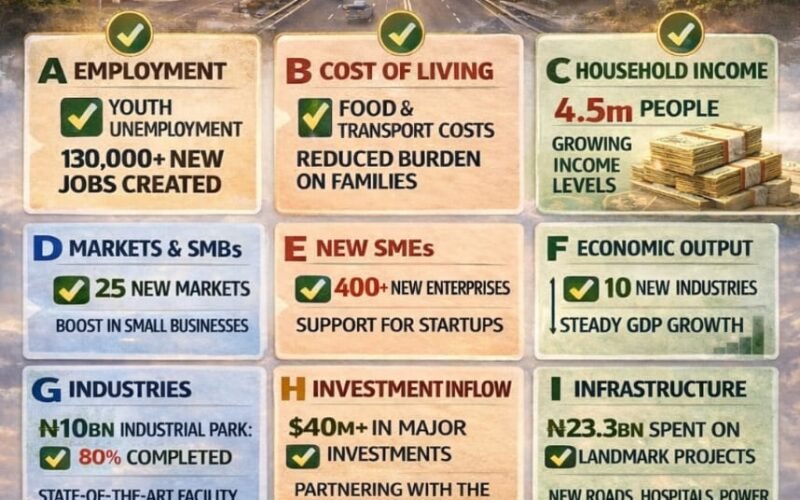
What follows is a robust, evidence-anchored response to the eight main claims in the circulating critique (unemployment, cost of living, income, SME growth, GDP/output, investment, industries, and “no landmark infrastructure”). I will show where the critic’s claims are unverifiable or methodologically weak, and where verifiable outcomes exist—especially those already independently reported.
1) UNEMPLOYMENT:
“Highest in Nigeria” is a claim—where is the dataset?
The statement “youth unemployment is the highest in Nigeria at over 18%” is presented as fact, but the critic does not cite a verifiable statistical source or the measurement year. In Nigeria, unemployment reporting has had methodology resets, and credible claims must be traceable to official statistical releases (NBS) or comparable international datasets.
What is verifiable is that Nigeria’s macro environment has been under intense cost and FX pressures, and monetary policy has remained tight; even Reuters notes inflation disinflation trends and the CBN’s restrictive stance—context that affects jobs nationally, not only Abia. �
Reuters +1
What Abia can verifiably point to as job-enabling fundamentals (not job slogans):
Aba Integrated Power / Geometric is operating within the Aba ringfence and is structurally job-enabling for manufacturing and SMEs. It has installed capacity (188MW plant) and the system has been reported as ready to generate up to 141MW (with the ringfence needing ~90MW). This is not a skit; it is industrial electricity with measurable MW data in national press. �
Punch Newspapers +2
A government that restores industrial power is not “failing the labour-market test” by default; it is laying the single biggest productivity input for Aba’s private sector.
2) COST OF LIVING:
You can’t blame Abia for Nigeria’s inflation curve
Cost-of-living pain is real—but it is primarily driven by national inflation, FX pass-through, fuel/transport costs, and food supply dynamics. The correct test is whether Abia is moving in the right direction within national constraints.
Verifiable inflation context: Nigeria’s headline inflation (rebased CPI series) fell to 15.15% in Dec 2025 and 15.10% in Jan 2026, according to reports citing NBS CPI releases. �
So, when critics ask, “Are food and transport cheaper?”—the honest answer is: national disinflation is easing pressures gradually, but household strain remains.
Vanguard News +1
What Abia can credibly argue is that transport interventions and service systems are not “magic wands,” but part of mitigating costs—especially when paired with productivity inputs like power and road rehabilitation.
3) HOUSEHOLD INCOME:
Salary/pension stability is not “nothing”—it is economic circulation
Calling salary “nothing” is fiscal illiteracy dressed as activism. Wages and pensions are the main engine of household consumption in a civil-service-heavy state economy.
And the critic’s attempt to dismiss wage adjustments while presenting “₦1.6 trillion earned” is analytically dishonest because it mixes tiers (State vs LG vs Federal) and ignores recurrent obligations as a lawful first charge.
This is precisely why global fiscal standards insist on classification and transparency disciplines (IMF/World Bank PFM frameworks). �
The Nation Newspaper +1
If Abia under Otti is stabilizing payroll and rebuilding service delivery systems, that is economic impact—even before big new factories come fully online.
4) SME GROWTH:
Aba electricity is an SME policy—not a press statement
The critique says, “No evidence of booming SMEs.” But the most measurable SME enabler is reliable power, and that is exactly what the Aba ringfence power project targets.
National press reports confirm:
the plant’s scale (188MW)
the operational generation readiness (141MW)
the ringfence industrial focus and the customer base effects. �
Punch Newspapers +2
Aba’s SME ecosystem—manufacturing clusters, leather/shoe lines, garment production—responds directly to power stability. This is not theoretical.
5) GDP/OUTPUT:
Critics shout “GDP unknown” while ignoring the real output lever
The critic mocks “GDP research.” But modern governments use data systems, mapping, surveys, and productivity baselines to plan investment and sector targeting. The correct question is not “why measure?” but whether the measurement is defensible, cost-effective, and transparent.
And the larger output lever—again—is energy + industrial infrastructure. Aba power is a measurable output driver. �
Punch Newspapers +1
6) INVESTMENT INFLOW:
industrial park + refinery approvals are investment pipeline signals
The critique insists there is “no visible pipeline.” That is false as a statement of record.
Credible business press and national outlets report that Abia’s Industrial Innovation Park (AIIP) is being positioned for industrial scale projects, including:
FG approval for a modular refinery inside the AIIP, reported by BusinessDay. �
Businessday NG
Additional reporting that Abia planned commencement of a 10,000-barrel/day modular refinery at the AIIP site. �
The Nation Newspaper
Government-linked activity indicators: site preparation and related road infrastructure flagged-off linked to the industrial corridor. �
Businessday NG
Investment attraction is not only “factory ribbon-cutting.” It includes approvals, site preparation, corridor roads, and enabling infrastructure—and those are documented.
7) INDUSTRIES:
The critic’s “forest” line ignores what’s publicly reported
If someone claims the industrial park is “a forest,” the adult response is: show the evidence of stasis against documented activity and approvals. BusinessDay reports the AIIP as an active policy platform linked to new industrial plans and corridor works. �
Businessday NG
Also, Aba’s biggest industrial enabler—power—is not an abstract promise; it is operating infrastructure reported in national outlets. �
Punch Newspapers +1
8) “NO LANDMARK INFRASTRUCTURE”:
Measurable power restoration and industrial energy contradict this
A “landmark” is not only a flyover with a selfie angle. Industrial power is a landmark. So is the restoration of electricity to previously dark communities.
Independent outlets reported electricity restoration to 33 communities after years of outage. �
Business Hilights +1
And Aba’s ringfence power is repeatedly described as one of the biggest private investments in the South-East and a major industrial platform. �
Punch Newspapers +2
THE BIG TAKEAWAY: the critic’s “indices” argument collapses on verification
A serious economic critique must provide verifiable sources for each claim: unemployment rate and year, state-level methodology, GDP/output metrics, SME registration statistics, investment inflow numbers, and cost structure. Instead, the circulating critique mostly offers:
assertions without datasets, and
macro pain blamed entirely on a subnational government, and
dismissal of reforms that don’t produce instant optics.
Meanwhile, Abia under Otti can point to verifiable, independently reported outputs:
Aba integrated power scale and MW capability �
Punch Newspapers +1
power restoration reports in Abia communities �
Business Hilights +1
documented industrial park policy pipeline and modular refinery approvals �
Businessday NG +1
macroeconomic context (disinflation trend, tight monetary stance) that frames living-cost realities nationally �
Reuters +1
That is what “improving the economy” looks like in real governance terms: enabling productivity, stabilizing systems, and building industrial platforms—not only chasing applause.