

“The Pride of the Party”: At 61, Otti’s Reform Agenda Reshaping Abia
When Nenadi Usman described Governor Alex Otti as “the pride of the party,” she captured more than partisan admiration. At 61, Otti’s leadership has become a focal point of reform politics in Abia—where governance is measured not only by projects delivered, but by systems rebuilt, arrears cleared, and trust restored after decades of institutional fatigue.
A defining pillar of this reform arc is the Abia Senior Citizens Welfare Law, which institutionalizes monthly stipends, free medical access, and structured social protection for residents aged 60 and above. In a region where elder welfare has long depended on family capacity rather than state policy, this law signals a shift from charity to entitlement—placing dignity within the architecture of governance rather than political benevolence. It reflects a broader doctrine visible across Otti’s tenure: welfare embedded in law, not announcements.
Equally consequential is the administration’s effort to clear legacy salary arrears dating back to 1999 for former local government councillors—debts accumulated across multiple administrations. The decision to settle these obligations reframes governance continuity: the state, not individuals, carries moral liability for institutional promises. In political economy terms, arrears clearance is more than fiscal housekeeping; it is credibility restoration, repairing the social contract between Abia’s government and its workforce.
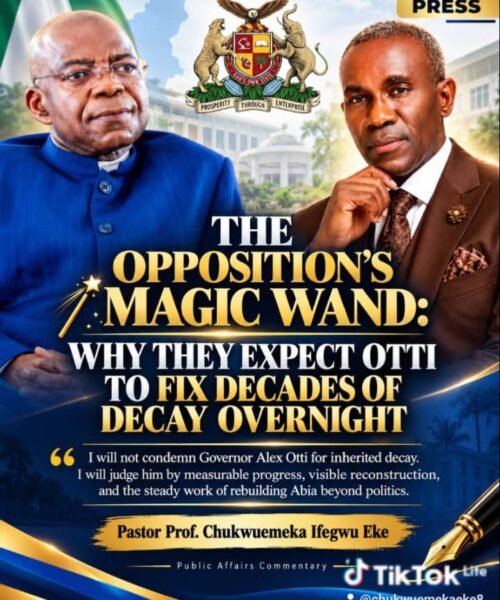
Contestation has accompanied reform. The debate around AI-generated visuals used in communicating infrastructure progress reflects a deeper tension between perception and verification in modern governance. Critics question representation; supporters point to visible roadworks, public building rehabilitation, and urban renewal, especially in Aba and Umuahia. Yet beneath the media discourse lies a structural reality: Otti’s administration has prioritized systems—digital governance networks, city modernization frameworks, and energy autonomy planning—alongside physical projects. Reform in Abia is therefore unfolding in both concrete and code.
Politically, Otti’s engagements across party lines—including consultations with figures such as Orji Uzor Kalu—signal a pragmatic governance style oriented toward coalition rather than isolation. In Nigeria’s federal context, subnational transformation often requires intergovernmental alignment; Abia’s repositioning within national political circuits is thus less maneuvering than strategy.
Nenadi Usman’s phrase endures because it resonates beyond party rhetoric. At 61, Otti’s tenure illustrates a leadership model defined by reform persistence under scrutiny. Welfare institutionalized. Arrears acknowledged. Systems digitized. Infrastructure contested yet advancing. In Abia’s evolving governance story, pride is not claimed—it is argued, measured, and daily tested in the burden of proof.
AProf Chukwuemeka Ifegwu Eke