
WHEN ACCOUNTABILITY MEETS COURTROOMS: THE ALEX OTTI DEFAMATION SUIT AND THE HEALTH OF ABIA POLITICAL DISCOURSE
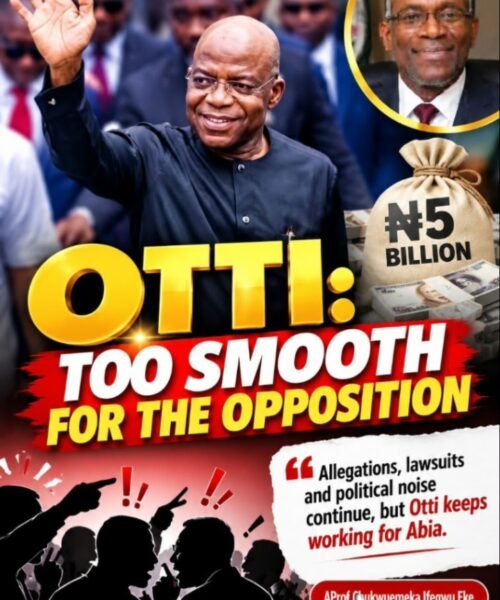
Abia State may be in the midst of an unprecedented political transformation, but its public discourse is also facing a test: whether vigorous debate about governance can coexist with civility and evidence-based scrutiny. The recent interlocutory injunction granted by a Federal Capital Territory High Court restraining a former Abia Commissioner of Information, Barr. Eze Chikamnayo, from publishing defamatory content against Governor Alex Chioma Otti is not merely a legal skirmish. It is a mirror reflecting the broader struggle between accountability and abuse, fact and fiction, and governance performance versus personal attack.
On December 18, 2025, the FCT High Court, presided over by Justice J.E. Obanor, granted an interlocutory order in favour of Governor Otti, restraining Chikamnayo “from writing, authoring, sharing, circulating, broadcasting, voicing, forwarding and/or syndicating the writing and publication of contents defamatory of the Claimant” on Facebook and other platforms pending the substantive suit (The Whistler, Dec 18, 2025). The order stemmed from posts that allegedly portrayed the governor in a series of injurious and unfounded terms, including labels such as “thief” and “criminal.”
Legal experts have noted that defamation suits of this nature are not unique to Nigeria. Democracies around the world provide elected officials the right to seek redress when public assertions cross into willful falsehood and reputational harm. In the United Kingdom, for example, defamation actions rest on proving that false statements have caused or are likely to cause serious harm to reputation. Courts routinely grant injunctions and damages where publications continue after notice of legal action. The principles are not alien to Nigerian law either, where defamation is actionable under both criminal and civil statutes.
Governor Otti’s legal team, led by Senior Advocate Dr. Sonny Ajala, argued that continued publication of offensive materials after service of court papers violated the doctrine of sub judice, a rule that forbids acts or statements capable of prejudicing the outcome of a matter pending before a court (The Whistler, Dec 18, 2025). Chikamnayo’s alleged posts, according to court filings, persisted even after being served with originating processes—a factor that weighed heavily in the court’s decision.
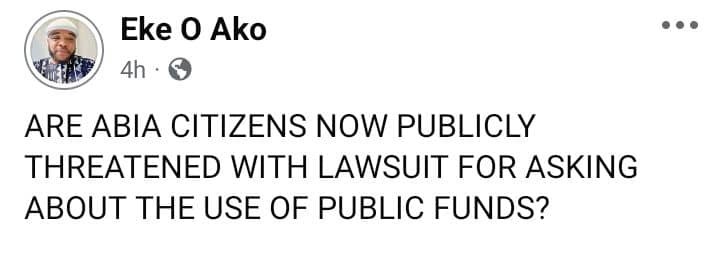
Some political commentators have framed the suit as an attempt to silence dissent. That interpretation, however, conflates defamation—a legal mechanism to protect reputation—with legitimate accountability. There is a clear distinction between questioning policy, budget execution, project sites, and governance outcomes on the one hand, and spreading persistent, unverified personal attacks on the other. The latter undermines trust, corrodes debate, and, if left unchecked, chills constructive engagement.
Public servants, including Governors, are not immune to criticism. But in the era of social media, where narratives can be weaponised in seconds to millions of followers, the law becomes necessary to prevent the degeneration of public debate into mob rhetoric. The law on defamation exists to balance freedom of expression with the protection of individual dignity and reputation—an equilibrium recognised in Nigeria’s Constitution and upheld in democracies worldwide.
It is important to situate this case within the broader context of Governor Otti’s record on transparency and governance. Unlike the past, where public funds and policy decisions often unfolded with limited documentation, the Otti administration has progressively opened fiscal data, published budget performance reports, and engaged independent monitors. BudgIT, a leading civic finance organisation, has noted improved budget publication and transparency in Abia’s financial reporting since 2023 (BudgIT Open States Portal: https://yourbudgit.com).
Moreover, citizen demands for accountability—whether about the recovery of Star Paper Mill, the execution of education or health projects, or the performance of major infrastructure initiatives—are not being ignored. What the defamation suit does is draw a clear line between institutional critique grounded in data and audit trails, and personal vilification that lacks factual support.
The governor’s legal action, seeking damages and injunctive relief, also demands an unreserved public apology to be published in both digital and traditional media outlets, including ThisDay and The Punch, if the substantive suit succeeds. This is standard practice in defamation litigation internationally and serves both to vindicate reputation and to set norms for responsible public discourse.
The backdrop to all of this is Nigeria’s ongoing struggle to balance robust political engagement with respect for the rule of law. As Reuters has observed, Nigeria’s vibrant social media landscape often amplifies both fact and fiction, making it ever more important for public figures and citizens alike to root assertions in verifiable evidence (Reuters, Nigeria social media and misinformation: https://www.reuters.com/technology/social-media-misinformation-nigeria).
At the same time, the wider public should not misconstrue legal protection of reputation as intolerance to criticism. Investigative reporting, policy analysis, and evidence-based public debate are all indispensable in a healthy democracy. The difference lies in whether critique is attached to documents, procurement records, project site verifications, budget performance reports, and published audit outcomes, rather than unsubstantiated personal attacks.
History will judge this moment not by the existence of a lawsuit, but by what it teaches Abians about the maturity of their public discourse. Mature democracies safeguard both freedom of speech and protection from defamatory falsehoods. That dual protection does not weaken accountability; it strengthens it by shifting debates from emotionally charged sloganeering to evidence-based engagement—exactly what Abia’s development journey demands.
In the end, the question is not whether governors can be criticised—of course they can and should be—but whether that criticism will be grounded in data, documented outcomes, and verifiable facts, not in derisive assertions that obscure the real challenges confronting the state.
Public funds deserve public answers—backed by evidence, not by defamation.
AProf Chukwuemeka Ifegwu Eke