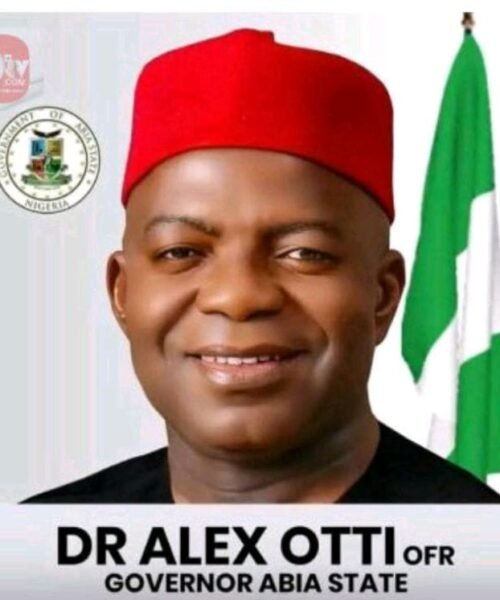


SUCCESSION, NOT ELECTIONS: THE HIDDEN BATTLE THAT WILL DECIDE ABIA’S 25-YEAR DEVELOPMENT FUTURE

For all the noise that dominates Nigerian politics, history shows that long-term development is rarely defeated by opposition parties or public criticism. It is defeated by something quieter and more lethal: succession failure. As Abia State sketches a 25-year development horizon under Governor Alex Otti, the most consequential question is not who wins the next election, but who governs after him—and whether governance survives beyond personalities.
This is not speculation. It is a pattern well documented across successful and failed reform states worldwide.
THE FIRST PHASE (2023–2031): THE REFORM FOUNDER AND THE IRREVERSIBILITY TEST
Governor Alex Otti’s tenure fits what political economists describe as the foundational reform window. This is the period when broken institutions are stabilised, credibility is restored, and the rules of governance begin to change. According to the World Bank’s World Development Report 2017: Governance and the Law, reforms succeed when early leaders create “credible commitment mechanisms” that make reversal costly.
https://www.worldbank.org/en/publication/wdr2017
This is precisely why Otti’s emphasis on fiscal transparency, asset recovery, de-risking moribund industries, and sustained investment in health matters. These actions are not ends in themselves; they are signals. As Why Nations Fail by Daron Acemoglu and James Robinson explains, development begins when governments move from extractive to inclusive institutions—where rules outlive rulers.
https://whynationsfail.com/
But this phase only sets direction. It does not guarantee arrival.
THE SECOND PHASE (2031–2039): WHERE MOST NIGERIAN REFORMS DIE
The most dangerous period in any reform cycle is not the first government—it is the second. Comparative evidence shows that successor leaders often dismantle reforms to establish political dominance. Nigeria’s own history is littered with examples, from post-Obasanjo reversals at the federal level to abandoned state-level master plans.
Vietnam avoided this trap after its Đổi Mới reforms not by electing charismatic successors, but by institutionalising policy continuity. As documented by the Asian Development Bank, Vietnam’s provincial reforms succeeded because successors were bound by performance metrics and party discipline, not personal ambition.
https://www.adb.org/publications/viet-nam-economic-reforms
Rwanda followed a similar path. The country’s long-term Vision 2020 and Vision 2050 frameworks survived leadership transitions because governance was anchored in delivery benchmarks rather than political theatre, according to the OECD’s States of Fragility reports.
https://www.oecd.org/dac/conflict-fragility-resilience/
Abia’s 2031–2039 governor will therefore matter more than the current one. If that successor treats governance as a personal project instead of a collective trajectory, the 25-year plan collapses permanently.
THE THIRD PHASE (2039–2047): WHEN DEVELOPMENT BECOMES SELF-REINFORCING
By the third phase, outcomes become visible—or irreversibly lost. This is when industrial clusters mature, private capital dominates job creation, and public investment shifts from emergency repair to productivity enhancement.
Ha-Joon Chang’s Kicking Away the Ladder demonstrates that late-industrialising economies only accelerate growth once institutional reforms are protected across multiple leadership cycles.
https://anthempress.com/kicking-away-the-ladder
Vietnam’s fastest growth did not occur immediately after reform; it came decades later, once successors stopped debating reform and focused on scaling it. The same pattern is observed in Malaysia and South Korea, where long-term plans survived leadership changes because institutions—not personalities—held the centre.
https://www.brookings.edu/articles/the-east-asian-development-model/
For Abia, this phase depends entirely on whether the second-phase governor preserved the reform architecture.
THE FINAL TEST (2047 AND BEYOND): CAN THE SYSTEM SURVIVE A MEDIOCRE LEADER?
The ultimate proof of development is not excellence—it is resilience. As Douglass North argued in Institutions, Institutional Change and Economic Performance, successful societies are those where rules constrain even bad leaders from destroying value.
https://www.cambridge.org/core/books/institutions-institutional-change-and-economic-performance/
If Abia’s institutions can survive a weak or average governor without collapsing into rent-seeking, then the project has succeeded. If not, the plan was never institutional—it was cosmetic.
This is why the World Bank increasingly frames development as a governance problem, not a funding problem. Countries fail not because they lack plans, but because they cannot protect them across leadership transitions.
https://www.worldbank.org/en/topic/governance
THE REAL ENEMY IS NOT OPPOSITION—IT IS SUCCESSION BETRAYAL
Across Africa, reformist governments fail not because critics are loud, but because successors dismantle systems to reward supporters. Ghana’s stalled industrialisation plans, Kenya’s abandoned Vision 2030 projects, and Nigeria’s countless unfinished master plans all trace back to leadership discontinuity, as documented by the African Development Bank.
https://www.afdb.org/en/documents
Abia’s challenge is therefore brutally simple and politically uncomfortable: how to make it irrational—not just immoral—for future governors to abandon the development path.
Vietnam answered this through party discipline. Rwanda answered it through performance legitimacy. Abia must answer it through institutional lock-in: fiscal rules, independent civil service norms, protected investment frameworks, and public accountability systems that punish regression.
THE BOTTOM LINE
Abia’s future will not be decided in the next election cycle. It will be decided by whether the governors of 2031, 2039, and 2047 treat development as a collective inheritance or a personal interruption.
History is unforgiving on this point. Development is not announced. It is defended—again and again—against the ambitions of those who come after.
And that is the real battle Abia must now prepare for.
AProf Chukwuemeka Ifegwu Eke