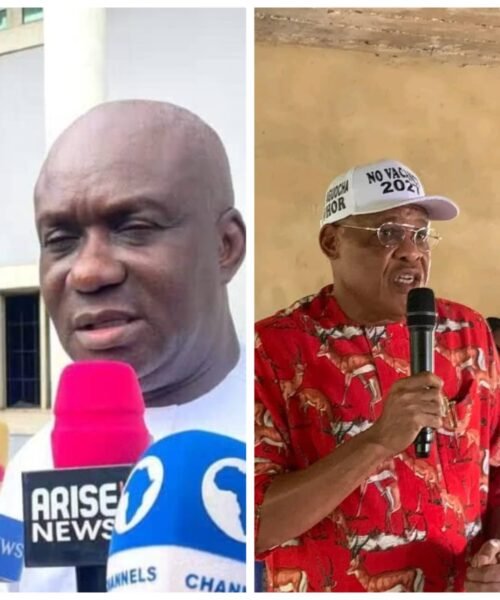


A Daniel Has Come to Judgment: Schooling Obinna Oriaku on Public Finance, Transparency and Intellectual Honesty
It is curious — almost tragicomic — that the same man who supervised Abia’s finances between 2015–2019 without publishing a single Quarterly Budget Implementation Report now seeks to interrogate Q2 and Q3 2025 documents with the zeal of a philosopher-king. But as Shakespeare warned in Measure for Measure, “Some rise by sin, and some by virtue fall.” In this debate, however, the irony is reversed: he who fell by opacity now pretends to rise by feigned transparency.
Before we engage his questions, the stage must be reset with facts — inconvenient, stubborn facts documented in the same public records he refuses to acknowledge.
The First Lesson: He Who Comes to Equity Must Come With Clean Hands
The Chief Press Secretary was correct to remind him of a basic jurisprudential principle: a man who failed to publish even one quarterly report cannot now claim the moral height to question published figures. Between 2015 and 2019, Abia never had a publicly accessible budget implementation report. Not one. This is verifiable through the Open Government Portal and the BudgIT State of States Reports, all of which catalogued Abia under Oriaku’s tenure as operating with “limited transparency” and “no published quarterly breakdown” (Source: BudgIT, State of States 2018, https://yourbudgit.com/stateofstates/).
Meanwhile, the Otti administration has published Q1, Q2 and Q3 2025 with revenue, expenditure, sector allocations, and financing details posted openly on the Abia State website (Source: Abia Open Treasury Portal, https://abiastate.gov.ng/public-finance). This alone invalidates Oriaku’s pretense to superior accounting.
Second Lesson: Understanding “Budget vs Actuals” Is Public Finance 101
In Shakespeare’s Julius Caesar, Brutus complained that “the eye sees not itself but by reflection.” Oriaku’s latest question—“What is the N14.4bn for Lands & Housing? What is the N9.1bn Transport?”—reveals not curiosity but a reflection of his own limitations.
He knows, or should know, that a budget line is not an expenditure receipt. Lands & Housing covers statutory compensation, site clearing, litigated judgments, Right-of-Way payouts, urban renewal support components and resettlement obligations tied to major roads. Many of these are inherited liabilities.
Transport includes: upfront design obligations, mobilisation fees, consultancy costs, counterpart funding for mass transit, traffic management upgrades, and ongoing contractual commitments. These are documented in the 2025 Q2 Budget Implementation Report, page 17–21 (https://abiastate.gov.ng/budget2025/Q2report.pdf). Asking “What is N9.1bn?” is the kind of question an undergraduate asks before he learns the difference between economic classification and functional classification.
Third Lesson: Actual Cash Flow Already Debunks His Figures
Oriaku continues to peddle the false claim that Abia “received only ₦122.78bn from January to August,” ignoring that the state Q2 report already shows ₦174.88bn revenue by June 30 (FAAC ₦147.44bn, IGR ₦27.44bn). This is publicly available at: https://abiastate.gov.ng/budget2025/Q2report.pdf
If revenue by June was already ₦174.88bn, how can January–August be ₦122.78bn? Arithmetic is not advanced mathematics; the inconsistency exposes his intellectual bad faith. Like Shakespeare’s Shylock, he insists on a “pound of flesh,” even when the measure no longer fits the facts.

Fourth Lesson: Project Financing ≠ Monthly Income
He feigns ignorance about loans, asking why Abia can fund projects when “inflow is small.” Yet the budget clearly states that Capital Development Fund Receipts — which include AfDB/IsDB-supported infrastructure financing — are part of the 2025 fiscal framework. The AfDB’s approved facility of $115m is a project-tied disbursement (Source: AfDB Country Office Nigeria: https://www.afdb.org/en/projects-and-operations). It does not appear as “monthly receipts.” Faking confusion here is either incompetence or mischief.
Fifth Lesson: Transparency Is a Mirror — and Some Cannot Look Into It
His sudden obsession with Q2 and Q3 reports is not scrutiny; it is nostalgia for an era where numbers were kept in the dark and accountants whispered in corners. Shakespeare again instructs us:
“There is no darkness but ignorance.” — Twelfth Night
For the first time in Abia’s history, quarterly reports are public, and he cannot cope with the light. The era where budgets were written on paper but executed in secrecy is gone.
Final Lesson: A Man Cannot Teach What He Never Practiced
How can a former finance commissioner who never published a single quarterly report lecture a government that has published three in one year?
How can a man who presided over the FAAC era of ₦1.8–₂.2bn monthly criticise a government delivering measurable infrastructure with ₦15–₲22bn monthly?
How can a man who left salary arrears, unpaid pensions, and abandoned projects claim expertise over a government that has cleared wage liabilities, restored pensions, funded Julius Berger projects, and revived public finance credibility?
Even Shakespeare would shake his head.
In King Lear, he wrote:
“Nothing will come of nothing.”
And that is exactly why the public places no weight on Oriaku’s arguments: you cannot build credibility on a foundation you never laid.