

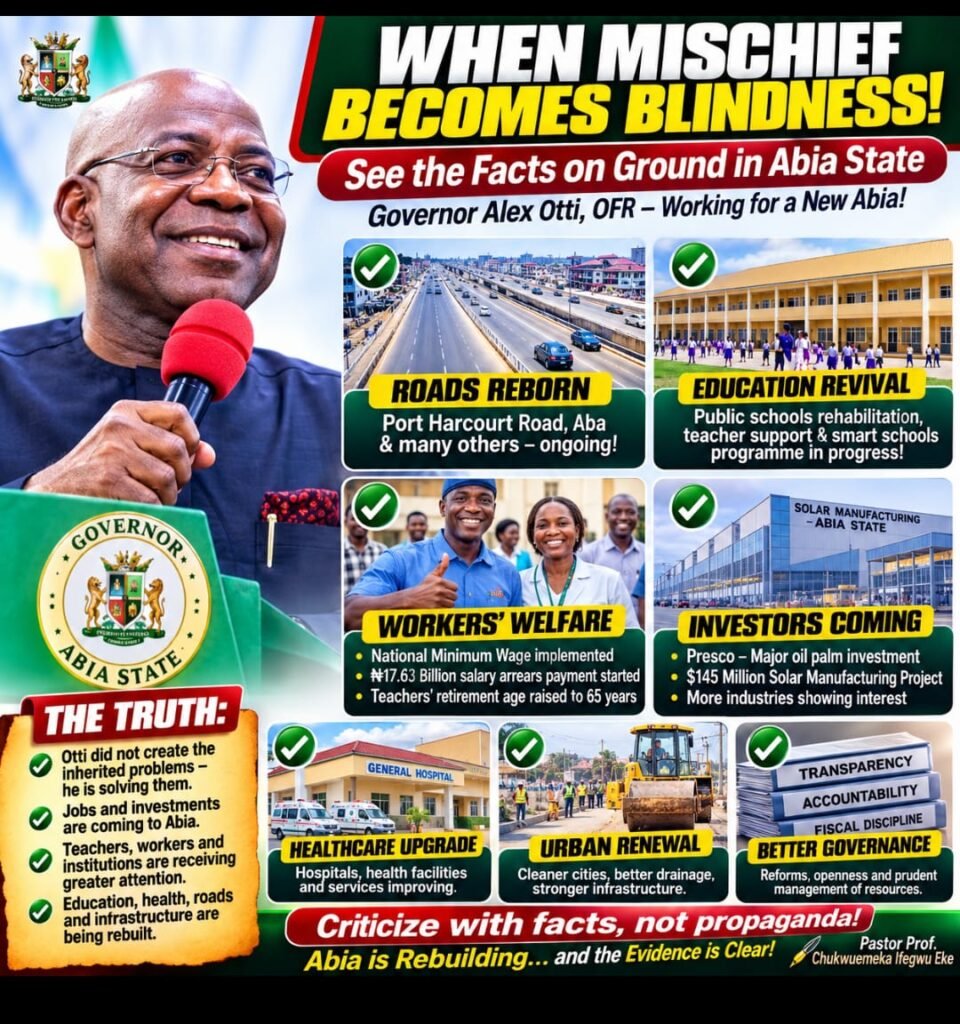
WHEN MISCHIEF BECOMES BLINDNESS: A SHORT LECTURE ON GOVERNOR ALEX OTTI’S GOOD WORKS
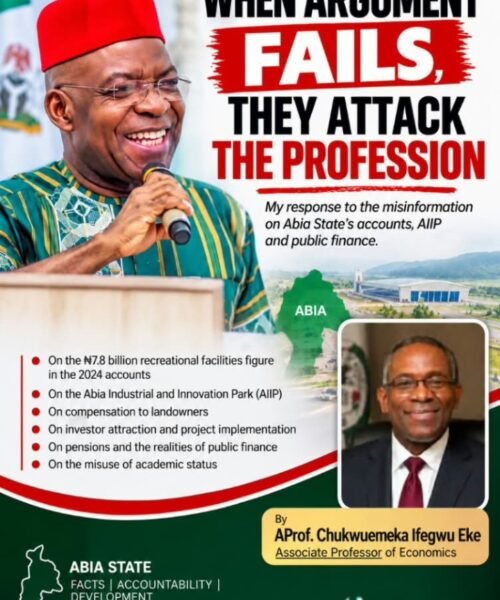
By Pastor Prof. Chukwuemeka Ifegwu Eke
Friday Solomon’s post is not a serious assessment of governance. It is a mixture of poor information, unsupported accusations and deliberate refusal to acknowledge the visible transformation taking place across Abia State.
Criticism is legitimate, but criticism must be based on facts.
1. “THEY CAME ONLY TO BLAME OKEZIE”
Governor Alex Otti did not create the salary and pension arrears inherited by his administration. However, instead of merely complaining, his government has committed billions of naira to clearing inherited salary and pension obligations.
The administration commenced the payment of about ₦17.63 billion in salary arrears owed to workers of Abia State University, Abia State Polytechnic, ASCETA, ABSUTH, the Health Management Board and other state institutions.
Is paying debts accumulated by previous governments “blaming Okezie,” or cleaning up the consequences of failed governance?
2. “THEY CAME TO BUILD THEIR OWN BUSINESSES”
This accusation is empty unless the writer can identify the alleged businesses, their owners, registration documents, government contracts and evidence of unlawful enrichment.
Responsible public commentary is based on evidence—not roadside gossip.
What is publicly documented is that Abia State is attracting serious private investment.
Presco announced a major investment in oil-palm development and processing. Other investors have equally shown interest in manufacturing, renewable energy, agriculture, housing and industrial production.
A proposed $145 million solar-manufacturing project is further evidence that investors are beginning to see Abia as a credible business destination.
Attracting investment is not a crime. It is one of the primary responsibilities of a development-oriented government.
3. “GOVERNMENT SHOULD IMPROVE THE CONDITION OF CIVIL SERVANTS”
Perhaps the writer was asleep when the Otti administration implemented the national minimum wage and began addressing inherited salary and pension obligations.
The administration also ended discriminatory salary arrangements affecting some categories of workers and increased the retirement threshold for teachers to 65 years of age or 40 years of service, subject to the applicable conditions.
No government is beyond criticism. Genuine outstanding welfare complaints should be investigated and resolved.
However, it is dishonest to pretend that nothing has changed.
4. “GOVERNMENT SHOULD ACCOUNT FOR WHAT IT IS DOING”
There is a difference between demanding greater transparency—which is proper—and falsely claiming that the government has given no account of its activities.
Budget documents, project announcements, Executive Council briefings, media engagements and financial reports are regularly made public.
Citizens have every right to interrogate these documents, but they must first read them.
Accountability is strengthened by intelligent questions, not Facebook fabrications.
5. “SHOW US THE 51 SMART SCHOOLS”
This is a legitimate request, but it should be presented correctly and investigated honestly.
The responsible questions should be:
What is the official definition of a smart school?
Which schools constitute the first 51?
Where is each school located?
What is the completion status of each project?
What facilities have been installed?
When will each school become fully operational?
Those are valid accountability questions.
However, pretending that the government has done absolutely nothing in education is propaganda, not scrutiny.
Across Abia, public schools are being rehabilitated, new facilities are being provided, teachers are receiving greater attention and the education sector is undergoing significant reform.
6. GOVERNMENT DOES NOT SEIZE PRIVATE COMPANIES
The claim that government should simply “invest in existing companies” shows a poor understanding of governance and economics.
Government does not take over private companies merely because they are located in Abia.
Its responsibility is to provide:
Good roads;
Security;
Reliable infrastructure;
Access to land;
Transparent regulation;
Skills development;
Electricity partnerships; and
A business environment in which legitimate enterprises can grow.
That is exactly why the improvement of Abia’s investment climate is important.
7. THE ROADS ARE SPEAKING
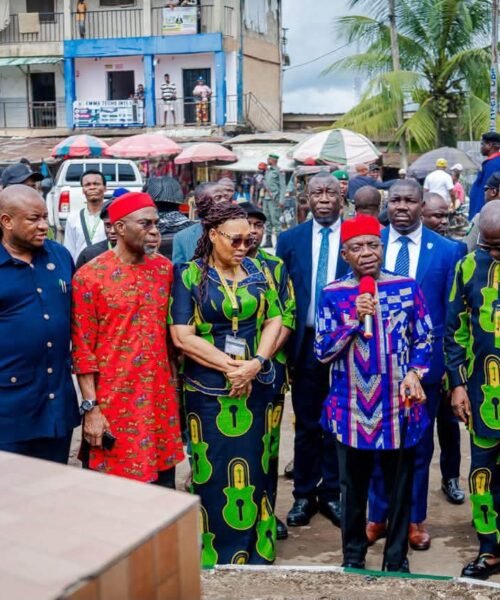
Across Aba, Umuahia and many communities, road projects are either completed or ongoing.
The reconstruction of Port Harcourt Road, Aba, alone represents a major intervention in a corridor that was abandoned for decades.
Other roads, drainage systems and urban renewal projects are restoring commercial activity and improving movement across the state.
One may debate the pace or demand attention for additional communities, but claiming that nothing is happening is an insult to the evidence visible on the ground.
8. OTTI IS REBUILDING PUBLIC INSTITUTIONS
The administration is investing in healthcare facilities, schools, roads, waste management, public transportation and institutional reforms.
The government has also taken steps to improve financial discipline and reduce the culture of reckless expenditure.
These reforms may not produce perfection overnight, but they demonstrate a clear departure from the old system.
THE LESSON FOR MISCHIEF MAKERS
Nobody is asking Friday Solomon or any other citizen to praise Governor Alex Otti blindly.
We are asking them to criticise intelligently.
Mention the specific abandoned project.
Name the alleged private business.
Provide the company registration records.
Identify the category of workers being owed.
State the school or community where work was promised but abandoned.
Demand the complete list and status of the smart schools.
That is how responsible citizens hold government accountable.
But when someone ignores cleared arrears, improved worker treatment, school rehabilitation, road construction, healthcare reforms and growing investor confidence, such a person is no longer conducting oversight.
He is merely advertising bitterness.
Governor Alex Otti, OFR, has not solved every problem in Abia State. No honest supporter should claim that he has.
However, the available evidence clearly shows that Abia is no longer governed through the old culture of unpaid obligations, abandoned infrastructure and institutional decay.
The government must continue working.
The opposition must continue asking questions.
But mischief makers must learn the difference between criticism and falsehood.
Abia is rebuilding—and no badly written Facebook post can hide the evidence.
Pastor Prof. Chukwuemeka Ifegwu Eke