

NOISE VS. REALITY: THE AI-GENERATED CRISIS AND THE EVIDENCE THAT REFUSES TO DISAPPEAR
How Abia’s Governance Record Survived the Age of Deepfakes
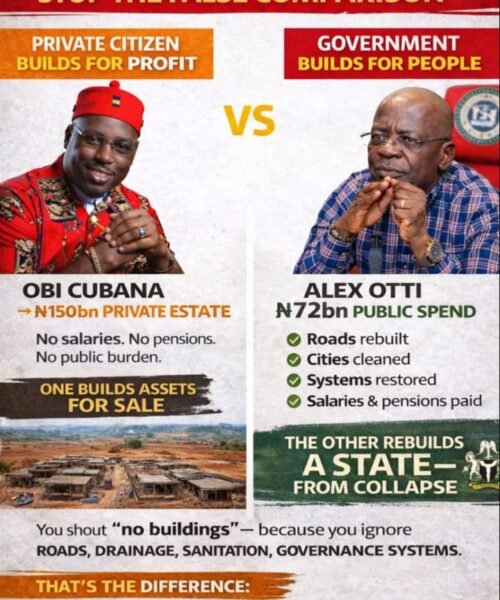
In the digital age, governance now competes not only with politics, but with algorithms. In Abia State, this reality crystallised into what many now describe as the AI-generated crisis—a controversy sparked by viral videos alleging that Governor Alex C. Otti’s administration used artificial intelligence to fabricate images of development projects.
The claim spread fast. The intention was obvious: erase reality with virality.
But facts, once documented, are stubborn.
Independent fact-checking organisation Dubawa addressed the controversy directly, clarifying that while one viral video was synthetically generated and misleading, it does not negate the existence of real, verifiable projects in Abia State.
Dubawa’s report is publicly available here:
👉 https://www.facebook.com/dubawa/posts/while-abia-state-has-seen-genuine-infrastructure-projects-under-governor-alex-ot/1187562013538167/
In other words, a single misleading clip was weaponised to construct a sweeping falsehood. The problem was not governance; it was misinformation amplification.
HEALTHCARE REFORM: DOCUMENTED, NOT GENERATED
While online debates raged, governance continued offline.
On healthcare delivery, the Abia State Government formally approved and commenced the recruitment of 649 new medical and health workers, including doctors, nurses, and allied professionals, to strengthen primary healthcare services across the state.
This development was reported and documented here:
👉 https://theeasternupdates.com/2026/01/26/abia-governor-greenlights-hiring-of-649-health-workers/
Further details on ongoing recruitment and sector strengthening were also reported through official and national channels, including:
👉 https://fmino.gov.ng/abia-government-to-recruit-more-medical-personnel-as-state-moves-to-strengthen-health-sector/
These are not promotional videos. They are official policy actions, reflected in recruitment notices, payroll adjustments, and deployment plans.
FEDERAL OVERSIGHT SPEAKS: PRAISE FROM THE HOUSE OF REPRESENTATIVES
Perhaps most damaging to the “AI project” narrative was the intervention of institutional oversight.
The House of Representatives Committee on Healthcare Services conducted an oversight visit to Abia State and publicly commended the Otti administration for its strides in healthcare delivery.
This was reported by Punch Newspapers here:
👉 https://punchng.com/reps-committee-lauds-abia-govs-strides-in-healthcare-delivery/
The committee highlighted improvements in primary healthcare centres, staffing, and funding commitment—observations that cannot be generated by AI models or social media graphics.
THE REAL CRISIS: POLITICS IN THE AGE OF SYNTHETIC MEDIA
The Abia episode reflects a wider global challenge: how democracies survive when images can lie faster than documents can speak.
AI-generated misinformation thrives on spectacle. Governance, however, leaves paper trails—budgets, recruitments, oversight reports, and court records. These are harder to manipulate and easier to verify.
In Abia’s case, the attempt to collapse an entire administration’s performance into one misleading video failed because evidence exists elsewhere—and publicly.
CONCLUSION: LINKS DON’T LIE
In politics, narratives can be manufactured.
But links remain.
Court decisions are reported.
Recruitments are published.
Oversight visits are documented.
The AI-generated crisis may trend, but verifiable records endure. And in the end, it is these records—not viral distortions—that will define Abia’s governance story.
Because while technology can fake images,
it cannot fake institutional memory.
AProf Chukwuemeka Ifegwu Eke