
WHEN MEN CHOOSE BLINDNESS: A SHORT HISTORY OF DEVELOPMENT DENIAL
From Ancient States to Osisioma Ngwa
History records a strange but recurring political disease: the refusal to see. Not because nothing exists, but because seeing would destroy a carefully built narrative. Across centuries and continents, political actors have chosen blindness to developmental efforts—sometimes out of rivalry, sometimes out of wounded pride, sometimes out of the simple fear that acknowledgment would elevate a rival.
Abia State, today, is not exempt from this ancient habit.
THE OLD STORY, RETOLD
From Athens to Washington, from Singapore to Johannesburg, history shows that reform periods attract a peculiar opposition—not critics who interrogate facts, but actors who deny the existence of facts altogether.
Pericles’ opponents dismissed the Parthenon as vanity.
Lincoln’s critics denied the necessity of the Union.
Lee Kuan Yew’s detractors called housing reform “elite propaganda.”
In every case, development existed. The blindness was chosen.
WHEN LOCAL POLITICS MIRRORS GLOBAL HISTORY
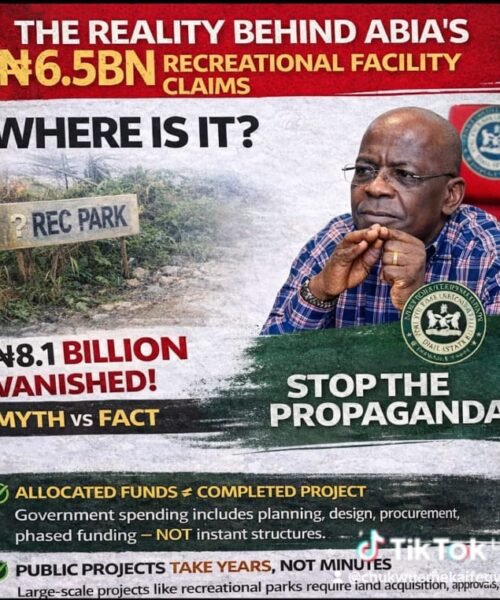
In Abia’s current political moment, the same script is being replayed—this time through the language of “Where is the money?” and “Nothing has been done.” These questions, in themselves, are legitimate. But history draws a sharp line between accountability and amnesia.
The present agitation around Osisioma Ngwa and Isiala-Ngwa South LGAs illustrates this tension clearly.
On one hand, there is a commendable acknowledgment of political decency:
that Nanaa respected the will of Ndi Osisioma in 2023, resisted subversion, and conducted himself with discipline and restraint. History should—and will—record that. Acts of democratic restraint matter, even when they do not yield immediate rewards.
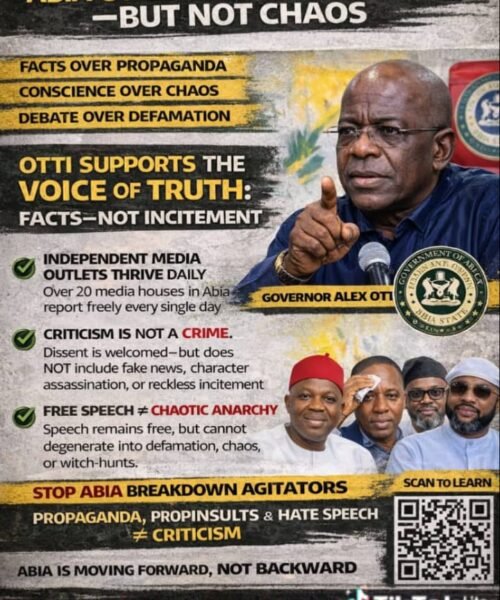
On the other hand, the narrative abruptly shifts from recognition to absolute negation: that nothing meaningful has happened anywhere in Abia; that over ₦1.2 trillion in revenues has produced no results; that governance has amounted to sweeping, painting, and media noise.
Here is where history raises an eyebrow.
THE DANGER OF RESULTS–REVENUE REDUCTIONISM
There is a long tradition—documented by political economists—that warns against reducing governance to a simplistic “money in vs. concrete out” equation.
Institutions are built before monuments.
Systems are repaired before megaprojects endure.
Fiscal discipline precedes visible scale.
To argue that development does not exist unless it appears as a single spectacular structure in one’s immediate locality is to repeat the very blindness history mocks.
This does not mean questions about Osisioma’s ₦15bn or Isiala-Ngwa South’s ₦11bn should not be asked. They should. In fact, demanding published LGA financial reports is a legitimate civic demand. Transparency at the local government level is essential.
But history is clear:
When legitimate questions harden into absolute denial, they cease to be inquiry and become crusade.
WHEN PERSONAL CONSISTENCY MEETS POLITICAL MEMORY
History is also unforgiving to selective memory.
Those who once described former administrations as “workaholic” and “precision-driven” after four years in office, only to later denounce them after eight, cannot escape the historian’s question:
Was blindness accidental—or convenient?
Civic advocacy gains moral weight from consistency, not intensity. When accountability appears reactive—triggered only by new political alignments—history files it under contested sincerity.
THE NGWA QUESTION IN HISTORICAL CONTEXT
Ngwa land’s developmental anxieties are real. No serious historian dismisses regional grievances. But history also warns against transforming regional neglect into a total negation of state-wide governance.
Athens was not only the Acropolis.
Abia is not only Aba.
But neither is Abia reducible to one LGA.
Development unfolds unevenly. History judges leaders not by whether every road is finished at once, but by whether direction, systems, and intent are discernible.
THE FINAL IRONY HISTORY NEVER FORGETS
History’s sharpest irony is this:
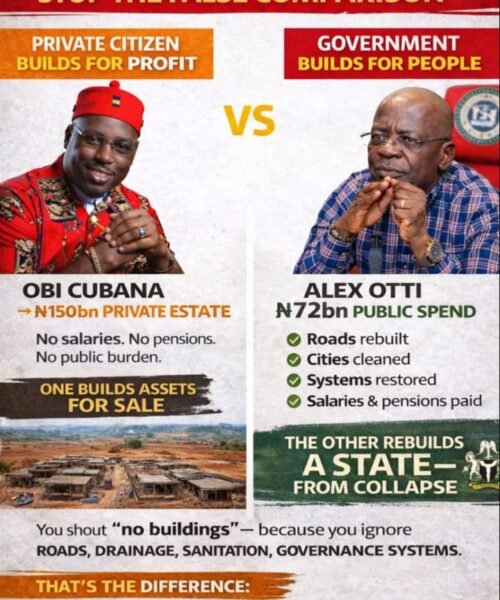
Those who dedicate their politics solely to proving that nothing works often end up remembered for building nothing themselves.
The road remains.
The institution stabilises.
The reform compounds.
And the voices that swore nothing existed become footnotes—quoted not for their foresight, but for their refusal to see.
CONCLUSION: ACCOUNTABILITY MUST SEE TO REMAIN ACCOUNTABLE
History does not condemn questioning. It condemns willful blindness.
To ask “Where are the LGA funds?” is civic duty.
To ask “Why hasn’t every community felt impact yet?” is legitimate.
But to insist that nothing exists anywhere—in the face of systemic reforms, fiscal restructuring, and ongoing capital execution—is to repeat a mistake as old as politics itself.
History has seen this before.
And it never sides with blindness.
Time, as always, will finish the argument.
AProf Chukwuemeka Ifegwu Eke