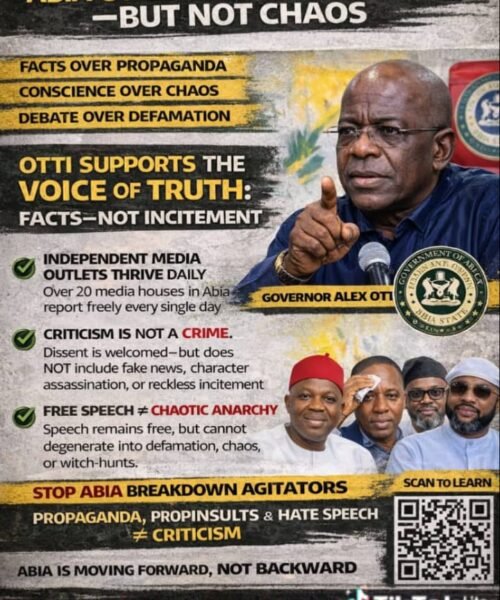


LAUGHABLE. MYOPIC. SADISTIC.
What you call “analysis” is really a tired social-media trope built on exaggeration, selective blindness, and deliberate amnesia.
First, the hypocrisy. You praise Peter Mbah and Charles Soludo as “quiet performers” while dismissing Alex Chioma Otti as a “social media governor.” Yet you ignore the obvious philosophical flaw: visibility is not noise, and documentation is not propaganda. A government that publishes what it is doing is not weaker than one that communicates less; it is simply more exposed to scrutiny. Serious governance welcomes exposure.
Second, the intellectual dishonesty. You assert that “almost ₦100bn was spent on schools and no single school can be seen,” but you provide no budget page, no audit reference, no procurement lot, no project-site coordinates. That is not critique; it is rhetoric. Education interventions under Otti are publicly documented and traceable through official releases and independent reporting on school rehabilitation, learning upgrades, and sector-wide reforms. Anyone genuinely interested can verify rather than shout.
Abia education policy trail and updates are publicly accessible via the state portal: https://abiastate.gov.ng/education/
Independent coverage of school rehabilitation and sector reforms: https://punchng.com/?s=abia+schools+otti
Third, the research claim collapses under its own weight. You allege “₦100bn for research with no centre anywhere,” yet research spending in subnational governments is typically embedded in sectoral MDAs—health, education, agriculture, ICT—through grants, pilots, data systems, and partnerships, not always stand-alone buildings. If you believe the figures are false, the burden is on you to publish the specific budget lines and execution reports. Otherwise, it is conjecture.
Fourth, the historical erasure is telling. Abia did not arrive at its current baseline in a vacuum. The state emerged from 24 years of PDP rule that hollowed institutions, degraded infrastructure, and normalised opacity. Any honest comparison with Enugu or Anambra must adjust for starting conditions. Pretending Abia and those states began the race from the same line is either naïveté or bad faith.
Finally, the philosophical point you avoid: governance is not a competition in silence. It is a contest of verifiable outcomes over time. Otti’s approach—publish, expose, invite scrutiny—creates more noise precisely because it opens itself to being checked. That is not weakness; it is confidence.
So please, continue your “good work.”
We will remain on the ground—fact-checking, providing context, and insisting on evidence over emotion.
Governance without long stories does not mean governance without records.
Time will indeed tell—but facts will speak louder than cynicism.
AProf Chukwuemeka Ifegwu Eke