
WHY ABIA POLITICS IS CHANGING — AND WHY ACCOUNTABILITY IS NO LONGER OPTIONAL UNDER ALEX OTTI
In every reform cycle, resistance follows reform. History shows that when entrenched systems of patronage and impunity begin to crack, the loudest reaction often comes not from evidence but from emotion. What is playing out in Abia State today fits a familiar global pattern: governance reforms provoke discomfort among political actors accustomed to opacity, while citizens unused to data-driven leadership struggle to recalibrate expectations.

Contrary to the claim that accountability has collapsed under Governor Alex C. Otti, available evidence suggests the opposite. Abia has, since 2023, become one of the more fiscally visible subnational governments in Nigeria. Independent civic monitors such as BudgIT confirm that Abia now publishes budget performance reports and procurement information more consistently than in the past, a shift that reduces the space for arbitrary spending and undocumented claims (BudgIT Open States Portal: https://yourbudgit.com/state/abia/).
The allegation that “hundreds of billions of naira” were spent on “non-existent projects” collapses when tested against public records. Abia’s approved budgets between 2023 and 2025 are publicly accessible, and capital allocations are traceable across sectors such as roads, healthcare, education, and power (Punch, Abia 2024 Budget: https://punchng.com/abia-approves-n567bn-budget-for-2024/). While delays and phased execution are legitimate subjects of scrutiny—as in every Nigerian state—there is no credible investigative report by ICIR, Premium Times, or Sahara Reporters establishing mass fabrication of projects in Abia under Otti.
On education, claims of “non-existent school projects” ignore verifiable interventions already documented by mainstream media. In 2024 and 2025, Channels Television and TheCable reported on the rehabilitation of public schools and the commencement of foundational education reforms, including teacher recruitment and curriculum upgrades (Channels TV, Abia Education Reform: https://www.channelstv.com/2024/06/18/abia-govt-begins-school-rehabilitation/; TheCable: https://www.thecable.ng/otti-education-reforms-abia). These are incremental, not theatrical, reforms—precisely the kind that rarely satisfy headline politics but form the bedrock of long-term outcomes.
The claim that Abia suffers Nigeria’s “highest graduate unemployment” is not supported by national labour statistics. The National Bureau of Statistics’ Labour Force Survey consistently places states such as Lagos, Rivers, and Kano higher in absolute graduate unemployment figures due to population size, while unemployment is a nationwide structural crisis rather than an Abia-specific anomaly (NBS Labour Force Survey 2023: https://www.nigerianstat.gov.ng). To weaponise unemployment statistics without proportional context is analytically misleading.
More importantly, the argument that salary payments amount to “media stunts” misreads both economics and governance. Salary arrears were a defining failure of past administrations in Abia, repeatedly reported by The Guardian and Vanguard during the Ikpeazu years (Vanguard, Abia Salary Arrears: https://www.vanguardngr.com/2021/10/abia-workers-protest-unpaid-salaries/). Clearing arrears and restoring regular wage payments is not propaganda; it is fiscal stabilisation. The World Bank identifies wage stability as a prerequisite for local economic recovery, particularly in subnational economies with weak private-sector absorption (World Bank, Subnational Finance, https://www.worldbank.org/en/topic/publicsector).
On healthcare, evidence of performance is not rhetorical. In December 2025, Abia emerged as the best-performing South East state at the Nigeria Governors’ Forum Primary Healthcare Leadership Challenge, winning USD500,000 and improving on its 2024 performance (NGF PHC Challenge: https://ngf.org.ng/primary-healthcare-leadership-challenge/). SBM Intelligence also ranked Abia as Nigeria’s most prepared state for health emergencies in 2025 (SBM Health Preparedness Index: https://www.sbmintel.com/2025-health-preparedness-index/). These are third-party assessments, not government press releases.
Claims that Governor Otti uses town halls to “attack journalists” similarly lack corroboration from Nigeria’s leading media watchdogs. No report by Media Rights Agenda, the Nigerian Union of Journalists, or Premium Times Investigations has documented systematic repression of journalists in Abia since 2023. In fact, Otti’s administration has been noted for frequent media engagement, including unscripted press interactions—an approach many Nigerian governors avoid (Premium Times, Subnational Media Engagement: https://www.premiumtimesng.com).
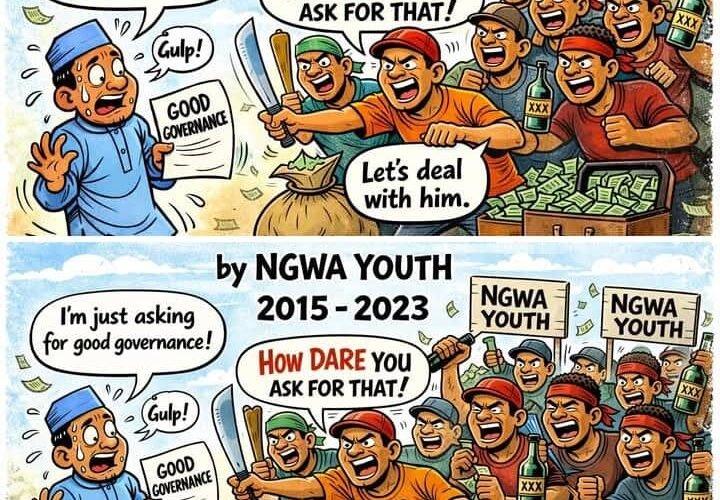
The accusation that criticism is silenced through “tribal mobilisation” also collapses under scrutiny. Political disagreement in Abia, as in most of Nigeria, remains vibrant and often hostile across ethnic lines. What has changed is that policy debate increasingly demands data. Assertions unsupported by procurement records, audit trails, or independent reporting no longer travel as easily as they once did. This is not tribalism; it is a rising accountability threshold.
Perhaps most telling is the industrial recovery agenda. The handover of Star Paper Mill by AMCON to Abia State was not symbolic theatre. It followed a formal recovery and refund process acknowledged by AMCON itself, with plans to de-risk the asset for private operators rather than return it to inefficient state control (Channels TV, AMCON handover: https://www.channelstv.com/2025/12/12/amcon-hands-over-star-paper-mill-to-abia-govt/). This aligns with global best practice in post-industrial recovery, as documented by the World Bank and OECD, where governments repair institutional failures and crowd in private capital rather than run factories indefinitely.
In every reforming polity, discomfort precedes consolidation. Abia today is not perfect, but it is measurably different from the era when budgets were opaque, salaries unpaid, industries abandoned, and plans undocumented. Criticism remains necessary—but it must rise to the level of evidence now available. Governance has moved from slogans to spreadsheets, from rumours to reports.
Accountability is no longer optional in Abia. And that is precisely why the noise is louder.
AProf Chukwuemeka Ifegwu Eke