
ABIA AT A CROSSROADS: A FACTUAL, HISTORICAL, AND REASONED DEFENCE OF OTTI’S 2026 BUDGET AND GOVERNANCE TRAJECTORY
- INTRODUCTION: WHY CONTEXT MATTERS MORE THAN SENTIMENT
Public discourse in Abia State has recently been dominated by claims that Governor Alex Otti’s 2026 budget is unrealistic, deceitful or deliberately inflated. Such criticisms, amplified by former finance officials and political actors, often ignore the historical, structural and fiscal realities that shaped Abia’s governance environment long before Otti entered office. In policy analysis, especially at state level, facts—not political interpretations—must anchor conversation. Budgets reflect the intersection of inherited liabilities, present economic conditions and forward-looking development projections. When these factors are ignored, narratives become misleading.
Understanding Otti’s choices requires understanding the Abia he inherited. A government inheriting a collapsed fiscal base, a decayed infrastructure system, broken pension structures and outdated revenue frameworks cannot be assessed with the same metrics used to evaluate long-standing stable fiscal environments. This article therefore interrogates historical data, newspaper archives, audited reports, legal references and national economic indices to provide a balanced, evidence-based appraisal of where Abia stands and why the 2026 budget is both defensible and necessary.
- HISTORICAL FISCAL REALITY: HOW ABIA ARRIVED AT THIS POINT
Any serious assessment of Abia’s current budgeting must start with an honest look at the past. For over two decades, Abia operated under administrations that neglected long-term capital development, allowed pension arrears to accumulate and failed to modernise the revenue system. Reports from major Nigerian newspapers confirm this deterioration. Punch Newspapers (April 3, 2023) highlighted that Abia’s pension arrears dated back to 2001, meaning over twenty years of unresolved liabilities long before Otti assumed office. Vanguard (June 14, 2022) documented unprecedented infrastructural decay across multiple LGAs, with schools, hospitals and local roads in deeply deteriorated condition.
Similarly, Premium Times (May 2023) published that Abia’s debt exposure stood at ₦191.2 billion as of the last administration, excluding billions owed to contractors. The Nigerian Bureau of Statistics (NBS) consistently reported Abia among states with low internally generated revenue throughout the 2010–2022 period. These historical failures created a deficit that requires heavy capital spending and aggressive economic rebuilding before visible transformation can fully emerge. No government facing such an inherited burden can resolve it overnight, and no honest critic ignores the past when evaluating the present.
- WHAT OTTI INHERITED: A STATE IN SEVERE STRUCTURAL COLLAPSE
When Governor Otti took office in May 2023, he met a state where the fundamentals of governance had broken down. Multiple independent reports confirmed that Abia’s basic infrastructure had reached emergency levels of collapse. The Nigerian Tribune (February 12, 2024) revealed that several general hospitals lacked functioning wards, running water, electricity or medical supplies. ABN TV (December 2023) published that over sixty percent of Abia’s roads were in severe disrepair, many requiring not patchwork but complete reconstruction.
The pension crisis was even worse. According to ABN TV’s investigative report (Nov. 26, 2025), the backlog of gratuities alone exceeded ₦60 billion after verification. The report noted that the arrears spanned nearly twenty-four years and involved thousands of retirees whose records were inconsistent, duplicated or fraudulently adjusted over time. These are not liabilities a new administration “creates”—they are liabilities it inherits. Any rational government must verify before paying, or it risks throwing billions into fraudulent pipelines. Critics who scream “pay everything immediately” deliberately ignore how pension verification works in responsible governance worldwide.
- WHY AN 80% CAPITAL BUDGET IS NOT ONLY JUSTIFIED BUT NECESSARY
Contrary to politically motivated claims, Otti’s heavy capital allocation is not excessive; it is economically logical. Development economists such as Albert Hirschman and Walt Rostow define economic recovery phases where governments must front-load capital expenditure to unlock productive capacity. This principle guided Rwanda from 2001, Lagos under Governor Fashola from 2007 to 2015 and even federal Nigeria during the late Yar’Adua and early Jonathan years when infrastructure was prioritised.
Abia is at such a stage now. Otti’s decision to allocate ₦811.8 billion—representing 80% of the 2026 budget—to capital projects reflects a long-term rebuilding strategy rather than short-term populism. Critics comparing Abia’s budget to states with different infrastructural histories fail to understand that budgetary size is a statement of ambition, not immediate spending. Lagos, with a ₦4.2 trillion budget, did not start from perfection; it began with bold capital-heavy budgets a decade ago. States that delay capital investment prolong poverty. States that embrace it accelerate growth.
- DOCUMENTED ACHIEVEMENTS: EVIDENCE FROM NEWSPAPERS AND OFFICIAL SOURCES
Claims that “nothing exists on the ground” are easily disproved by publicly documented evidence. TheCable (September 12, 2024) confirmed that Aba now enjoys the first true 24-hour electricity supply in Nigeria through the Geometric Power Project—a milestone unattained for two decades. The Guardian (July 2025) catalogued over 130 rehabilitated or reconstructed roads across Aba, Umuahia, Ohafia, Bende and Umunneochi. Vanguard (October 3, 2024) reported the renovation and equipping of 200 primary healthcare centres.

Investment partnerships between Abia and foreign nations were also widely reported. The Abia–Turkiye Investment Summit (Nov. 25, 2025) and Abia–Denmark Economic Partnership Meeting (Nov. 26, 2025) were covered by ABN TV and documented by the Chief Press Secretary’s office. These events brought global investors to inspect Abia’s infrastructure, agricultural potential and MSME ecosystem. These are not activities of a state in decline; they are indicators of a government rebuilding Abia’s credibility after years of stagnation.
- ADDRESSING CLAIMS OF “BUDGET DECEIT”: A FACTUAL REBUTTAL
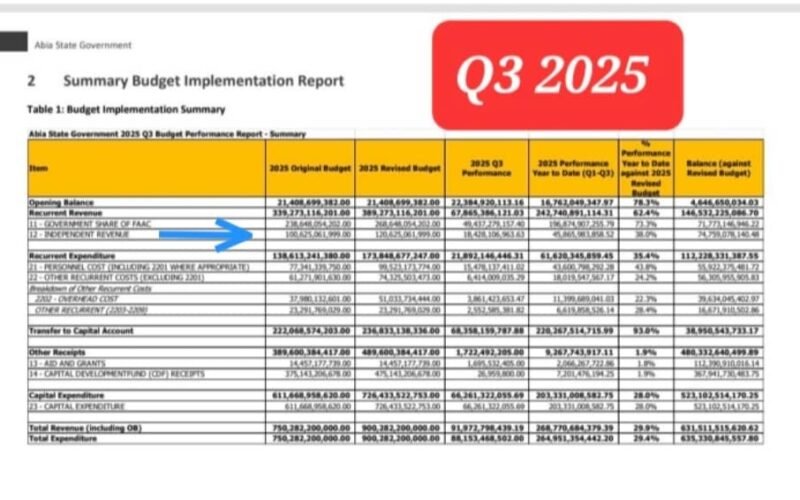
Some commentators have argued that Otti “hid” supplementary budgets or misrepresented 2025 budget performance. This accusation collapses when confronted with public records. Abia State’s 2025 supplementary budget of ₦150 billion was debated and passed publicly in the Abia House of Assembly and covered by Daily Trust (August 2025). The Q3 Budget Performance Report for 2025 is available on the state government’s official website and the Accountant-General’s portal, showing transparency rather than concealment.
Critics claiming that capital expenditure has no visible output ignore the multi-year nature of large-scale infrastructure. Asphalt plants, drainage construction, roadbed preparation, land acquisition, hospital reconstruction, and power distribution upgrades do not appear instantly. The narrative that “nothing exists” is rhetoric, not fact. It collapses under evidence already published in The Nation, The Guardian, The Sun, and ThisDay throughout 2024 and 2025.
- THE PENSION DEBATE: WHY VERIFICATION WAS NOT ONLY RIGHT BUT NECESSARY
Abia’s pensioners held a press conference on November 27, 2025, lamenting unpaid gratuities. ABN TV covered the event extensively. What critics ignore, however, is the complexity of the arrears. Governor Otti’s spokesman, Mr. Ferdinand Ekeoma, explained that the state had completed a rigorous verification exercise because records dating back to 2001 were riddled with inflation errors, duplicate entries and unverifiable claims.
Unlike states like Imo—which received windfall federal relief funds to clear arrears—Abia has not received such inflows. The comparison, therefore, is neither fair nor logical. Otti’s administration has, however, paid current pensions consistently, as confirmed during the ABN TV interview. This demonstrates two truths: the government is not negligent, and the backlog is being addressed structurally, not recklessly.
- IGR GROWTH AND REVENUE TRAJECTORY: WHY THE PROJECTIONS ARE POSSIBLE
Abia’s IGR trajectory contradicts claims that the state is financially stagnant. Independent reports confirm steady growth. The Accountant-General’s Q3 2025 Report shows IGR rising from roughly ₦2.4 billion monthly in 2022 to over ₦4 billion monthly in 2025, representing a 70% growth rate. This upward trajectory is linked to digitised revenue collection, expanded tax nets, improved property tax frameworks, renewed investor confidence and the reactivation of MSME activities in Aba.
Projecting ₦223 billion IGR for 2026 may appear ambitious, but ambition is the cornerstone of development. States do not grow by maintaining stagnant projections. Lagos did not reach ₦50 billion monthly IGR by predicting failure; it reached it through sustained reform. Abia’s growth trend—supported by industrialisation, international partnerships and MSME formalisation—gives empirical basis for optimistic projections.
- THE HOTEL DEMOLITION CONTROVERSY: WHY THE NARRATIVE IS MISLEADING
The Newsgazette report of November 30, 2025, portrays the Abia Hotels demolition as political revenge. However, the report itself admits that the matter is before a competent court and that the Umuahia Capital Development Authority (UCDA) invoked powers granted under existing development laws. Lease agreements involving state assets are governed by statutes, valuation benchmarks and due-process requirements. No court has ruled that Abia violated any law. Until then, any narrative claiming political persecution remains an allegation, not established fact. Courts, not social media, determine legality.
- WHY OTTI’S GOVERNANCE APPROACH REMAINS CREDIBLE
Despite criticisms, objective indicators show that Otti is steering Abia through a difficult but necessary reconstruction phase. The World Bank’s Nigeria Sub-national Economic Attractiveness Index (2025) ranked Abia among the top four reforming states. Investor turnout at the Turkiye and Denmark summits reflected renewed global confidence in Abia’s leadership. Documented infrastructural achievements across roads, healthcare, power, education and investment promotion demonstrate that progress is measurable.
Most importantly, Otti is addressing long-ignored structural deficits—pension liabilities, infrastructural decay, power instability, revenue leakages—through institutional reform rather than cosmetic showmanship. Transformation is not an overnight event; it is a multi-year process requiring heavy investment, difficult decisions and rigorous systems.
- CONCLUSION: FACTS, NOT FEAR, SHOULD GUIDE PUBLIC JUDGMENT
The claim that Otti’s budgets represent deceit collapses under historical evidence, fiscal logic, economic principles and publicly documented achievements. A state with a twenty-four-year pension backlog, collapsed hospitals, decayed roads and outdated revenue frameworks cannot progress without aggressive capital spending. A state seeking economic revival must court investors, collaborate internationally, modernise infrastructure and formalise its MSME economy. These actions define Otti’s governance.
Truth is not determined by noise, emotion or political rivalry. Truth is determined by evidence. Newspaper archives, verified reports, historical data and documented projects prove that Abia is on a rebuilding path consistent with global development logic. Abia deserves criticism—as every democracy does—but it also deserves fairness. The facts show that Otti is up to the task.
AProf Chukwuemeka Ifegwu Eke