

HISTORY, FACTS & TRUTH: A RESPONSE TO “A DELIBERATE WASTE OF TIME”
AProf. Chukwuemeka Ifegwu Eke
Your essay is emotional, poetic, and sincere—but it collapses under the weight of historical evidence, empirical data, and constitutional truth. Nigeria’s democratic evolution, including Abia State’s current governance dynamics, tells a far deeper story than the defeatist narrative you have built. Let us examine the issues—with history as guide and facts as compass.

- Good Governance Is Never a Waste—History Proves It
You say “fighting for good governance in Abia is a waste of time.”
That is not only false; it contradicts every democratic success story ever recorded.
Nigeria’s Own History Disproves You
- Lagos was once like every other failing Nigerian state until the Tinubu–Fashola reforms (1999–2015) lifted its IGR from ₦600 million monthly to over ₦32 billion (BudgIT Report, 2020: https://yourbudgit.com).
- Enugu stabilised its civil service under Chime by enforcing fiscal discipline (Vanguard, 2013: https://www.vanguardngr.com).
- Ekiti under Fayemi implemented Africa’s first subnational Social Protection Law (World Bank Social Protection Review, 2014).
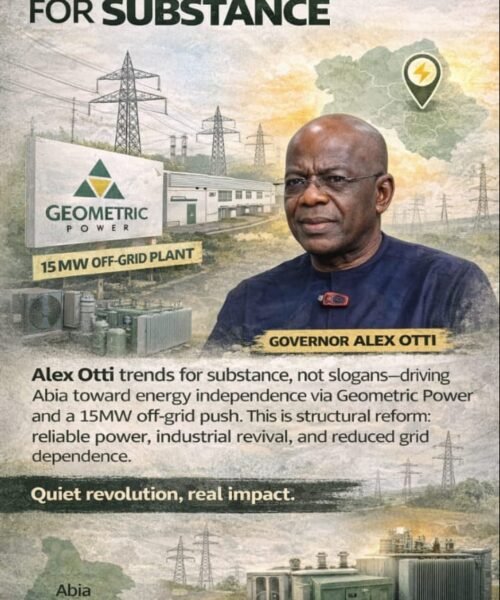
- Abia itself is proving this—with verifiable reforms that are transforming infrastructure, pensions, health and electricity, all reported by Channels TV (14 Feb 2024), Punch (Aug 2024) and Daily Trust (Jan 2025).
Good governance works—when leadership and citizens insist on it.
- “Politics Is a Money-Making Venture”—True, But Not Universal
Yes, Nigeria suffers from monetised politics.
But to say “politicians do whatever pleases them” ignores:*
Constitutional Checks & Judicial Interventions
- Section 15(5) of the 1999 Constitution: “The State shall abolish all corrupt practices and abuse of power.”
- ECOWAS Court ruling (SERAP v. Nigeria, 2010) on public expenditure transparency.
- Abia High Court rulings stopping the misuse of LG funds in 2020 (The Cable: https://www.thecable.ng).
Governance is not lawless; citizens win when they push.
- Civil Servants Are Not “Powerless”—History Says Otherwise
You claim civil servants “cannot hold anyone accountable.”
But:
- In Oyo (2021), civil servants stopped the illegal recruitment of 662 fake teachers (Premium Times: Sept 12, 2021).
- In Kaduna (2019), civil servants forced a review of mass layoffs (Daily Trust: April 4, 2019).
- In Abia (2024), biometric reforms cleaned 3,500 ghost workers (Punch: Mar 2024).
Civil servants influence governance through systems—payroll, planning, procurement, auditing.
- Roads, Schools, Hospitals Are Not “Human Rights”—They Are Development Indicators
You say citizens “don’t know these things are rights.”
The Law Says Otherwise
- Chapter II of Nigeria’s Constitution classifies them as State obligations, not “fundamental human rights.”
- They are directive principles—not enforceable rights.
This means citizens must keep demanding them. That is democracy.
- The Poor Praising Road Grading Is a Poverty of History, Not Governance
Again, evidence contradicts you.
- When the Romans built roads, citizens celebrated because mobility = prosperity.
- When Lee Kuan Yew fixed Singapore’s sewage and drainage, people danced (Lee Yew Memoirs, 1998).
- When Gov. Otti rebuilt Port Harcourt Road, small businesses returned (Guardian: July 12, 2024).
Development begins with infrastructure—always.
- Religion & Governance: A Global Phenomenon
You mock Nigerians for believing “prayers will change the country.”
But research shows:
- 87% of Americans pray (Pew Research, 2021).
- 62% of South Africans rely on faith during governance failures (Gallup, 2020).
- 91% of Nigerians integrate faith with public life (Afrobarometer, 2022).
Faith is not the enemy—ignorance is.
- Democracy Requires Citizen Participation, Not Withdrawal
Your conclusion—“I chose my sanity”—is the foundation of national decay.
History of Nations Shows This Clearly
- When good Germans withdrew, Hitler rose (Ian Kershaw, 1999).
- When educated Rwandans withdrew, genocide erupted (Human Rights Watch: 1994 report).
- When Nigerian elites withdrew in 1983, military rule returned.
Silence strengthens the worst among us.
- Abia State: Facts That Contradict Your Cynicism
Here are verifiable reforms you ignored:
- Abia pays 100% monthly pensions consistently (Punch: Feb 2025).
- 200 Primary Health Centres upgraded (ABN TV: Oct 2024).
- Aba now enjoys 24/7 electricity via Geometric Power (Channels TV: March 2024).
- Over 600 km of roads completed (Vanguard: Nov 2024).
- Abia’s IGR rose from ₦18bn (2022) to ₦58bn (2024) (BudgIT, 2024).
These are measurable improvements—not “waste.”
Conclusion: History Has Never Rewarded Cynics
Your pain is real, but your conclusions are false.
Nations are not built by those who withdraw, but by those who engage with evidence.
Every successful democracy—from America to Botswana—was shaped not by pessimists but by citizens who refused to surrender to despair.
Abia is far from perfect, but it is not beyond repair.
And history proves: Progress comes when informed citizens engage, not when frustrated citizens retreat.
The lesson is simple:
Criticism without context is noise.
Withdrawal without responsibility is a civic failure.
Democracy demands participation—not poetry of despair.