
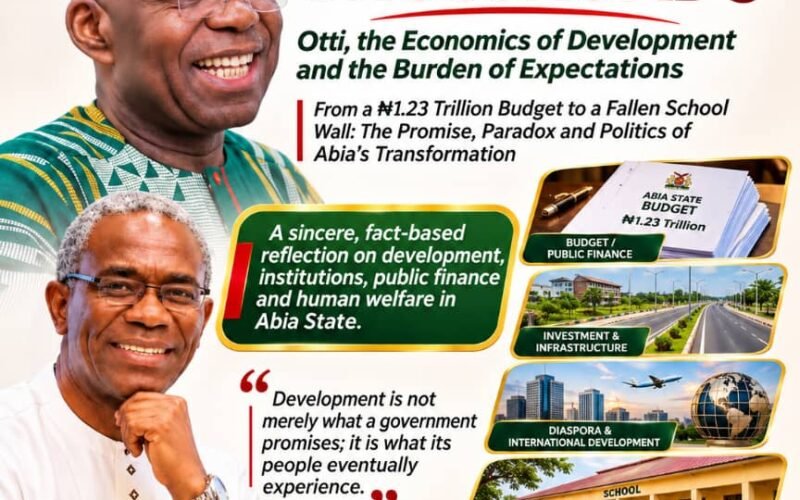
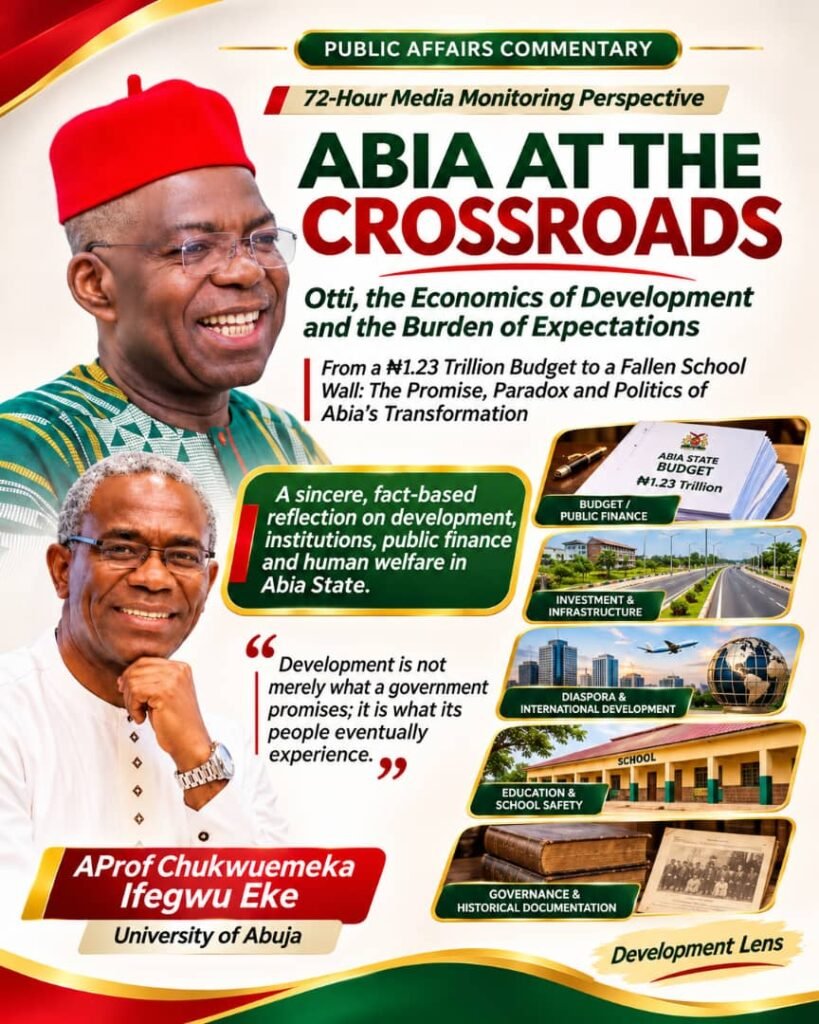
ABIA AT THE CROSSROADS: OTTI, THE ECONOMICS OF DEVELOPMENT AND THE BURDEN OF EXPECTATIONS
From a ₦1.23 Trillion Budget to a Fallen School Wall: The Promise, Paradox and Politics of Abia’s Transformation
By AProf Chukwuemeka Ifegwu Eke
Associate Professor of Economics, University of Abuja
23 November 2026
WHEN SEVENTY-TWO HOURS BEGIN TO TELL A STORY
There are moments in the history of a society when seemingly unrelated events suddenly begin to speak to one another.
A government presents an ambitious budget. Investors are invited. New cities are proposed. Political stakeholders declare their positions. Questions arise about the treatment of workers. A governor addresses his citizens in the diaspora. A publication attempts to preserve the economic history of a state.
Then, almost without warning, another headline appears.
A school wall collapses.
A child dies.
And the entire conversation about development assumes a different meaning.
I have spent considerable time studying the political economy of development, particularly the relationship between public institutions, government expenditure and the welfare of ordinary citizens.
But the events reported in Abia State between 21 and 23 November 2026 presented an unusual opportunity to examine several dimensions of development within a remarkably short period.
In those seventy-two hours, newspaper reports and public commentary brought together nine major developments: the proposed ₦1.23 trillion budget, new investment initiatives, an international village, diaspora participation, a tragic school incident, political endorsements, questions about the civil service, misinformation surrounding electoral activities and the public presentation of a five-volume account of Abia’s governance history.
Individually, these events may appear disconnected.
Collectively, they raise a profound economic question.
Is Abia merely experiencing increased government activity, or is it building the institutions necessary for sustainable development?
That distinction is fundamental.
I returned to three scholars whose writings have shaped my understanding of development: Chinua Achebe, Daron Acemoglu and Amartya Sen.
Their ideas provide a framework for examining the events without confusing political declarations with economic achievements or legitimate criticism with evidence of institutional failure.
And I begin with the money.
THE ₦1.23 TRILLION QUESTION: CAN A BUDGET TRANSFORM A STATE?
On 19 November 2026, Governor Alex Chioma Otti presented the proposed 2027 Appropriation Bill to the Abia State House of Assembly.
The headline figure was approximately ₦1.23 trillion.
Of particular interest was the proposed allocation of ₦960 billion to capital expenditure, described by the government as approximately 80% of its expenditure programme.
The administration also identified education and healthcare as major priorities, with reports indicating a combined proposed allocation of 35% to the two sectors.
According to the accompanying financing projections, the government anticipated approximately ₦647.33 billion in revenue and ₦552.67 billion in concessional borrowing.
These are substantial numbers for a subnational economy.
They also require careful interpretation.
First, the budget represents an expenditure proposal awaiting the relevant legislative processes.
Second, the reported ₦960 billion capital and ₦240 billion recurrent figures total ₦1.2 trillion; consequently, the exact approved schedules should be consulted when reconciling those rounded components with the widely reported ₦1.23 trillion headline.
Third, borrowing is not automatically an indication of fiscal irresponsibility.
Its economic justification depends on the cost of financing, repayment obligations, project productivity and the extent to which the borrowed resources create durable economic benefits.
I have always argued that public expenditure must be evaluated through three distinct stages.
The first is allocation.
The second is implementation.
The third is outcome.
An allocation authorises or proposes the use of resources. Implementation determines whether those resources reach their intended purposes. Outcomes reveal whether the spending improves productive capacity and public welfare.
Economists describe the productive contribution of public investment through several channels.
Improved roads can reduce transportation costs.
Reliable electricity can increase industrial output.
Educational investment can enhance labour productivity.
Health expenditure can reduce preventable illness and improve workforce participation.
However, these benefits are neither automatic nor guaranteed.
An abandoned project may absorb public funds without generating the expected economic return.
A poorly maintained facility may deteriorate long before its anticipated useful life.
And a completed building may contribute little to development if it cannot deliver the service for which it was constructed.
This is why I consider Abia’s proposed capital expenditure an important expression of policy priorities, rather than conclusive evidence of development.
The deeper questions concern project selection, procurement efficiency, completion rates, fiscal sustainability and measurable social returns.
A state does not become prosperous because its budget becomes large.
It becomes more productive when public resources are converted into useful, functioning assets.
FROM UMUAHIA TO KIGALI: THE ECONOMICS OF AN INTERNATIONAL VILLAGE
Another development caught my attention.
During the Abia Day celebration in Abuja on 21 November 2026, Governor Otti announced plans for an International Village in Umuahia.
Reports also indicated that work had commenced on a separate Diaspora City initiative intended to encourage investment and strengthen the participation of Abians living outside the state.
The proposed International Village was presented in the context of an aspiration to develop a facility comparable in concept to an initiative associated with Kigali, Rwanda.
I find the economic implications interesting.
Cities increasingly compete for investment, conferences, business services, tourism and skilled professionals.
Such competition extends beyond the construction of hotels and conference facilities.
It involves connectivity, security, transport systems, reliable electricity, digital infrastructure, hospitality services and predictable administrative institutions.
When these elements operate together, a city can develop an ecosystem that attracts commercial activity.
I see potential complementarities between Umuahia’s administrative functions and Aba’s established industrial and commercial activities.
Umuahia could strengthen its role in business meetings, investment coordination and public administration.
Aba could benefit from improved market access, investment partnerships and stronger production networks.
But I would not equate the announcement of an International Village with the emergence of an international conference economy.
That transformation requires feasibility studies, financing, construction, professional management and sustained demand.
It also requires examining the opportunity cost of public investment.
Every naira committed to one project is a naira unavailable for an alternative use.
The economic responsibility of government is therefore to demonstrate why a particular investment offers sufficient social and economic benefits to justify its cost.
I welcome the discussion of new development corridors.
I would also expect transparent implementation milestones and credible projections of their contribution to employment, enterprise development and internally generated revenue.
THE DIASPORA: FROM SENTIMENT TO PRODUCTIVE CAPITAL
The proposed Diaspora City introduces another question that has interested development economists for decades.
How can a society convert the attachment of its citizens abroad into productive domestic investment?
Diaspora participation is frequently discussed in terms of remittances.
Yet remittances represent only one dimension of the relationship.
Diaspora communities may also provide business networks, investment finance, technology, professional knowledge and access to international markets.
The challenge is institutional.
Private investors require confidence that their resources will be protected.
They need transparent land administration, credible contractual arrangements, dependable infrastructure and efficient dispute-resolution mechanisms.
Without these safeguards, emotional attachment to one’s place of origin may not translate into sustained investment.
I therefore regard Diaspora City not simply as a proposed physical development but as an opportunity to examine whether Abia can construct a reliable institutional framework for diaspora investment.
That opportunity should be measured by actual commitments, completed developments, operating enterprises and employment generated.
Not by declarations of goodwill alone.
AFRICANDO AND THE QUESTION OF WHO REALLY BENEFITS
The investment discussion did not emerge in isolation.
On 17 November 2026, Governor Otti opened the AfrICANDO US–Africa Trade and Investment Conference and Expo in Umuahia.
The event brought investment promotion, international trade and enterprise development into public discussion.
Although it preceded the seventy-two-hour monitoring window, the conference provided important context for the investment stories circulating during that period.
The administration encouraged international investors and entrepreneurs to explore commercial opportunities in Abia.
The economic logic is understandable.
Abia possesses an established entrepreneurial culture, particularly in Aba’s manufacturing and trading communities.
However, the existence of entrepreneurial energy does not automatically guarantee international competitiveness.
Manufacturers require reliable power, accessible finance, modern production equipment, efficient logistics and quality-assurance systems.
They also need access to markets beyond their immediate environment.
Trade and investment conferences can create useful connections.
But I distinguish between an event’s visibility and its economic consequences.
A conference may attract hundreds of participants without generating a substantial investment.
Conversely, a modest engagement may produce commercially significant partnerships.
The relevant indicators include signed agreements, actual capital inflows, enterprise expansion, export orders and jobs created.
I would particularly like to see opportunities for small and medium-sized enterprises translated into measurable results.
For me, the success of investment promotion lies not in the number of speeches delivered but in the expansion of productive economic activity.
THEN CAME EHERE: THE SCHOOL WALL THAT CHALLENGED THE DEVELOPMENT NARRATIVE
While these conversations about investment and economic opportunity continued, another event demanded attention.
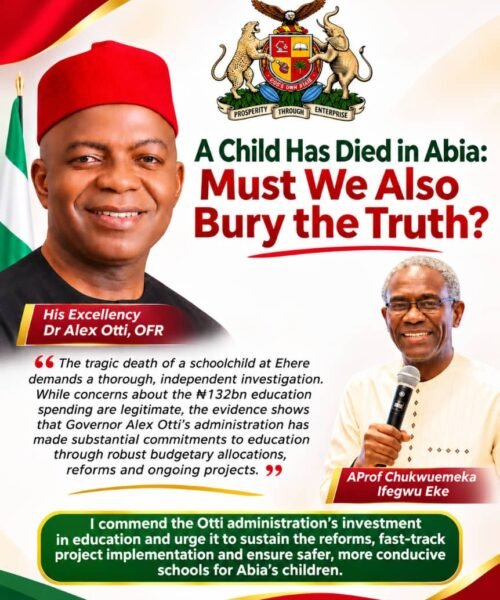
On 20 November 2026, a deteriorating school structure reportedly collapsed at Ehere in Obingwa Local Government Area.
A Primary Two pupil, identified in several reports as Vincent Chiedozie Dum, lost his life.
Other children reportedly escaped the incident.
I find it difficult to discuss this tragedy merely as another item in a media-monitoring report.
A child’s death is a human loss before it becomes a matter of public policy.
Yet public policy has an obligation to confront the conditions that place children at risk.
Governor Otti reportedly directed an investigation into the incident.
That response creates an opportunity to establish the facts and identify the institutional responsibilities involved.
The questions deserve answers.
What was the structural condition of the building?
Had defects been reported?
Which authority was responsible for inspecting and maintaining the facility?
Was the school included in a rehabilitation programme?
Were resources allocated for repairs?
If so, were those resources released and utilised?
And what immediate steps are being taken to identify similar hazards in other schools?
The investigation must determine the answers rather than allow political interests to substitute allegations for evidence.
This tragedy also brings Amartya Sen’s conception of development into sharp focus.
In Development as Freedom (1999), Sen argued that development must be understood through the expansion of people’s substantive freedoms and capabilities.
Education occupies a central place in this framework.
But education cannot be reduced to school enrolment or classroom construction.
Children must be able to attend school in conditions that support learning, dignity and safety.
A society cannot claim comprehensive educational progress merely because it has increased expenditure while dangerous infrastructure remains unaddressed.
Equally, a tragedy at one school does not, by itself, establish the condition of every school in the state.
The appropriate analytical response is therefore to examine the broader educational infrastructure system.
How many facilities have been assessed?
How many require urgent intervention?
How many have been rehabilitated?
What proportion of completed facilities meet applicable safety standards?
How effective are inspection and maintenance arrangements?
These are measurable questions.
They are more useful than either dismissing the tragedy or using it to make unsupported claims about the entire education sector.
A budget may reveal what government intends to prioritise. The condition of a classroom reveals something about what public institutions are actually delivering.
That is the uncomfortable but necessary relationship between fiscal planning and human development.
THE PUBLIC SERVICE QUESTION: WHO BELONGS TO ABIA?
Another development concerned the treatment of non-indigenes.
Reports published on 22 November indicated that the government was reviewing the circumstances surrounding the dismissal of non-indigenous workers from the Abia State Civil Service.
Deputy Governor Ikechukwu Emetu was reported to have discussed the issue during an engagement involving the Anambra community in Abia.
Governor Otti also reaffirmed the importance of fair treatment and economic opportunities for residents, irrespective of their states of origin.
This development deserves attention because inclusive institutions are central to sustainable economic growth.
A state benefits from the productive contributions of workers, entrepreneurs and professionals who may originate from different communities.
Their participation expands the labour market, strengthens commercial networks and promotes the circulation of knowledge.
Acemoglu and Robinson, in Why Nations Fail (2012), emphasised the relationship between institutional arrangements and economic prosperity.
Although their analysis concerns the deeper origins of national development, the principle is relevant to subnational governance.
Institutions that expand opportunities can encourage productive participation.
Institutions that impose arbitrary exclusions may weaken confidence and discourage investment.
I would nevertheless distinguish between reviewing previous dismissals and implementing an actual reinstatement programme.
There is also an important policy history here.
Earlier statements reported in July 2026 suggested that the administration preferred payment of outstanding entitlements to reinstatement for workers disengaged in 2011 and 2012.
The more recent reports therefore require clarification concerning the categories of workers involved and the precise remedies under consideration.
A credible resolution would identify eligibility, financial implications, employment-law considerations and the administrative procedure to be followed.
The broader economic principle remains clear.
A modern state benefits when public institutions are fair, predictable and capable of attracting productive human resources.
THE POLITICS OF DEVELOPMENT: WHEN A FALSE STATEMENT BECOMES NEWS
The seventy-two-hour monitoring period also produced a controversy surrounding a statement attributed to Governor Otti.
A social-media post claimed that the governor had declared he would not engage in conventional re-election campaigning because his achievements should speak for themselves.
The Abia State Government rejected the attribution.
Ferdinand Ekeoma, the governor’s Special Adviser on Media and Publicity, described the statement and the account associated with it as fake.
Reports subsequently documented the government’s denial.
I consider this episode important for reasons extending beyond electoral politics.
Development requires an informed public.
An informed public requires access to reliable information.
And reliable information depends on the ability to distinguish authentic official statements from fabricated claims.
Political misinformation can distort how citizens evaluate public programmes.
It may create artificial controversies, redirect public debate and make evidence-based scrutiny more difficult.
The public should neither accept favourable claims merely because they flatter an administration nor accept damaging allegations simply because they confirm an existing political position.
Both require verification.
This is especially important as Abia approaches the 2027 electoral cycle.
Public debate should examine fiscal performance, infrastructure delivery, educational outcomes, healthcare access, employment conditions and institutional reforms.
These matters are more consequential than arguments built around fabricated quotations.
ABIA NORTH AND THE POLITICAL ECONOMY OF PUBLIC EXPECTATIONS
Within the same monitoring period, reports emerged that stakeholders from Abia North had declared support for Governor Otti’s re-election.
The Alliance for Good Governance in Abia State, Abia North, reportedly held a meeting on 20 November, with coverage appearing on 21 November.
The endorsements were associated with stakeholders from the senatorial district, including prominent political figures.
Political endorsements are legitimate expressions of political preference.
But I do not treat them as direct measurements of development.
An endorsement tells us something about the position of those making it.
It does not establish how all residents assess government performance.
Nor does it substitute for independently measured development indicators.
Nevertheless, political support and public expectations are connected.
When stakeholders publicly associate themselves with an administration’s development programme, they create expectations concerning continuity, project completion and institutional performance.
Those expectations can be evaluated through the same economic questions that should apply to every administration.
What has been completed?
What remains unfinished?
What measurable benefits have emerged?
What fiscal obligations have been incurred?
And how widely are those benefits distributed?
The answer should not depend on whether the questions originate from political supporters or opponents.
ABIA THEN, ABIA NOW: WHY HISTORY MUST ENTER THE DEVELOPMENT CONVERSATION
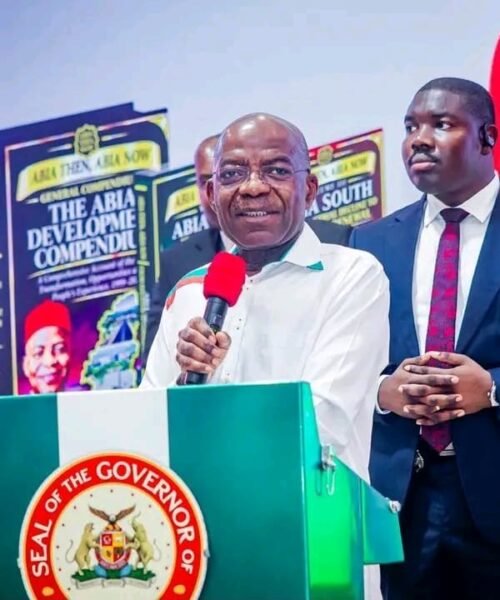
Perhaps the most personally significant development in the monitoring period concerned the public presentation of Abia Then, Abia Now.
On 22 November 2026, The Guardian reported on the unveiling of the five-volume publication documenting Abia’s governance and development experience from 1999 to 2026.
As Chief Editor of the work, I approached the project with an understanding that the economic history of a state cannot be adequately explained through isolated announcements.
Development occurs over time.
One administration inherits the assets, liabilities, institutions and unfinished projects of another.
New policies interact with previous investments.
Some initiatives produce benefits years after their commencement.
Others impose costs long after the political administration responsible for them has left office.
This is why historical documentation is essential.
Without a credible baseline, analysts may attribute every existing problem to the present administration.
Alternatively, they may credit an incumbent government with developments whose origins are more complex.
Neither approach is satisfactory.
The purpose of serious economic history is to establish continuity and change.
What was inherited?
What was improved?
What deteriorated?
Which investments produced measurable benefits?
And which institutional problems persisted across successive administrations?
These questions are particularly relevant to Abia’s 17 local government areas.
Development is not necessarily uniform across a state.
A substantial investment in Aba may produce significant commercial benefits while communities elsewhere continue to experience infrastructure deficits.
An improvement in Umuahia’s urban services may not immediately resolve development challenges in remote communities.
A comprehensive assessment therefore requires attention to geography, sectoral performance and distributional outcomes.
I consider this one of the most important contributions that historical documentation can make to development analysis.
It gives present-day political debates a longer and more rigorous frame of reference.
ACHEBE, ACEMOGLU AND SEN: THREE THINKERS, ONE DEVELOPMENT QUESTION
As I examined these developments together, I realised that the three scholars with whom I began provide complementary explanations.
Chinua Achebe’s The Trouble with Nigeria (1983) directs attention to leadership and public responsibility.
Daron Acemoglu and James A. Robinson’s Why Nations Fail (2012) emphasises the importance of institutions in shaping economic opportunities and long-term prosperity.
Amartya Sen’s Development as Freedom (1999) reminds us that development must ultimately improve human capabilities and living conditions.
These perspectives should not be treated as competing slogans.
They illuminate different dimensions of the same economic process.
Leadership influences institutional priorities.
Institutions shape the allocation and effectiveness of resources.
The resulting economic and social conditions affect human welfare.
I see these relationships reflected in the events reported in Abia.
The proposed budget concerns resource allocation.
The International Village and Diaspora City concern investment and economic diversification.
AfrICANDO concerns market opportunities and productive enterprise.
The civil-service discussion concerns institutional inclusion.
The school tragedy concerns public safety and human welfare.
The misinformation controversy concerns the integrity of public discourse.
Political endorsements concern public expectations and democratic accountability.
And Abia Then, Abia Now concerns historical evidence and the measurement of progress.
Together, they demonstrate why development cannot be adequately explained by any single indicator.
THE NINE HEADLINES AND THE ONE QUESTION THEY LEAVE BEHIND
I began this reflection by asking whether Abia was experiencing increased government activity or undergoing a deeper economic transformation.
The evidence presents a complex picture.
The administration has announced substantial public-investment priorities and initiatives intended to strengthen trade, attract investment and expand economic opportunities.
Those decisions deserve examination through their financing arrangements, implementation records and measurable outcomes.
The government has also addressed questions involving institutional inclusion and the treatment of residents from other states.
Such matters influence the credibility and fairness of public administration.
At the same time, the Ehere school tragedy exposes the importance of infrastructure maintenance, safety oversight and effective service delivery.
No serious development analysis should ignore that responsibility.
Political endorsements and campaign controversies show that the state’s development agenda is increasingly being interpreted through the approaching electoral contest.
Yet the economy does not become more productive because a political argument has been won.
It becomes more productive when infrastructure functions, institutions improve, enterprises expand and households experience better living conditions.
That is the distinction I believe must guide the conversation.
I am interested in what Abia spends.
But I am more interested in what that expenditure produces.
I am interested in attracting investors.
But I am more interested in whether their investments create sustainable employment.
I am interested in new schools.
But I am equally interested in whether existing classrooms are safe.
I am interested in the expansion of cities.
But I am also interested in whether development reaches communities beyond major urban centres.
I am interested in the historical record.
But I am especially interested in what the lessons of history can teach those entrusted with present responsibilities.
These concerns are not contradictory.
They are complementary requirements of sustainable development.
WHEN THE HEADLINES FADE
The seventy-two hours will pass.
The headlines will be replaced.
Political commentators will move to other controversies.
The proposed budget will enter the legislative and implementation processes.
Investment announcements will face the practical demands of financing and execution.
The school tragedy will require investigation and corrective action.
Questions about affected workers will need administrative resolution.
The electoral conversation will intensify.
And the historical record will continue to grow.
But one question should remain.
What will be different in the lives of Abia’s citizens when these events have passed from newspaper headlines into the permanent record of governance?
That, to me, is the development question.
Not whether an administration has attracted praise.
Not whether its critics have been silenced.
Not whether its budget contains impressive figures.
But whether the public institutions entrusted with the state’s resources are becoming more capable of delivering measurable and lasting benefits.
I return once more to Achebe, Acemoglu and Sen.
Leadership matters.
Institutions matter.
People matter.
And development becomes meaningful when the three are brought into a productive relationship.
Abia stands at an important point in its economic and institutional journey.
The emerging development agenda creates opportunities.
The unresolved challenges impose responsibilities.
History will examine both.
And perhaps, when future scholars return to the events of November 2026, they will discover that the most important story was not the size of the budget, the announcement of a new city or even the intensity of the political arguments.
Perhaps they will ask a more demanding question.
Did Abia succeed in converting the promise of development into institutions that improved the lives of its people?
That is the question I would leave with Governor Otti, his administration, the political opposition and every citizen concerned about Abia’s future.
Because development is not merely what a government promises.
It is what its people eventually experience.
And that is the real burden of expectations at Abia’s crossroads.
AProf Chukwuemeka Ifegwu Eke
Associate Professor of Economics
Department of Economics
University of Abuja, Nigeria
23 November 2026