
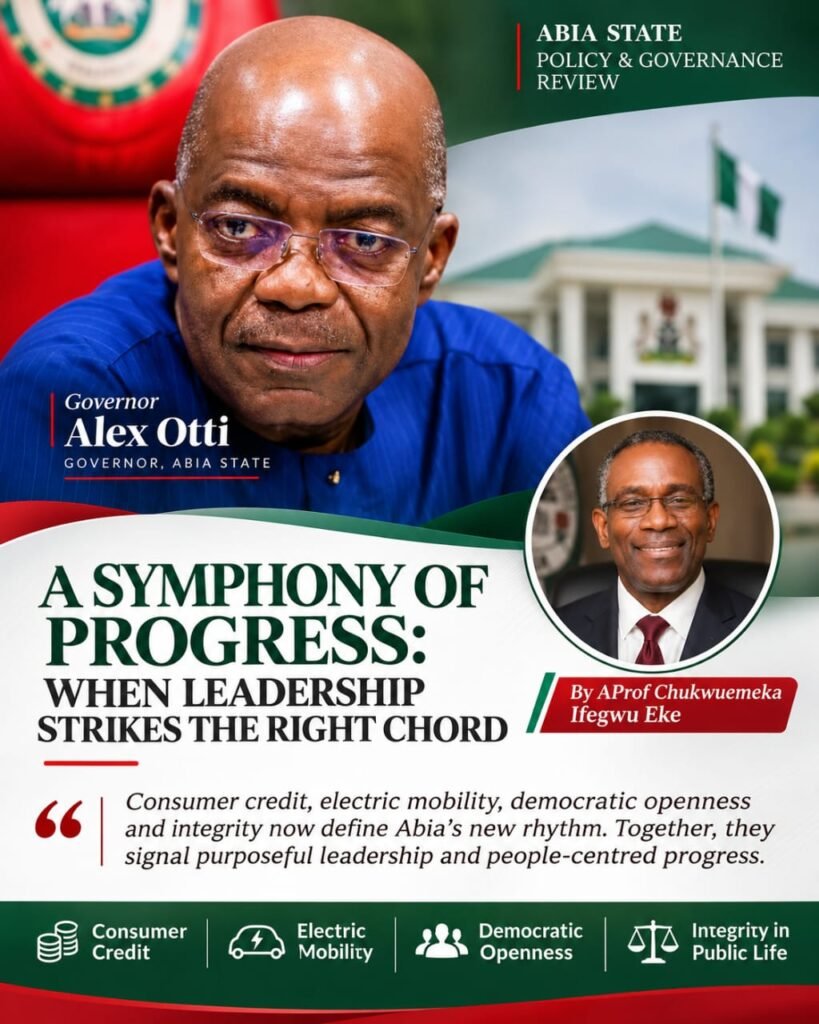
A SYMPHONY OF PROGRESS: WHEN LEADERSHIP STRIKES THE RIGHT CHORD
By AProf Chukwuemeka Ifegwu Eke
There is something remarkable about a well-conducted symphony. Different instruments produce different sounds, yet they respond to one conductor, follow one composition, and ultimately deliver one harmonious performance. The beauty lies not merely in the individual instruments but in the coordination that transforms separate sounds into a coherent musical experience.
I see a similar pattern emerging in Abia State under the leadership of Governor Alex Chioma Otti.
Across economic development, financial inclusion, transportation, political administration, and social reorientation, I observe a government pursuing different initiatives that share a common objective: building a more productive, responsible, competitive, and prosperous Abia.
Interestingly, the national media have recently captured these developments from different perspectives. When I bring these reports together, I find that they tell a larger story about the direction of governance in Abia State.
THE FIRST MOVEMENT: ECONOMIC INCLUSION AND THE SOUND OF OPPORTUNITY
On November 4, 2026, Ogbonnaya Ikokwu, writing for The Punch, reported that Governor Alex Otti had commended the Federal Government for facilitating consumer credit access for more than 1,000 residents of Abia State.
The report concerned the activities of the Nigerian Consumer Credit Corporation (CREDICORP), including the introduction of SPARK, a USSD-based credit product designed to improve access to formal financing.
Similarly, Gordi Udeajah, writing in The Guardian on October 31, 2026, reported that CREDICORP had extended ₦53.5 billion in consumer credit to approximately 351,000 Nigerians, including more than 1,000 beneficiaries in Abia State.
I consider these developments significant because access to affordable and responsible credit remains an important component of economic participation.
For traders, artisans, transport operators, young entrepreneurs, and working families, financial inclusion can provide the means to acquire productive assets, improve living standards, and expand economic opportunities.
What interests me particularly is the administration’s willingness to cooperate with the Federal Government where such cooperation serves the interests of Abia residents.
I believe that development should never become a casualty of political differences. Where an initiative benefits our people, responsible leadership must recognise its value and create the conditions necessary for its success.
In Abia, I see this approach reflected in the government’s efforts to strengthen the business environment and encourage investment.
This is an important movement in the larger symphony: economic empowerment through productive partnerships.
THE SECOND MOVEMENT: ELECTRIC MOBILITY AND THE RHYTHM OF INNOVATION
Another important development concerns the administration’s preference for electric buses in its public transportation programme.
On November 2, 2026, Premium Times, in a News Agency of Nigeria report, published an explanation of Governor Otti’s decision to adopt electric vehicles rather than Compressed Natural Gas-powered buses for public transportation.
The same policy position was reported by Vanguard on October 31, 2026, while Afia Television also highlighted the governor’s explanation through its digital media platforms.
The central argument was straightforward: electric vehicles represent a technological advancement in transportation.
Importantly, the governor did not dismiss CNG technology. He acknowledged its economic advantages over petrol and expressed support for additional CNG infrastructure to serve private and commercial vehicle owners.
I find this distinction important.
It demonstrates that the government’s transportation policy is not necessarily a choice between competing technologies but an attempt to accommodate different mobility needs while positioning public transportation for future technological developments.
As an economist, I recognise that technological choices must ultimately be evaluated through their costs, reliability, supporting infrastructure, maintenance requirements, and benefits to users.
The administration’s preference for electric mobility therefore deserves attention not simply as an innovation but as a policy decision whose long-term success will depend on effective implementation.
I want an Abia where transportation becomes increasingly accessible, efficient, affordable, and environmentally responsible.
I also want our young people to recognise the opportunities associated with emerging transport technologies, including technical maintenance, charging infrastructure, renewable energy, and digital transport management.
For me, this movement is about preparing our economy for the future rather than remaining permanently dependent on yesterday’s technologies.
THE THIRD MOVEMENT: POLITICAL MATURITY AND THE HARMONY OF DEMOCRACY
On November 2, 2026, Premium Times, drawing on a News Agency of Nigeria report, published an important account of Governor Otti’s position on political competition ahead of the 2027 elections.
Speaking during the flag-off of the Labour Party’s election campaign in Umuahia, the governor warned supporters against attacking opposition parties or obstructing their legitimate political activities.
He also stated that opposition parties should be permitted to use public facilities subject to established procedures.
I consider this an important declaration because democracy cannot flourish where political competition is treated as an offence.
Political parties may disagree over policies, priorities, and leadership choices. Such disagreements are legitimate features of democratic governance.
What must remain protected is the right of citizens to participate peacefully in the political process.
I believe that an administration confident in its record should welcome scrutiny, competing ideas, and open debate.
The responsibility of government extends beyond its supporters. Public institutions belong to the people, and their administration must reflect fairness, accountability, and respect for the law.
The governor’s reported position therefore establishes an important standard against which the conduct of political actors and public institutions can be assessed.
I regard this as another essential movement in Abia’s development symphony: strengthening democratic culture while maintaining the continuity of governance.
THE FOURTH MOVEMENT: INTEGRITY AND THE MORAL COMPOSITION OF SOCIETY
On November 2, 2026, Henry Adedeji, reporting for Channels Television, published a story titled Gov Otti Moves To End Culture Of Honouring Questionable Characters.
The report followed the governor’s remarks at the 90th birthday celebration of Emeritus Professor Benson Oluikpe in Umuahia.
Governor Otti expressed concern about a society that sometimes celebrates individuals of questionable character while overlooking people whose achievements, integrity, and contributions deserve recognition.
He also referred to the recent recognition of five Abia schoolchildren who distinguished themselves at an international competition in Qatar.
I believe this aspect of governance deserves serious attention.
Economic development cannot be sustained by infrastructure and financial investments alone. It also requires a social environment in which honesty, discipline, excellence, and productive achievement are respected.
The values celebrated by a society inevitably influence the aspirations of its younger generation.
When young people observe that wealth attracts recognition regardless of its source, the consequences can extend beyond individual behaviour to the broader economic and institutional environment.
Conversely, when genuine achievement, intellectual contribution, entrepreneurship, and public service receive recognition, society creates stronger incentives for productive conduct.
I therefore see the governor’s emphasis on integrity as part of a wider effort to influence the values that shape Abia’s future.
I want our schools, universities, businesses, communities, and public institutions to celebrate achievement that can withstand public scrutiny.
I want young Abians to understand that excellence does not require dishonesty and that public recognition should be accompanied by responsibility.
This is the moral movement of the symphony.
WHEN THE DIFFERENT MOVEMENTS BECOME ONE COMPOSITION
What connects these developments?
Consumer credit addresses access to economic opportunities.
Electric mobility introduces a technological dimension to public transportation.
Respect for political competition strengthens democratic participation.
The promotion of integrity seeks to establish positive standards of public recognition and social conduct.
Each initiative addresses a different aspect of society. Yet together, they suggest an approach to governance that recognises the relationship between economic opportunity, technological advancement, institutional conduct, and social values.
I believe this relationship deserves greater attention in public discussions about Abia State.
It is not enough to build roads without encouraging productive economic activities. It is not enough to introduce new technologies without developing the skills and infrastructure required to sustain them.
Similarly, economic progress becomes vulnerable where public institutions lack credibility or where society rewards conduct that undermines collective development.
The strength of a development programme therefore depends not only on individual projects but also on the relationship between them.
This is precisely why I find the musical analogy compelling.
An orchestra does not achieve harmony because every instrument plays the same note. Harmony emerges because different instruments perform their respective parts within a coordinated composition.
THE CONDUCTOR AND THE CONTINUING PERFORMANCE
I recognise Governor Alex Otti’s leadership as the coordinating force behind the Abia State Government’s current development agenda.
However, I also recognise that a symphony is never judged by the conductor’s intentions alone.
Its quality must ultimately be determined by what the audience hears.
In governance, that audience is the people.
The success of consumer credit initiatives must be reflected in meaningful access to finance. Transportation reforms must translate into reliable services. Democratic commitments must be demonstrated through institutional conduct. The promotion of integrity must influence public appointments, recognition, and accountability.
These are the practical standards by which progress should be measured.
I remain supportive of the administration’s commitment to economic renewal, institutional strengthening, technological advancement, and responsible governance.
I also understand that development is a continuing process requiring consistency, disciplined implementation, and measurable results.
A great symphony is not completed with its opening movement.
Its beauty unfolds as the composition develops, the instruments remain coordinated, and the conductor maintains the discipline necessary to bring the performance to its intended conclusion.
For Abia State, I believe the task is to sustain the momentum of reform while ensuring that ordinary citizens experience its benefits.
When economic opportunity finds its rhythm, innovation meets purposeful leadership, democracy retains its harmony, and integrity becomes a shared social value, the different movements of governance can produce something truly meaningful.
That is the symphony of progress I see taking shape in Abia State.
And that is what it means when leadership strikes the right chord.
AProf Chukwuemeka Ifegwu Eke
Associate Professor of Economics
University of Abuja, Nigeria