
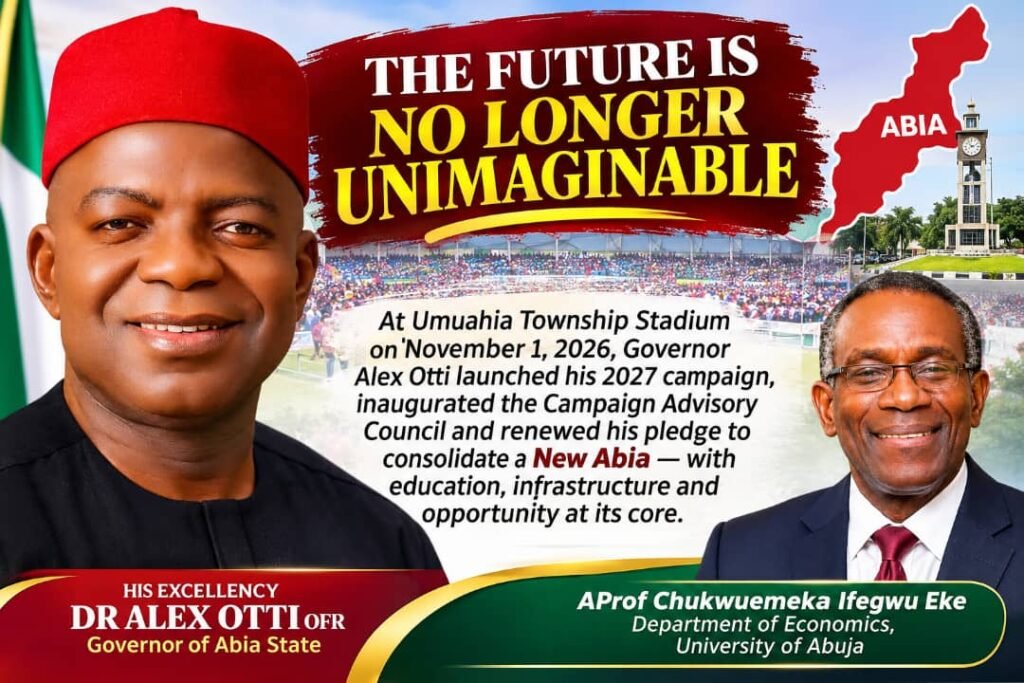
THE FUTURE IS NO LONGER UNIMAGINABLE
Alex Otti, November 1, and My Walk Through the History of a Changing Abia
By AProf Chukwuemeka Ifegwu Eke
Department of Economics, University of Abuja
History has a curious way of returning me to the places where my convictions were formed. Sometimes, it returns through the pages of a book. Sometimes, through the corridors of an old school. And sometimes, through a political gathering whose significance extends far beyond the occasion that brought people together.
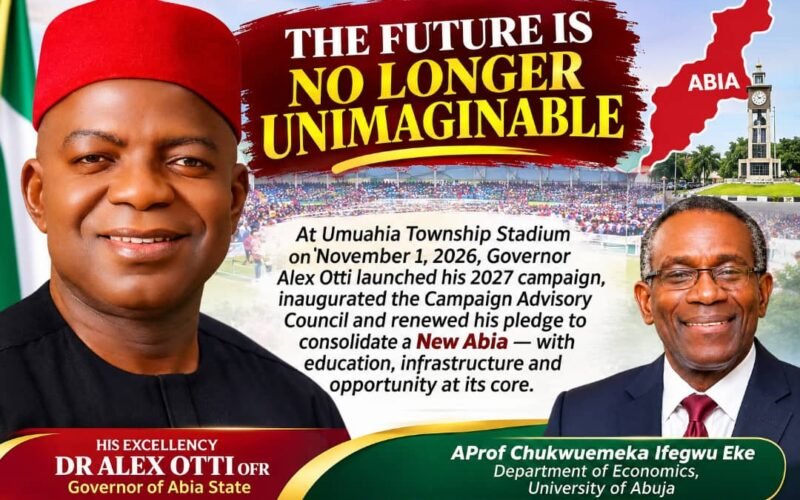
On Sunday, November 1, 2026, that place was Umuahia Township Stadium.
Governor Alex Chioma Otti had gathered members and supporters of the Labour Party for the formal commencement of his 2027 re-election campaign and the inauguration of the Campaign Advisory Council.
Yet, as I reflected on the occasion, my thoughts travelled considerably farther than the stadium.
I travelled backwards through history.
I returned to Lagos, where I was born. I returned in memory to Abiriba, the ancestral home that defines my identity as an Abiriba son. I returned to Ngwa High School in Aba, where an important chapter of my education unfolded before I left in 1988.
And then I travelled forward again, through the experiences that eventually brought me into the academic environment of the University of Abuja.
Across these places and experiences, one question has remained remarkably persistent: What does it take for a society to move from imagining a better future to constructing one?
It is a question I have examined professionally as an economist.
It is also a question I have lived personally as a Nigerian whose history is deeply connected with Abia State.
THE ABIRIBA SON BORN IN LAGOS
I was born in Lagos, but my ancestral identity is Abiriba, in Ohafia Local Government Area of Abia State.
There is something profoundly instructive about belonging to one place while beginning life’s journey in another.
Lagos introduced me to the wider Nigerian experience. Abiriba provided the ancestral connection through which I understood belonging, heritage and community.
My subsequent education in Aba added another dimension to that identity.
Ngwa High School was part of my formative journey. When I left in 1988, I could not have anticipated the many directions my life would subsequently take.
Neither could I have imagined that, nearly four decades later, the condition and future of that institution would become part of a wider conversation about governance and development in Abia.
But history has a remarkable capacity to connect experiences that once appeared unrelated.
The schoolboy of 1988 and the university academic of 2026 are separated by years of learning, work and reflection.
Yet they remain connected by a common conviction: education is among the most important instruments through which a society changes its future.
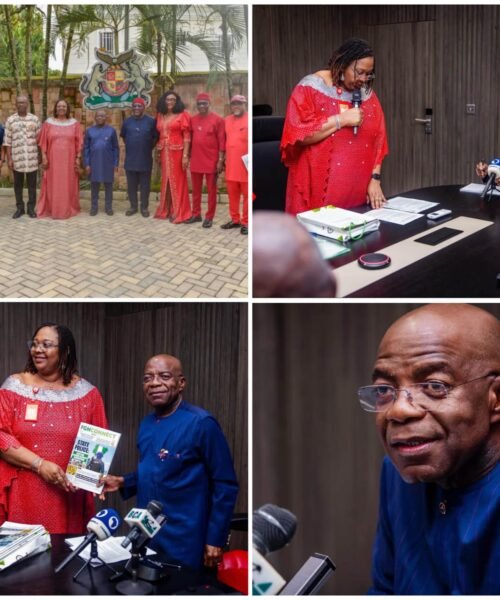
That conviction helps explain why Governor Otti’s recent engagement with the Ngwa High School Old Boys Association attracted my attention.
The governor’s reception by the old boys, and the discussions surrounding the rehabilitation of the institution, brought the question of educational renewal directly into a place that has personal significance for me.
And there is another interesting intersection of history. My friend and schoolmate from Ngwa High School, Barrister Onyebuchi Ememanka, now serves as Director-General of the Abia State Strategic Communications Bureau. I recall his reflections on his years as Chief Press Secretary to former Governor Okezie Ikpeazu and the memorable manner in which he signed off as that administration departed in May 2023. Today, he serves under Governor Alex Otti. For someone like me, who shared the Ngwa High School experience with him, the transition is a fascinating reminder that political chapters close, new chapters open, but personal history continues to connect the actors across generations and administrations.
I do not regard the renewal of an old school merely as a matter of reconstructing buildings.
I see classrooms that may produce tomorrow’s professionals.
I see laboratories that may nurture future scientists.
I see teachers whose influence may extend far beyond their working lives.
I see young people whose opportunities will be shaped by decisions made long before they fully appreciate their consequences.
And I see, through the familiar name of Ngwa High School, a reminder that the future of a state is inseparable from the future of its children.
WHEN HISTORY ARRIVED AT UMUAHIA TOWNSHIP STADIUM
The November 1 gathering brought Governor Otti’s political journey into renewed public focus.
His emergence as governor in 2023 had followed earlier unsuccessful attempts to secure the office.
That history matters.
Political leadership does not begin on the day an individual assumes office. It is often preceded by years of argument, political organisation, public expectations and competing visions of government.
For Otti, the transition from governorship aspirant to sitting governor introduced a fundamentally different responsibility.
Political promises had to encounter administrative realities.
Campaign arguments had to confront budgetary limitations.
Public expectations had to be addressed through institutions, policies and implementation.
It is one thing to describe what a government ought to do. It is another to organise the resources, personnel and systems required to do it.
As an economist, I recognise that difference.
The governor’s November 1 campaign launch therefore represented more than another political declaration. It provided an occasion for examining the relationship between the expectations associated with his 2023 victory and the record of his administration since assuming office.
The occasion also featured the inauguration of a Campaign Advisory Council chaired by former Deputy Governor Ude Oko Chukwu.
The governor retained Deputy Governor Ikechukwu Emetu as his running mate.
These developments established important elements of the Labour Party’s organisational preparations for the 2027 election.
But the larger question extends beyond campaign organisation.
It concerns the meaning of continuity in public administration.
THE DIFFERENCE BETWEEN CHANGE AND TRANSFORMATION
I have spent years examining the relationship between public policy and economic outcomes.
My experience at the University of Abuja has continually reinforced one lesson: a society does not become prosperous simply because its political leadership changes.
Leadership change creates an opportunity.
Transformation depends on what that opportunity produces.
A road becomes economically meaningful when it reduces transportation costs, improves market access and facilitates productive activity.
An educational investment becomes meaningful when it improves learning, strengthens human capital and widens opportunity.
A healthcare intervention becomes meaningful when people receive accessible and effective services.
Public financial reforms become meaningful when they improve accountability and the efficiency of expenditure.
These are the standards through which I approach the development conversation in Abia.
Governor Otti’s administration has emphasised infrastructure renewal, education, healthcare, public financial management and institutional reform.
Its supporters point to projects and administrative changes as evidence of progress.
Critics continue to raise questions about project coverage, expenditure priorities, implementation and the distribution of development benefits.
I consider both the claims and the questions important.
Development must be examined through evidence rather than reduced to political applause or political hostility.
An administration’s achievements deserve recognition where they are established. Its shortcomings deserve scrutiny where they remain unresolved.
That, to me, is the foundation of responsible public analysis.
NGWA HIGH SCHOOL AND THE RESPONSIBILITY TO FUTURE GENERATIONS
I return again to Ngwa High School.
There is a reason this institution occupies such an important place in my reflection.
I was once a student whose future depended, in part, on the educational opportunities available to me.
I subsequently travelled beyond that environment and built a career in higher education.
Today, when I consider the rehabilitation of public educational institutions, I see more than infrastructure expenditure.
I see the economic consequences of opportunity.
I see the possibility of social mobility.
I see the relationship between the quality of today’s education and the productive capacity of tomorrow’s society.
The recent engagement between Governor Otti and the Ngwa High School Old Boys Association therefore represents an opportunity to examine the practical commitments required to restore the institution.
Announcements and pledges are important beginnings.
Implementation is the decisive test.
I would want to see rehabilitation commitments translated into functional classrooms, improved facilities, strengthened teaching and sustainable institutional management.
I would want the young people passing through that school today to encounter educational opportunities that prepare them for an increasingly competitive world.
My expectations arise not merely from nostalgia but from my professional understanding of education as a foundation of economic development.
The development of human beings must remain central to the development of a state.
FROM ABIRIBA TO ABUJA: THE ECONOMICS OF POSSIBILITY
My academic journey has repeatedly demonstrated that development is never an isolated event.
It is the cumulative outcome of investments, institutions and decisions made over time.
As an Abiriba son born in Lagos, educated in Aba and professionally established at the University of Abuja, I have experienced the geographical breadth of Nigeria.
I have also observed the uneven opportunities available across different communities.
Some young people encounter functioning educational institutions.
Others must struggle against inadequate facilities and limited resources.
Some communities enjoy reliable infrastructure.
Others remain constrained by the absence of essential public services.
These differences influence economic productivity, social mobility and the quality of life.
Consequently, whenever I examine the record of a government, I am interested not only in the projects it announces but also in their distribution, accessibility and long-term effects.
For Abia, that means considering the needs of Aba and Umuahia alongside those of Abiriba, Ohafia and communities across the state’s seventeen local government areas.
Development becomes more meaningful when its benefits extend beyond prominent urban centres.
It becomes more sustainable when institutions are capable of maintaining those benefits.
And it becomes more inclusive when ordinary citizens can participate in the economic opportunities it creates.
THE GOVERNOR’S DEMOCRATIC MESSAGE
Another aspect of Governor Otti’s November 1 address deserves attention.
He called for peaceful political campaigns and urged supporters to avoid intimidation and personal attacks.
He also stated that opposition parties should be able to access public facilities for legitimate political activities, subject to the appropriate procedures.
For me, these declarations raise an important institutional question.
How should political power be exercised in a democratic society?
The answer cannot depend exclusively on the preferences of whoever occupies Government House.
Democratic rights must be protected consistently.
Opposition parties must be permitted to organise lawfully.
Citizens must be free to express political disagreement without fear of unlawful retaliation.
Public institutions must operate according to established rules rather than partisan preferences.
The governor’s statements therefore establish commitments against which the conduct of the campaign and relevant public authorities can be assessed.
Democracy requires more than competitive elections.
It requires the preservation of the civic space in which those elections take place.
THE FUTURE IS NO LONGER UNIMAGINABLE
As I consider the political developments of November 1, I find myself returning once more to my personal history.
I think about Lagos, where my life began.
I think about Abiriba, where my ancestral identity is rooted.
I think about Ngwa High School, Aba, which I left in 1988.
I think about the University of Abuja, where my academic journey has provided opportunities to examine the forces that shape economies and societies.
And I think about Abia State, whose political future is once again the subject of vigorous public debate.
I have walked through enough history to appreciate that progress is neither automatic nor permanent.
Political promises may inspire hope, but institutions must sustain results.
Infrastructure may change the physical appearance of communities, but development must also improve the lives of their inhabitants.
Educational investment may begin with the restoration of buildings, but its ultimate achievement lies in the opportunities created for students.
The inauguration of a campaign council may mark the beginning of another electoral contest, but the lasting significance of political leadership is established through governance.
These distinctions matter.
The November 1 gathering has opened another chapter in Abia’s democratic journey.
Governor Otti has presented his argument for continuity.
Other political actors will present their own visions and assessments.
Citizens will examine the competing records, commitments and proposals.
For me, the most meaningful question is not simply who occupies political office after the next election.
It is whether the institutions, investments and opportunities being created today will make Abia a more productive, accountable and prosperous society tomorrow.
That is the question I carry from my childhood memories to my professional life.
It is the question I carry from Abiriba to Aba and from Aba to Abuja.
It is the question that gives the events of November 1 a significance extending beyond the stadium.
For generations, a better future has remained an enduring aspiration of the people of Abia.
The challenge now is to determine how much of that aspiration has been translated into reality and what further work is required.
I have walked through history.
I have witnessed the passage of generations.
I have learned that the most consequential changes are not always the loudest.
Sometimes, they begin with the restoration of a school, the strengthening of an institution, the opening of an economic opportunity or the recognition that public leadership must be judged by its effects on human lives.
And so, as I reflect upon the events at Umuahia Township Stadium on November 1, 2026, one thought remains with me:
The future is no longer unimaginable.
But imagining it is only the beginning. Building it—and ensuring that it endures—is the greater responsibility.
AProf Chukwuemeka Ifegwu Eke
Department of Economics
University of Abuja
November 2, 2026