

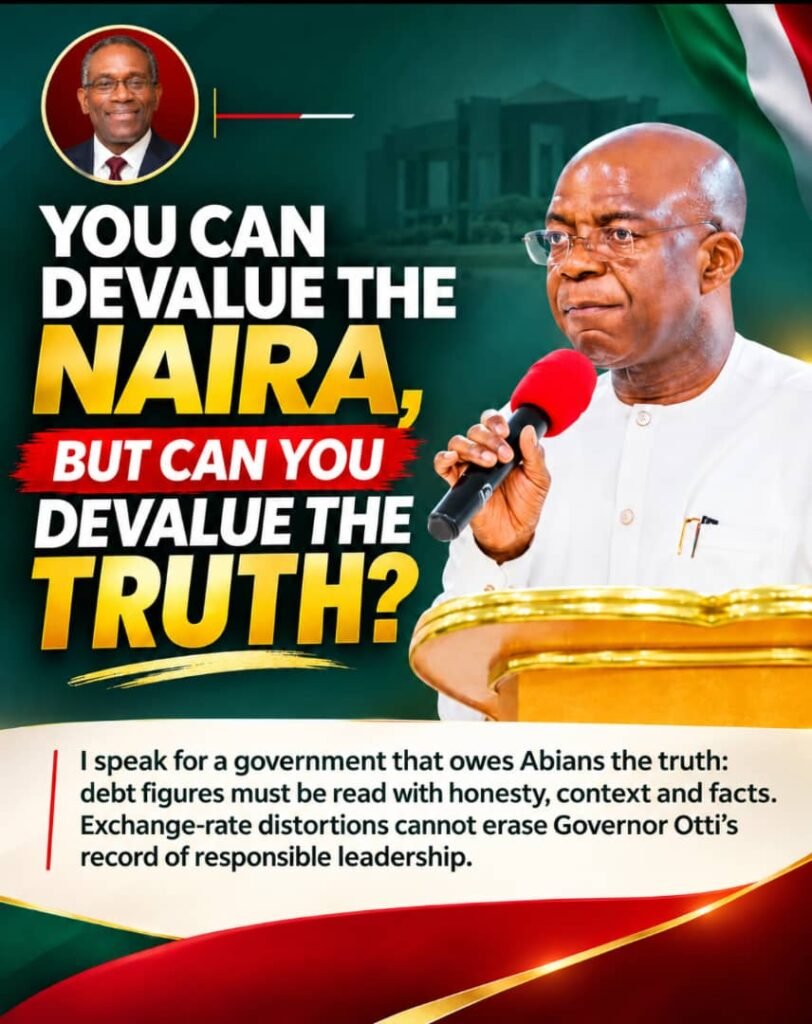
YOU CAN DEVALUE THE NAIRA, BUT CAN YOU DEVALUE THE TRUTH?
THE ABIA DEBT DEBATE
Sunday, November 1, 2026
I have seen the latest attempt to challenge the debt-reduction figures disclosed by His Excellency, Dr. Alex Chioma Otti, OFR, Governor of Abia State.
The argument being circulated is that the Governor’s announcement of substantial debt repayments must be false because the combined naira value of the state’s domestic and external obligations has increased.
I reject that reasoning.
My position is straightforward: an increase in the naira valuation of outstanding debt is not, by itself, evidence that an equivalent amount of fresh borrowing has occurred.
Anyone challenging the government’s financial disclosures must distinguish debt repayment from debt valuation, new borrowing from existing loan disbursements, and domestic liabilities from foreign-currency obligations.
THE ₦98.6 BILLION QUESTION
During his October 2026 media engagement, Governor Otti disclosed that Abia’s reported debt stock had declined from ₦147.2 billion in the second quarter of 2023 to ₦48.6 billion in the corresponding quarter of 2026.
That represents a difference of ₦98.6 billion.
The Governor explained that the administration had paid down inherited obligations. He further disclosed that the debt position inherited in 2023 included outstanding pension and salary obligations that were not fully reflected in the Debt Management Office’s reported figures.
I stand by the importance of this disclosure.
The opposition cannot establish that repayments never happened merely by presenting a different aggregation of debt figures. To challenge a repayment claim properly, the relevant opening balances, repayments, disbursements and closing balances must be reconciled.
I am prepared to defend that accounting principle anywhere.
THE EXCHANGE-RATE QUESTION
Let me address the central weakness in the argument being circulated.
Suppose a government owes $100 million.
At ₦750 to the dollar, that obligation is valued at ₦75 billion.
At ₦1,400 to the dollar, the same $100 million is valued at ₦140 billion.
The difference is ₦65 billion.
Did the government necessarily borrow another ₦65 billion? No.
The foreign-currency obligation remained unchanged in this illustration. What changed was the exchange rate used to express it in naira.
That is why I reject any attempt to treat every increase in the naira value of external debt as fresh borrowing.
I equally recognise that exchange-rate depreciation is not necessarily the only explanation for changes in foreign debt. New disbursements, repayments and other adjustments must also be considered.
My position requires the entire financial movement to be explained, not merely whichever component produces the most dramatic headline.
THE OPPOSITION’S ₦19.21 BILLION ARGUMENT
The circulating graphic compares a reported total of ₦213.60 billion in June 2023 with ₦232.81 billion in June 2026.
It concludes that the combined naira-denominated debt increased by ₦19.21 billion.
I do not dispute the arithmetic of subtracting one figure from another.
What I dispute is the attempt to make that subtraction answer a completely different question.
The graphic itself acknowledges that the increase includes exchange-rate effects and does not entirely represent fresh borrowing.
That admission matters.
I therefore challenge those advancing the argument to provide a complete reconciliation showing the domestic debt movement, the foreign-currency debt movement, the exchange rates applied, the amounts repaid and the additional disbursements recorded.
A comparison of two totals is not a substitute for that exercise.
EXISTING LOANS ARE NOT THE SAME AS NEW LOAN AGREEMENTS
Governor Otti has also addressed the increase in the state’s foreign debt obligations.
He explained that funds had been drawn from existing multilateral arrangements, including the Abia State Integrated Infrastructure Development Project and the Rural Access and Agricultural Marketing Project.
He maintained that his administration had not undertaken direct borrowing, distinguishing that position from disbursements under previously existing financing arrangements.
I consider this distinction essential.
A loan facility can be approved before an administration assumes office, while portions of the facility are disbursed during that administration.
Those subsequent disbursements can increase outstanding liabilities.
Consequently, I will not describe a drawdown from an existing facility as proof that an entirely new financing agreement has been executed.
Neither will I pretend that such drawdowns have no effect on outstanding debt.
My responsibility is to defend the government’s actual financial explanation, not to replace it with accounting shortcuts.
THE GOVERNMENT’S FINANCIAL POSITION
I want the distinction clearly understood.
The government’s position, as presented by Governor Otti, is that substantial inherited debt obligations have been paid down, while changes in external debt also reflect disbursements under existing multilateral facilities.
That is a position capable of being examined through financial records.
I do not accept the suggestion that government accountability requires every category of debt to move in precisely the same direction at precisely the same time.
It does not.
Domestic debt may decline while external obligations increase.
The naira value of foreign debt may rise because of depreciation.
Existing development facilities may generate disbursements while older obligations are being repaid.
These circumstances can occur simultaneously.
What matters is that each movement is identified and accounted for correctly.
MY RESPONSE TO THE OPPOSITION
I have no difficulty with rigorous scrutiny of Abia’s public finances.
Indeed, I welcome it.
But I challenge the opposition to elevate this discussion beyond slogans and selective figures.
If the allegation is that no debt was repaid, let the evidence establish that.
If the allegation is that new loans were contracted, let the relevant agreements be identified.
If the allegation is that the government’s figures omit certain categories of liabilities, let the disputed categories be specified.
And if the argument concerns the combined naira valuation of domestic and external debt, let it be presented as exactly that.
I will not accept a change in debt valuation being casually presented as proof of fresh borrowing.
That is not the standard of financial analysis I am prepared to defend.
MY FINAL POSITION
I remain unequivocal in defending the need for a fair and complete assessment of Governor Otti’s debt-management disclosures.
I defend the distinction between paying down inherited obligations and reporting the naira equivalent of outstanding foreign debt.
I defend the distinction between drawing down existing development facilities and entering into new loan agreements.
I defend the principle that public financial claims must be assessed on comparable accounting bases.
I also insist that government figures must withstand verification against the underlying records.
The administration has publicly explained its position. Those challenging it are entitled to examine the evidence, but their conclusions must follow from the evidence rather than from the dramatic presentation of selected numbers.
I will not allow an accounting distinction to disappear simply because it makes a headline less sensational.
You can devalue the naira, but can you devalue the truth?
I insist that the truth must be established by complete records, transparent reconciliation and economic reasoning.
That is the standard I defend. And that is the standard by which every competing claim must be judged.