

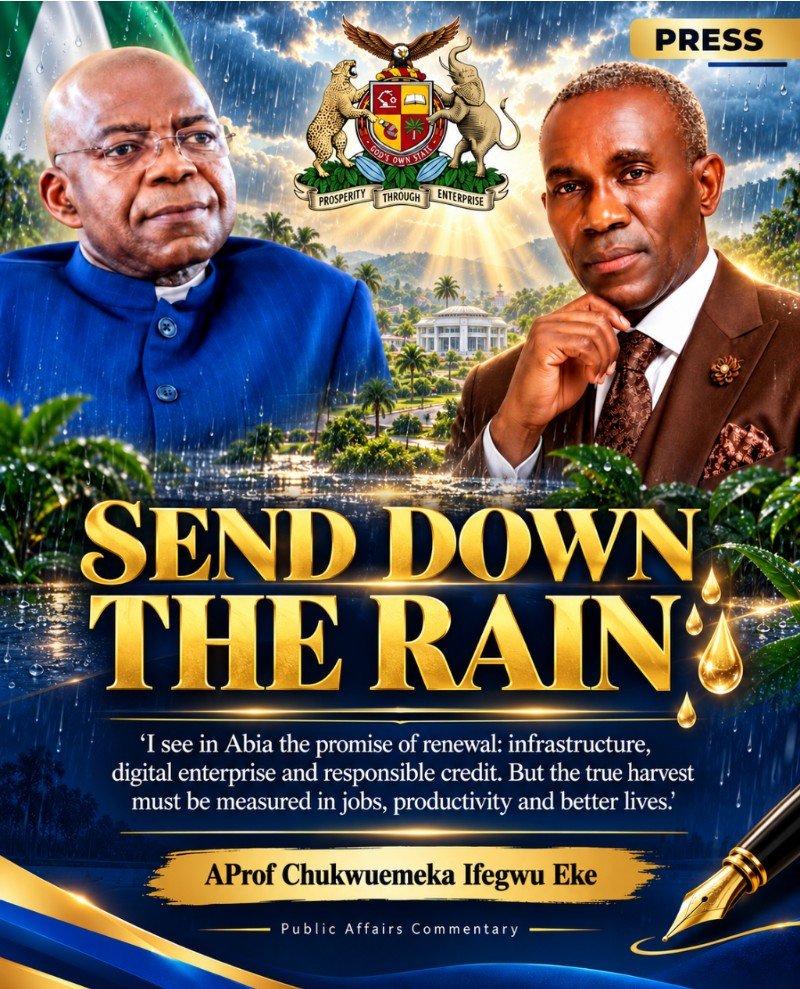
SEND DOWN THE RAIN
By AProf Chukwuemeka Ifegwu Eke
There was something profoundly spiritual about the legendary Majek Fashek and his timeless musical appeal, Send Down the Rain. Whenever I reflect on that extraordinary composition, I hear something beyond the rhythm of reggae. I hear the cry of a people yearning for relief, the anguish of a land exhausted by drought, and the expectation that someday, somehow, the heavens will open. To me, Majek Fashek was not merely asking for rainfall. He was invoking renewal. He was expressing that universal human desire to see the barren become fertile, the hopeless rediscover hope, and the seemingly impossible become possible. Rain, in this context, is more than water descending from the clouds. It is the arrival of possibilities after prolonged deprivation.
I have always considered rain one of nature’s most democratic gifts. It does not consult political affiliations before falling. It does not discriminate between the wealthy and the poor. When the heavens open, the farmer sees a harvest, the trader anticipates increased purchasing power, the industrialist sees renewed economic activity, and the ordinary household welcomes relief from the oppressive heat. Yet, I also recognise that rainfall alone does not guarantee a harvest. The soil must be prepared, the seeds must be planted, and the farmer must possess the discipline to cultivate what nature has provided. This is where I find the deeper economic meaning of Majek Fashek’s metaphor. The arrival of rain creates opportunities, but only preparation, investment, productive enterprise and responsible management can convert those opportunities into prosperity.
It is against this background that I have followed developments in Abia State under Governor Alex Otti with considerable intellectual interest. For too long, I believe, the economic conversation around Abia was dominated by the enormous gap between its commercial potential and its development outcomes. Here is a state blessed with remarkable entrepreneurial energy, a commercially vibrant population, an established manufacturing tradition and one of West Africa’s most recognisable centres of indigenous enterprise. Yet the persistence of infrastructural difficulties, inadequate access to finance and institutional weaknesses constrained the full expression of that potential. In my understanding, Abia never suffered from a shortage of entrepreneurial talent. What it lacked was sufficient institutional rainfall to nourish that talent.
Today, I see signs of a deliberate attempt to change that narrative. I do not suggest that every problem has disappeared or that every promise has been fulfilled. Economic transformation is neither instantaneous nor magical. Nevertheless, I recognise the importance of a government that increasingly places infrastructure, enterprise development, investment confidence and institutional reform at the centre of its economic philosophy. I see in this approach an understanding that sustainable prosperity cannot be commanded into existence through political declarations. It must emerge from the interaction of productive people, functioning institutions, accessible finance, modern technology and an enabling business environment.
This brings me to Governor Otti’s presentation at the maiden Chidi Anyaegbu Annual Public Lecture at Chukwuemeka Odumegwu Ojukwu University, Igbariam, on October 29, 2026. The lecture, centred on connecting indigenous business knowledge with modern investment strategies, raised issues I consider fundamental to the future of the South-East economy. Particularly significant was the emphasis on moving beyond restrictive traditional business models towards joint ventures, sustainable partnerships and production-driven enterprise. “New Telegraph” (https://newtelegraphng.com/era-of-sole-proprietorship-over-says-gov-otti/) reported the governor’s call for greater collaboration among entrepreneurs and a stronger orientation towards production.
I find this argument compelling because the economic strength of the South-East has historically rested on entrepreneurship, commercial networks, apprenticeship and indigenous capital formation. However, I also recognise that the business environment of the twenty-first century is fundamentally different from that of previous generations. Technology has compressed distances, transformed markets, altered consumer behaviour and introduced new forms of competition. An enterprise that refuses to modernise risks losing relevance, irrespective of its historical achievements.
For me, digital entrepreneurship is therefore not a fashionable slogan. It is an economic necessity.
I envisage an Abia where the Aba manufacturer does not depend exclusively on customers physically visiting a shop; where digital platforms connect locally manufactured products to national and international markets; where artisans use technology to manage inventories, receive payments and build customer relationships; and where young entrepreneurs can establish scalable businesses without being constrained by geographical boundaries.
I also envisage a commercial environment in which entrepreneurs increasingly embrace shared ownership, cooperative investment, professional management and improved corporate governance. I believe that the future of indigenous enterprise requires a gradual transition from businesses built entirely around the personality of their founders to institutions capable of surviving generations. The entrepreneurial ingenuity that built Aba must now be strengthened by digital competence, structured finance, research, innovation and strategic partnerships.
In this respect, I consider Governor Otti’s message particularly timely. I see an opportunity to move the conversation from merely celebrating indigenous entrepreneurship to deliberately increasing its productivity, competitiveness and capacity to create sustainable employment.
The recent unveiling of the Nigerian Consumer Credit Corporation’s SPARK initiative in Aba reinforces this wider discussion. The programme introduces a USSD-based pathway through which eligible Nigerians, including first-time borrowers, can begin accessing formal credit without requiring smartphones or internet connectivity. The launch also highlighted financing opportunities for traders, young people and other economic participants. Governor Otti, represented at the event by Chinenye Mba-Uzoukwu, reaffirmed his administration’s commitment to creating conditions that support investment and responsible credit. (“TheCable” (https://www.thecable.ng/credicorp-unveils-ussd-based-product-to-ease-credit-access-for-nigerians-without-internet-connectivity/))
I consider this development significant for one fundamental reason: an economy cannot achieve its productive potential when commercially viable individuals and enterprises remain financially excluded.
Access to credit is not simply about borrowing money. Properly structured, it provides the opportunity to acquire productive assets, smooth household expenditure, expand commercial operations and build financial credibility. When credit becomes accessible through technology, the distance between financial institutions and ordinary citizens can begin to narrow.
Nevertheless, I must emphasise that credit is not a gift, and borrowing is not synonymous with prosperity. I believe consumer protection, responsible lending, repayment discipline and financial literacy must accompany every serious attempt to deepen financial inclusion. Otherwise, what should have been the rain of opportunity could become a flood of unsustainable indebtedness.
I am particularly interested in what these developments could mean for micro, small and medium enterprises. In my assessment, MSMEs remain indispensable to employment creation, household income generation and local economic resilience. However, their growth depends on much more than entrepreneurial determination. Reliable electricity, functional roads, efficient transportation, access to technology, affordable finance and predictable regulations are essential components of the economic ecosystem.
This is why I regard infrastructure investment and business development as complementary rather than separate government responsibilities. A rehabilitated road can reduce transportation costs. Improved electricity supply can strengthen manufacturing competitiveness. Digital payment systems can reduce transaction frictions. Better access to finance can increase productive capacity. When these interventions reinforce one another, I expect their combined economic benefits to exceed what each intervention could achieve independently.
In economic language, I see the possibility of positive multiplier effects. In Majek Fashek’s language of hope, I see the rain beginning to reach the roots.
I am equally interested in Governor Otti’s willingness to acknowledge difficult national economic realities, including the challenges associated with petroleum subsidy removal and exchange-rate reforms. His earlier defence of aspects of President Bola Ahmed Tinubu’s economic programme attracted attention precisely because it demonstrated a willingness to evaluate economic policies beyond narrow political boundaries. (“TheCable” (https://www.thecable.ng/otti-tinubus-reforms-courageous-hardship-a-fallout-of-previous-bad-behaviour/))
As an economist, I believe that a serious assessment of reform must distinguish between policy intentions, implementation processes and actual welfare outcomes. I cannot ignore the hardship experienced by households, businesses and workers. Neither can I pretend that structural economic problems disappear merely because difficult decisions are postponed.
My position is that reforms must ultimately be judged by their capacity to improve productivity, restore macroeconomic stability, encourage investment, protect vulnerable households and expand economic opportunities. Political courage may be necessary to initiate reforms, but administrative competence, transparency and measurable improvements in citizens’ welfare are necessary to sustain their legitimacy.
I therefore see no contradiction in supporting a sound economic principle while demanding that its implementation produce meaningful improvements in ordinary lives.
For Abia, I believe the central challenge is to translate the present reform momentum into durable economic institutions. Roads must remain serviceable beyond political tenures. Public investments must generate measurable returns. Entrepreneurs must find opportunities to expand. Young people must acquire skills relevant to emerging markets. The informal economy must be progressively connected to modern financial and technological systems.
Above all, I want to see economic transformation measured not merely by the number of projects announced or commissioned, but by improvements in employment, productivity, enterprise survival, household income and living standards.
I believe this is where the real test of the new Abia lies.
I am not persuaded by the argument that development should be evaluated solely through partisan loyalty. My interest is in results. Where I observe purposeful investment, I will acknowledge it. Where I identify weaknesses, I will raise questions. Where policies offer the possibility of lasting economic benefits, I will examine their implications. I consider this a more responsible approach than either uncritical celebration or automatic opposition.
Returning to Majek Fashek, I am reminded that the arrival of rain does not immediately erase the memory of drought. The earth may remain hard for some time. Old cracks do not disappear overnight. Seeds require patience before they germinate, and even the most promising harvest can be threatened by poor cultivation.
Yet I know that something fundamental changes when the first meaningful rain arrives: the possibility of renewal becomes real.
That, to me, is the significance of the emerging economic conversation in Abia State. I see an opportunity to replace the politics of perpetual lamentation with the economics of productive transformation. I see an opportunity to move beyond celebrating Aba’s commercial history towards building its technological and industrial future. I see an opportunity to connect indigenous ingenuity with modern finance, innovation and institutional discipline.
I do not claim that the harvest has arrived. I am saying that the seeds are being planted, the soil is being prepared, and the conditions for growth deserve serious attention.
And so, as I reflect on Majek Fashek’s enduring musical metaphor, I find myself returning to its central appeal with renewed conviction.
Let the rain of productive investment fall.
Let the rain of digital innovation reach the young entrepreneur.
Let the rain of affordable and responsible credit nourish the small business owner.
Let the rain of infrastructure strengthen the foundations of commerce.
Let the rain of sound economic governance restore confidence in public institutions.
But above all, let every drop translate into measurable improvements in the lives of ordinary people.
For I have come to understand that the true beauty of rain is not in the sound it makes upon the rooftop, but in the harvest it eventually produces.
And if Abia must rise to its full economic potential, then I say, with the enduring spirit of Majek Fashek:
SEND DOWN THE RAIN!
Let the earth receive it. Let enterprise absorb it. Let productivity multiply it. And let prosperity become the harvest.
AProf Chukwuemeka Ifegwu Eke
October 29, 2026