
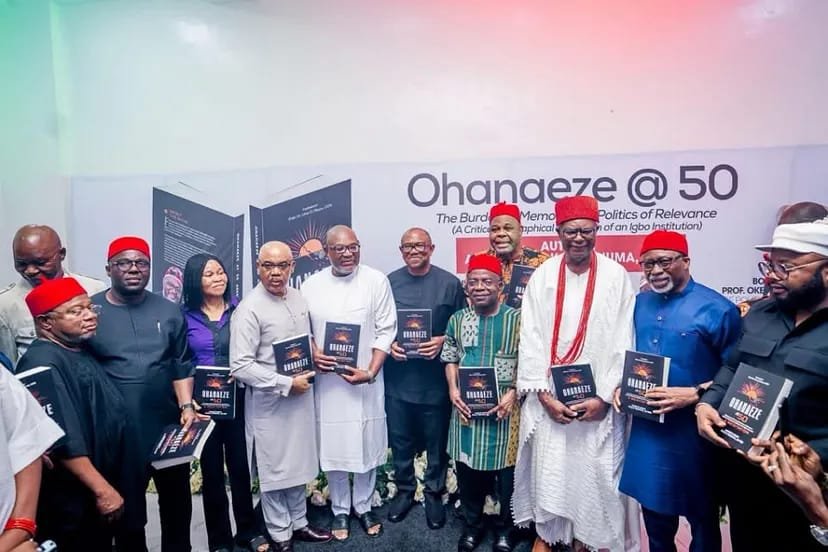
An Address by the Author at the Public Presentation of Ohanaeze @ 50: The Burden of Memory, The Politics of Relevance
Author. · Agbeze Ireke Kalu Onuma, AI-KO
Date. · Tuesday, 22nd September 2026
Venue. · Dover Hotel, Ikeja, Lagos, Nigeria
Press enter or click to view image in full size
“Until the lions have their own historians, the history of the hunt will always glorify the hunter.” – Chinua Achebe, The Paris Review (1994)
“Storytellers are a threat. They threaten all champions of control, they frighten usurpers of the right-to-freedom of the human spirit – in state, in church or mosque, in party congress, in the university or wherever.” – Chinua Achebe, Anthills of the Savannah (1987)
Your Majesty.
Your Excellencies.
Distinguished Elder Statesmen.
Reverend elders and chiefs.
My lords, ladies, and gentlemen.
Ndị Igbo na Ọhaneze.
Fellow sons and daughters of the Igbo nation assembled here today:
I am Igbo. And today, I have written my own history.
Chinua Achebe, in that celebrated 1994 interview with The Paris Review, reached for an African proverb to make a point so precise and so unsettling that it has outlasted nearly every other observation he made in his long and extraordinary public life. “Until the lions have their own historians,” he said, “the history of the hunt will always glorify the hunter.”
He was speaking about colonialism. About the danger of a people whose story is told entirely from outside, entirely by those with an interest in a particular version of events, entirely through the lens of those who won. He was warning that a people without their own historians are not merely misrepresented – they are captured. Their past becomes a tool in someone else’s argument.
I have spent fifteen years thinking about that proverb. Not in the abstract. In the very specific, very particular context of an institution that was created to give the Igbo people their own voice in the Nigerian national story – and that has too often, across fifty years, been content to let that voice be shaped by whoever was politically convenient at the time.
Ohanaeze Ndigbo was supposed to be the lions’ own historian. The institution that would stand before the Nigerian state and say: here is what we are, here is what we want, here is the truth of our experience, and we are writing it ourselves. That is a large promise. This book examines whether the promise was kept.
The Essayist’s Vocation & Genesis of the Work
Before I go further, let me make one thing abundantly clear about who stands before you: I am first and foremost an essayist.
Long before this took the physical form of a hardbound volume, this work did not begin as an orthodox institutional commission, nor did it begin as a detached academic treatise. It started as an organic, searching series of lengthy essays, written at various times, in different seasons, under the pressing weight of immediate contemporary events and evolving historical realities. Essay by essay, observation by observation, reflection by reflection – what began as dispersed inquiries slowly, almost inevitably, coalesced, deepened, and demanded to be woven into the tapestry that has now become this book.
Because of that essayistic genesis, let me also state with humility and absolute candour: this work is neither the first nor the final word on Ohanaeze Ndigbo.
History is far too vast, its currents far too layered, and the collective experience of our people far too complex for any single volume or author to presume closure. I do not come bearing a definitive verdict etched in stone.
But what I do hope – what I pray this book accomplishes – is to be the first comprehensive catalyst to trigger fearless conversations, robust debates, and rigorous scholarship across generations. If it opens the doorway for others to probe deeper, challenge my premises, write counter-histories, and bring intellectual clarity to our shared civic life, then its highest duty will have been fulfilled.
Storytellers as a Threat
Achebe also said something else. Something that speaks more directly to this specific moment, to this specific room, and to this specific act of putting a book before an audience and asking them to receive it honestly.
In Anthills of the Savannah, published in 1987 – the last novel he completed, the one that distils a lifetime of thinking about power, narrative, and resistance into its most concentrated and most frightening form – he wrote: “Storytellers are a threat. They threaten all champions of control, they frighten usurpers of the right-to-freedom of the human spirit.”
I want you to sit with that sentence for a moment, because I have been sitting with it for years.
Storytellers are a threat. Not a nuisance. Not an inconvenience. A threat.
Because authentic narrative – history told honestly, from the inside, without the permission of the powerful, without the approval of those who would prefer a more comfortable version – challenges institutional orthodoxy. It dismantles the sanitised accounts that every institution, every leadership structure, every power arrangement manufactures about itself. It makes things visible that were designed to remain invisible. And it does so publicly, permanently, in print, where it cannot easily be recalled, denied, or buried.
I say this not to dramatise what I have done. Fifteen years of work on a book about an institution that carries the political and cultural aspirations of forty million people is its own drama; it needs no inflation. I say it because I think you deserve to understand what this book is, before you receive it. And you deserve to understand what it cost – not in money or time, though both were considerable – but in the particular courage that writing honestly about people who are still alive, institutions that are still operating, and decisions that are still being disputed requires of any serious author.
In the weeks before this moment, I have been described simply as someone who begins from his own sense of purpose rather than from external endorsement, and I accept that. Chinua Achebe did not pause for approval before writing Things Fall Apart. Ngũgĩ wa Thiong’o did not seek authorization before creating Petals of Blood. Writers who shape meaningful work begin from conviction, not consent. The lions tell their stories from where they stand – through the lens of their own experience, guided by their own priorities. That is what makes a narrative truthful. Anything else, however polished, serves a different purpose entirely.
The Child Belongs to the Community
Now let me tell you about the child.
Ndị Igbo si na nwa bụ nke obodo.
The child belongs to the community.
It is one of the most profound statements in the Igbo moral imagination – and one of the most demanding. It means that no achievement, no matter how individual its origin, belongs only to the person who accomplished it. It means that every significant birth – of a life, of an idea, of a book – is a communal event. The community carried the gestation. The community provided the conditions. The community has claims on what is born.
This book is that child. And I stand here today to return it to the community that made it possible.
It did not spring fully formed from fifteen years of solitary labour, though it felt like that on many mornings:
- It came from a conversation with the late Elder K. U. Kalu in the early stages of this project, who told me that the most honest thing I could do for Ohanaeze was to tell it the truth about itself.
- It came from Elder Dr. Uma O. Eleazu, who wrote the Foreword and whose intellectual generosity across decades of our acquaintance is more present in these pages than he knows.
- It came from His Majesty the Obi of Onitsha, who read the manuscript, wrote a commendation with his own hand, and confirmed for me that what I had written was true to the institution as he himself had observed it.
- It came from Professor Okey Anueyiagu, who today reviews this work publicly and who is, in the truest sense, the kind of critic every serious author needs: honest, exacting, and unwilling to flatter.
- It came from my ancestral community of Abiriba, whose ancient traditions of enterprise, community self-reliance, and courageous public service have been a living compass throughout every year of this work.
- It came from Ndigbo Lagos, in whose administrative service I have spent twenty-six years – watching, from the inside, how the Igbo organise their diaspora life, what institutions they build, how they sustain them, and where they fall short. That observation is in this book on every page.
- And it came from my family. From the enduring patience and grace of my beloved wife, who watched her husband disappear into research, drafts, and revisions for years longer than either of us expected. From a life structured around a single long commitment. From the ancestral wellsprings of my upbringing, and from the deep faith that what was being built was worth the time and sacrifice it demanded.
This child belongs to all of them. It was always theirs, even when it lived inside me.
The Argument & The Charge Forward
What I am returning to the community today is a book that makes a serious argument. That Ohanaeze Ndigbo has, at its best, been the conscience of a people – honest, bold, capable of speaking truth to power. That at its worst, it has been a vehicle for the ambitions of individuals who placed themselves before the institution they were supposed to serve. That the gap between the best and the worst is structural, not merely personal. That the next fifty years can produce a different story, but only if the people who hold the institution – and the community that owns it – make the structural choices that would allow a different story to emerge.
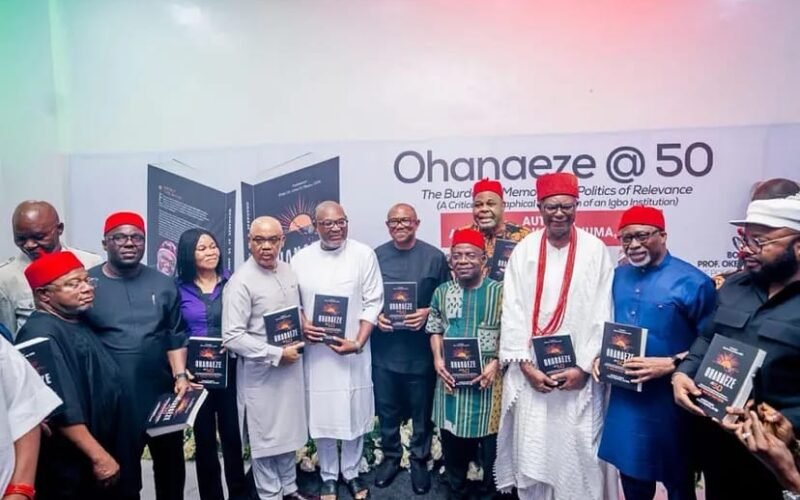
This is not a comfortable argument. Achebe was right: storytellers are a threat. If what I have written did not threaten anyone’s comfortable account of themselves, I would not have spent the last several weeks fielding calls and letters from people who would prefer this book had not been written, or at least not presented in Lagos in September, in the presence of the most consequential gathering of Igbo national leadership that has been assembled around an intellectual occasion in many years.
To our political leaders, traditional rulers, captains of industry, and youth leaders here present: let this gathering not end in self-congratulation or ceremonial applause. An institution that reaches fifty years old must either renew its vows or surrender to obsolescence. Ohanaeze cannot meet the twenty-first century with nineteenth-century habits or twentieth-century grievances alone. We must transition from an era of episodic political declarations to an era of permanent institutional architecture – where economic planning, youth empowerment, regional integration, and cultural safeguarding are pursued with strategic discipline.
The child is born. And the child belongs to the community. In the tradition of our people, what belongs to the community cannot be unmade by the discomfort of individuals. It can only be received honestly, discussed seriously, and used wisely.
I am giving you this book today. I am giving it to every person in this room, and through this room, to the wider Igbo nation whose institutional story it tells. Take it. Read it. Argue with it. Correct what is wrong. Build on what is right. And pass it to your children, so that when they inherit Ohanaeze – and they will inherit it, in one form or another – they inherit it with a clear account of how it arrived in their hands, and what they are therefore responsible for doing with it.
The lions have written their history. Now the community must receive it.
Closing
Kaa ni. Daalu nụ. Ndigbo ndị ọma!
Agbeze Ireke Kalu Onuma, AI-KO
Author & Essayist
Tuesday, 22nd September 2026. |. Dover Hotel, Ikeja, Lagos