
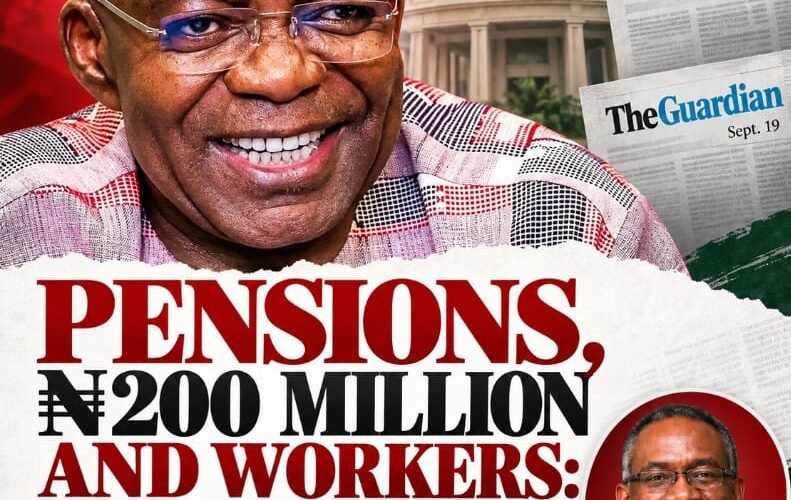
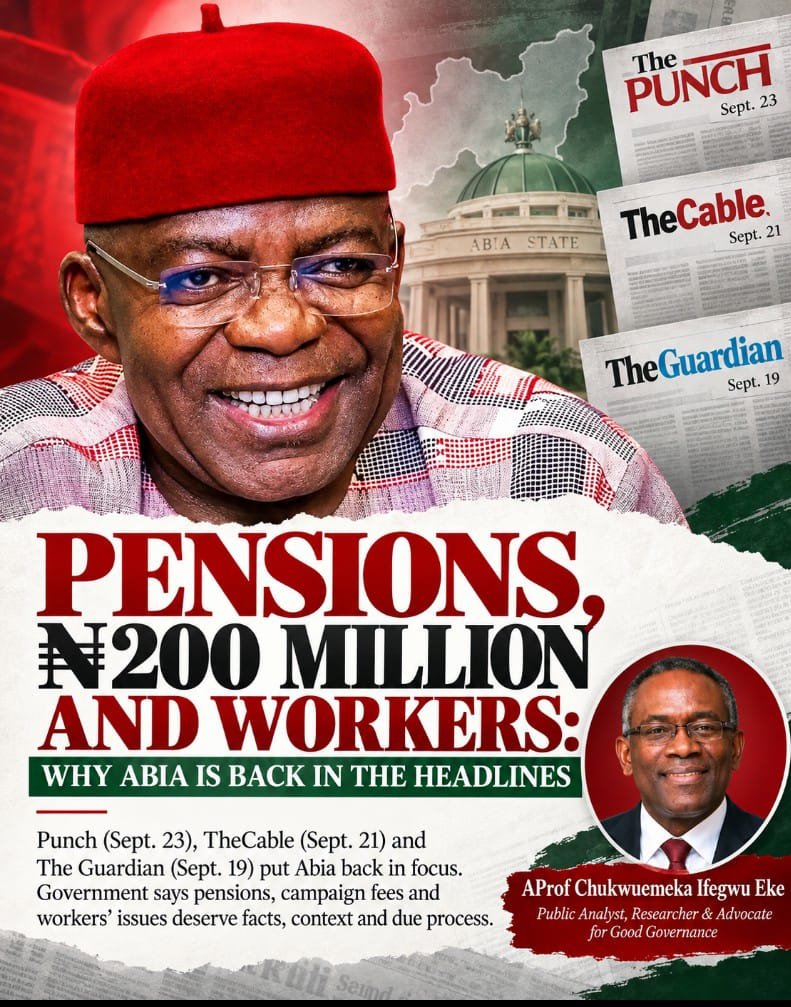
PENSIONS, ₦200 MILLION AND WORKERS: WHY ABIA IS BACK IN THE HEADLINES
Within the last few days, three separate reports have placed the Abia State Government under renewed national media scrutiny. The issues are serious enough to deserve answers, but they must also be presented with the full facts rather than as settled indictments of the government.
On 23 September 2026, Punch Newspapers, in a report by Ikenna Obianeri titled “Gratuity: Pensioners’ Forum alleges payment shortfall,” reported complaints by the Abia Pensioners’ Forum concerning alleged short-payments, delays and transparency in the ongoing gratuity exercise.
Significantly, however, the same pensioners’ body acknowledged that the Governor Alex Otti administration had actually commenced payment of gratuities—an obligation accumulated over many years.
That distinction matters. The question before Abians is no longer whether gratuities will be addressed, but how quickly an inherited mountain of liabilities can be reconciled and paid accurately.
The government’s own 2026 approved budget provides ₦15.084 billion for gratuity, while Governor Otti stated at the May 2026 Workers’ Day celebration that more than ₦10 billion had been earmarked that fiscal year to tackle accumulated gratuity liabilities.
Where individual pensioners allege computational discrepancies or shortfalls, those complaints deserve investigation and correction where established. That is different from suggesting that government has abandoned pensioners.
Indeed, the administration’s public position is that substantial inherited salary and pension obligations have already been cleared while regular obligations continue to be met.
The second headline arose on 21 September 2026, when Bolanle Olabimtan of TheCable reported that Oyo State Governor and APM presidential candidate Seyi Makinde, together with the Allied Peoples Movement, had instituted an action challenging the ₦200 million presidential campaign advertising permit fee applicable in Abia.
The plaintiffs contend that the regulation is unconstitutional and inconsistent with federal electoral law.
Those are now arguments before a court. They should therefore be treated as allegations and legal submissions, not judicial findings.
Earlier reporting on the policy records the Abia Government’s explanation that the charges were introduced as part of the regulation of outdoor political advertising, public safety and equal access to advertising spaces, with the rates applying across political parties.
Government of Abia is ready to defend the regulation in court and comply with whatever determination the judiciary ultimately makes. Political disagreement over a fee does not by itself establish illegality; that is precisely what the court has been asked to decide.
The third report came from The Guardian on 19 September 2026. Sodiq Omolaoye, writing under the headline “PDP guber candidate accuses Otti of neglecting Abia workers,” reported allegations by PDP governorship candidate Dr Kelechi Anosike that increased federal allocations had not translated sufficiently into improved wages and that some workers received comparatively small increases following implementation of the national minimum wage.
Again, these are statements by an opposition candidate during an election season and should be identified as such.
The documented government position is that Abia began implementing the ₦70,000 national minimum wage in October 2024, and Governor Otti subsequently directed that consequential adjustments be reviewed after anomalies were identified.
The administration has also publicly maintained that it is meeting current salary obligations while addressing liabilities inherited from earlier years.
Governor Otti’s May 2026 Labour Day address specifically stated that government had spent tens of billions of naira on longstanding worker obligations predating the present administration.
So yes, Abia is back in the headlines. But headlines are the beginning of scrutiny, not the end of it.
Pensioners raising discrepancies have always received transparent reconciliation. The government’s position is that a campaign-fee dispute can be tested by the courts. Dr Otti believes that opposition claims about workers should be measured against payroll records, the wage structure and actual government expenditure.
The Otti administration does not quarrel with scrutiny. Her stronge response has always been verifiable records in the public domain and allows citizens to distinguish between legitimate complaints, unresolved legal questions and partisan assertions.
AProf Chukwuemeka Ifegwu Eke