
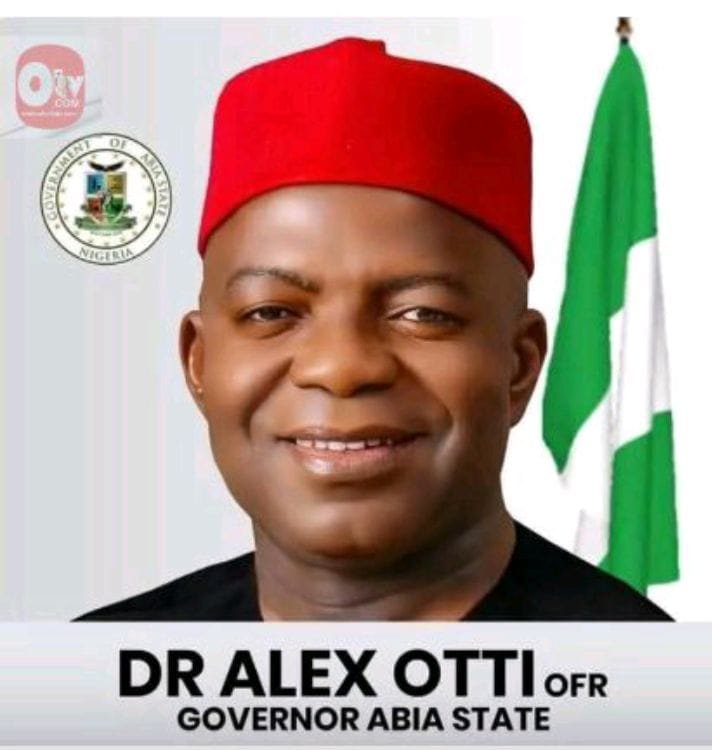
ABIA CAMPAIGN SIGNAGE CONTROVERSY: THE FACTS HISTORY MUST NOT ERASE
The current controversy surrounding political campaign signage charges in Abia State cannot be discussed honestly without recalling what Governor Alex Otti suffered as an opposition candidate under the former Peoples Democratic Party administration. Many of those now attempting to portray the present government as hostile to political participation were either active members, beneficiaries or defenders of the political establishment that openly frustrated Otti’s campaign, even after his organisation reportedly complied with the regulations and paid the required fees.
In September 2022, the Alex Otti Campaign Organisation disclosed that it had paid the prescribed sum of ₦10 million to the Abia State Government for the display of campaign billboards. The campaign also stated that the licensed advertising vendors engaged for the exercise had paid the relevant fees demanded by the Abia State Signage and Advertisement Agency. Despite these payments and the campaign’s insistence that it had complied with all known regulations, a major Labour Party billboard mounted at Umuikaa Junction along the Aba–Port Harcourt Expressway was reportedly removed by agents of the state government.
This was not merely a social-media allegation or an unverified political claim. The matter was reported by respected national newspapers. The Guardian, in its report of September 15, 2022, stated that the Abia Labour Party accused the government of removing its campaign billboard despite the payment of the prescribed charges. THISDAY also reported on September 14, 2022, that Otti cried out over the destruction of his campaign billboard after paying ₦10 million to the Abia State Government. The campaign organisation maintained that it had respected the guidelines of the signage agency and had no reason to expect that an approved and paid-for billboard would be removed.
The matter became even more disturbing when additional reports emerged in December 2022 that another prominent Otti campaign billboard at Umuikaa Junction had been pulled down. The campaign message on the billboard reportedly read, “Ndi Abia Weep No More, Help Is on the Way.” This was a simple democratic message of hope to a people who desired a change in governance. Yet the opposition campaign alleged that the billboard was targeted because of its political content and because the growing popularity of Alex Otti had become uncomfortable for the ruling establishment.
The reports also alleged that a Labour Party chieftain and campaign director, Dr Eze Nwaigburu, was arrested and detained in connection with political activities in Isiala Ngwa. These developments revealed the difficult political environment in which Alex Otti contested the 2023 governorship election. He was not merely confronting an opposing political party. He was confronting an entrenched system that allegedly used administrative power, state institutions and regulatory agencies to frustrate his campaign.
It is therefore important to distinguish between what happened under the former PDP government and the current signage policy under Governor Otti. Under the former administration, Otti’s campaign reportedly paid the prescribed fee and still suffered the removal of its billboards. The issue was not simply the amount charged. It was the alleged refusal of the government to honour its own regulatory process after receiving payment from an opposition candidate.
The present administration has announced campaign advertising permit fees that apply to political candidates according to the offices they seek. The charges have been publicly stated and are not presented as secret, selective or partisan demands. The government has explained that the policy is intended to regulate political advertising, protect public infrastructure, maintain environmental standards and prevent the indiscriminate erection of billboards and posters across the state.
This distinction is fundamental. A publicly announced regulatory framework that applies to all political parties cannot reasonably be equated with a situation in which an opposition candidate allegedly paid the required fee but still had his campaign materials removed. One represents a regulatory policy. The other represented alleged political victimisation and administrative bad faith.
Those who now criticise the present administration must therefore answer important questions. Where were they when Alex Otti’s paid campaign billboards were removed? Where were their voices when the Labour Party complained of political intimidation? Did they condemn the destruction of campaign materials belonging to an opposition candidate? Did they demand that the PDP government refund the ₦10 million reportedly paid by the Otti campaign? Did they insist that the signage agency protect the rights of all political parties?
Many politicians who were prominent in the Abia PDP during that period have since migrated to the All Progressives Congress. Their change of political platform does not erase the history of the administration they supported or the actions they failed to condemn. They cannot now reinvent themselves as defenders of political fairness while pretending that the persecution of opposition candidates began after they lost power.
Governor Alex Otti’s political journey gives him a unique understanding of the importance of fairness, transparency and equal access to the political space. He personally experienced what it meant to campaign under an administration accused of using regulatory institutions against opposition parties. That experience provides a strong reason to believe that his government understands the need to establish order without denying any lawful candidate the opportunity to communicate with the electorate.
The current signage charges should therefore be considered within the wider objective of restoring discipline and proper regulation to Abia State. Political campaigns must not become an excuse for the uncontrolled defacement of public buildings, road infrastructure, traffic facilities and private property. Campaign materials must be displayed according to approved standards, and those who seek public office should be prepared to comply with the regulations established to protect the environment and ensure public safety.
The charges also recognise that political advertising is a major commercial activity. Candidates spend enormous sums on rallies, media campaigns, vehicles, branded materials, consultants and political mobilisation. It is therefore not unreasonable for the state to establish a formal permit system governing the use of public spaces and outdoor advertising infrastructure.
What should concern Abians most is not the manufactured outrage of politicians who were silent when Otti was victimised. The real concern should be whether the rules are clearly stated and applied equally to every candidate. The Otti administration has publicly declared that the regulations will apply to all political parties without discrimination. This is a significant departure from the political environment of 2022, when the opposition alleged that compliance and payment did not protect its campaign materials.
The former PDP establishment must not be allowed to rewrite history. It cannot collect ₦10 million from an opposition campaign, allegedly remove the campaign’s billboards and later present itself as the champion of affordable political advertising. Such selective memory insults the intelligence of Abians.
The facts remain clear. Alex Otti complied with the regulations imposed by the previous government. His campaign reportedly paid the prescribed ₦10 million. Licensed vendors also reportedly paid the relevant charges. Yet his billboards were removed, his campaign complained repeatedly and the government failed to provide a satisfactory public explanation.
Despite these obstacles, the people of Abia State rejected intimidation and voted for change. Alex Otti emerged victorious because Abians recognised that the attacks on his campaign were part of a desperate effort to preserve a failing political order. The removal of his billboards did not remove his message. The obstruction of his campaign did not stop the people’s desire for a new direction.
The present campaign signage policy must therefore be understood as part of an effort to establish an orderly, transparent and enforceable regulatory system. It should not be confused with the political persecution Otti experienced under the former PDP government. The administration has the responsibility to ensure that those who comply with the published requirements are allowed to advertise without harassment, intimidation or arbitrary removal of their materials.
The greatest irony is that some of the same political figures who watched silently while Otti’s campaign was obstructed are now loudly condemning a government that has merely published a general fee structure applicable to every party. Their criticism lacks moral weight because it is not founded on a consistent defence of democratic principles. It is driven by the discomfort of operating outside the structures of power they once controlled.
Abians must reject this political hypocrisy. They must remember who suffered when the former government used its agencies against the opposition. They must remember who paid the prescribed charges and still had his billboards removed. They must remember who remained peaceful in the face of provocation and continued to appeal to the law, the media and the conscience of the people.
Governor Alex Otti’s emergence represented the triumph of democratic resilience over political intimidation. His administration should be judged by its commitment to rebuilding Abia, restoring public institutions and creating a level playing field governed by clear rules. Opposition parties are free to campaign, criticise and compete, but they must comply with lawful regulations just as every responsible participant in the political process is expected to do.
The debate over signage charges must not become an opportunity for the former PDP establishment and its recent APC converts to erase their own record. Before they accuse the present government, they should first explain what they did when Alex Otti’s billboards were destroyed after his campaign reportedly paid ₦10 million.
History cannot be edited merely because yesterday’s oppressors have become today’s opposition. The people of Abia remember. The newspapers documented the events. The evidence remains available.
The real lesson is that Alex Otti endured political obstruction, remained peaceful, trusted the people and ultimately prevailed. Those who failed to silence him through the removal of billboards should not now pretend to be victims of a transparent regulatory policy.
Abia has moved beyond the politics of intimidation. The state is now governed by an administration committed to order, accountability and institutional reform. Political parties should engage the electorate with ideas, policies and credible alternatives rather than attempting to manipulate public memory.
The former PDP government removed Otti’s billboards after his campaign reportedly paid the required fee. The present government has publicly announced a general regulatory framework. These two situations are not the same, and no amount of political propaganda can make them equivalent.
The truth remains that Alex Otti was treated unfairly as an opposition candidate, yet he persevered and won the confidence of the people. His administration is entitled to regulate campaign advertising fairly, transparently and in the overall interest of the state.
Abians must therefore insist on facts, reject selective outrage and refuse to be deceived by those seeking to rewrite the political history of the state.
REFERENCES FOR VERIFICATION
The Guardian, September 15, 2022:
THISDAY, September 14, 2022:
New Dawn Nigeria, December 3, 2022: