
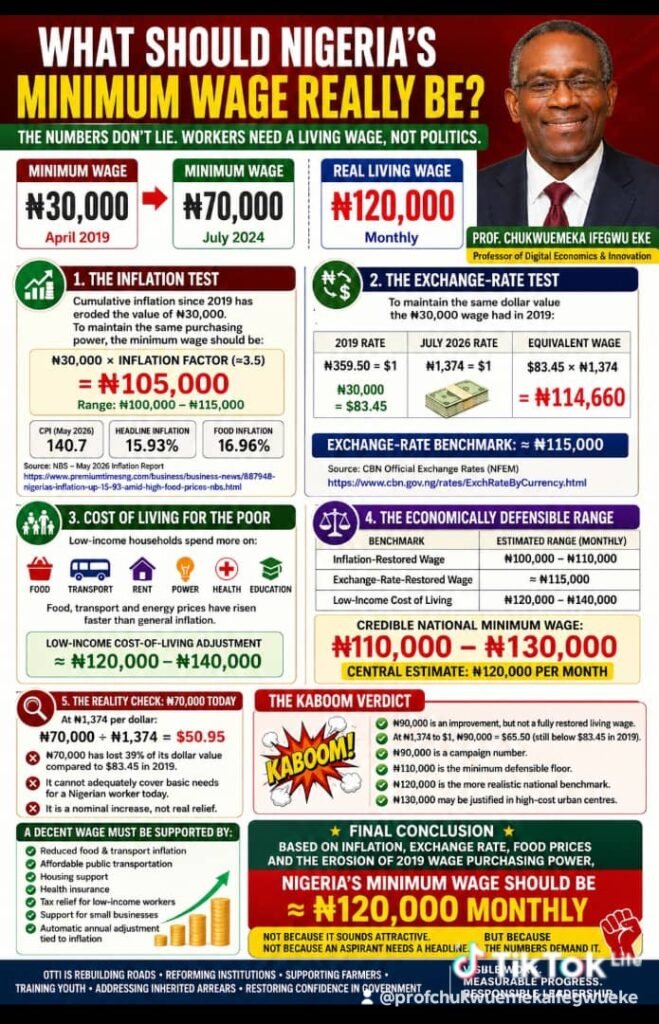
WHAT SHOULD NIGERIA’S MINIMUM WAGE REALLY BE? — A QUANTITATIVE VERDICT
It should be calculated from the purchasing power workers have lost.
Nigeria’s minimum wage was raised to ₦30,000 in 2019. It became ₦70,000 in July 2024. The ILO has acknowledged that although the increase was significant, persistent inflation had already weakened its real effect and made it inadequate for the rising cost of living. 0
1. THE INFLATION TEST
A minimum wage is meaningful only if it can buy approximately what the earlier wage bought.
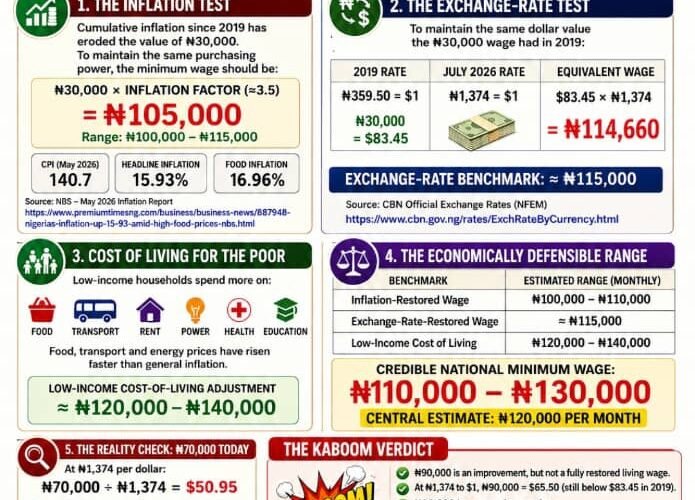
Using Nigeria’s cumulative inflation experience since 2019, the ₦30,000 minimum wage would now require roughly:
₦30,000 × cumulative inflation factor of about 3.5 = approximately ₦105,000.
Depending on the precise starting month and CPI series applied, the inflation-restored value falls broadly between ₦100,000 and ₦115,000 monthly.
Nigeria’s latest available NBS data showed that the Consumer Price Index reached 140.7 in May 2026, while headline inflation stood at 15.93%. Food inflation was even higher at about 16.96%. Prices were therefore still increasing—not falling—even though the annual inflation rate had moderated. 1
This means that the present ₦70,000 wage has already suffered further erosion since it was approved in 2024.
2. THE EXCHANGE-RATE TEST
When the ₦30,000 wage was introduced in April 2019, the naira exchanged at approximately ₦359.50 to US$1.
Therefore:
₦30,000 ÷ ₦359.50 = approximately US$83.45.
By July 2026, the exchange rate was approximately ₦1,374 to US$1.
To preserve that same dollar value:
US$83.45 × ₦1,374 = approximately ₦114,660.
The Central Bank of Nigeria’s official NFEM rate in late June 2026 was around ₦1,381 per dollar, confirming the scale of the naira’s depreciation. 2
Therefore, using the exchange-rate benchmark alone, the minimum wage should be about:
₦115,000 monthly.
3. THE CURRENT ₦70,000 WAGE IN REAL TERMS
At an exchange rate of ₦1,374 per dollar:
₦70,000 ÷ ₦1,374 = about US$50.95 monthly.
Therefore, today’s ₦70,000 wage has considerably less international purchasing power than the ₦30,000 wage had in 2019.
Compared with the 2019 benchmark of approximately US$83.45, the current wage has lost roughly:
39% of its dollar value.
That is not wage growth in real terms. It is a nominal increase accompanied by severe currency depreciation and inflation.
4. THE FOOD AND TRANSPORT REALITY
Minimum-wage earners do not spend like the average consumer. A larger proportion of their income goes to:
✅ Food
✅ Transport
✅ Rent
✅ Electricity and energy
✅ Schooling
✅ Healthcare
Because food and transport prices have risen particularly sharply, a poor household’s personal inflation rate may be higher than the national headline rate.
This is why adjusting wages only by the general CPI may still underestimate what low-income workers actually require.
5. THE ECONOMICALLY DEFENSIBLE RANGE
Three benchmarks produce the following results:
Inflation-restored wage: approximately ₦100,000–₦110,000.
Exchange-rate-restored wage: approximately ₦115,000.
Low-income cost-of-living adjustment: approximately ₦120,000–₦140,000.
Therefore, a credible national minimum wage in present economic conditions should fall within:
₦110,000–₦130,000 monthly.
My central estimate is:
₦120,000 PER MONTH.
That figure is high enough to restore much of the purchasing power destroyed by inflation and naira depreciation, but it is more economically defensible than an arbitrary or politically attractive figure.
THE KABOOM VERDICT
₦90,000 is an improvement, but it is not a fully restored living wage.
At ₦1,374 per dollar:
₦90,000 is only about US$65.50.
It remains well below the approximately US$83.45 represented by the ₦30,000 wage in 2019.
Therefore:
₦90,000 is a campaign figure.
₦110,000 is the minimum defensible floor.
₦120,000 is the more realistic national benchmark.
₦130,000 may be justified in high-cost urban centres.
However, the wage should be accompanied by:
✅ Reduced food and transport inflation
✅ Affordable public transportation
✅ Housing support
✅ Health insurance
✅ Tax relief for low-income workers
✅ Support for small businesses expected to pay the wage
✅ Automatic annual adjustment tied to inflation
Without these measures, even ₦120,000 will soon be overtaken by inflation.
FINAL CONCLUSION
Based on cumulative inflation, naira depreciation, food prices and the erosion of the 2019 wage’s purchasing power, Nigeria’s minimum wage should currently be approximately:
₦120,000 MONTHLY.
Not because it sounds attractive.
Not because an aspirant needs a headline.
But because the numbers demand it.
THAT IS THE ECONOMIC KABOOM.