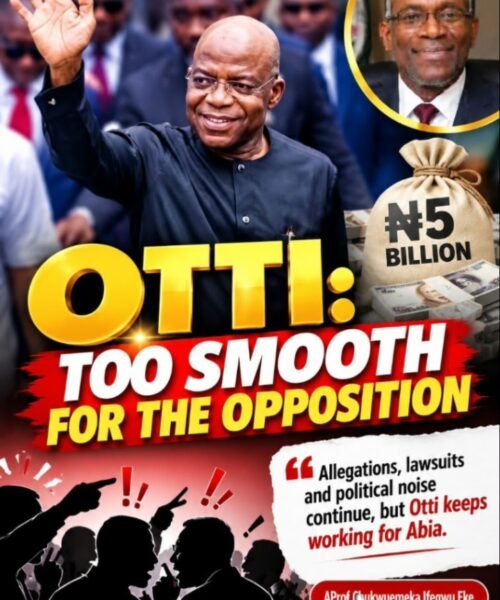

A MASTERCLASS IN PUBLIC FINANCE: SETTING THE RECORD STRAIGHT FOR EKE O AKO, OBINNA ORIAKU & CO.
Let us begin from first principles, because public finance is too serious to be surrendered to outrage, selective arithmetic, and political performance. The loudest voices in this debate keep recycling one misleading impression: that Abia State is receiving huge inflows without evidence of discipline, prudence, or fiscal restructuring. That claim collapses once the numbers are read properly. The most important point, which Eke O Ako, Obinna Oriaku, and their sympathizers keep dodging, is that Abia State has been on a measurable path of debt reduction, exposure control, and fiscal rebalancing. This is not campaign poetry; it is the language of structured finance.
Debt management is not judged by how much anger critics can generate online. It is judged by whether a government is reducing expensive liabilities, avoiding reckless borrowing, managing obligations, and preserving room for development spending. That is exactly why Abia’s fiscal direction deserves a more disciplined reading. The Debt Management Office framework for subnational debt remains the appropriate reference point for understanding how states manage their debt stock over time, and it is from that broader context that Abia’s current posture should be judged.
👉 https://www.dmo.gov.ng/publications/sub-national-debt�
Now, what does debt reduction or fiscal rebalancing actually mean in real terms? It means a government is not merely spending; it is restructuring its exposure. It is reducing dependence on high-cost domestic borrowing, aligning debt service with repayment capacity, and resisting the temptation to mortgage the future for short-term applause. This is how serious governments behave in difficult macroeconomic environments. The IMF is clear that debt sustainability is not the absence of debt, but the ability to manage debt at tolerable cost and within a credible repayment framework. Once that principle is applied, the lazy attacks begin to fall apart.
👉 https://www.imf.org/en/Publications/fandd/issues/Series/Back-to-Basics/Debt�
What many critics refuse to admit is that Nigeria’s macroeconomic environment has been brutal for subnational governments. Inflation, exchange-rate volatility, rising cost of services, and pressure on recurrent obligations mean that every naira must now do more work than before. In such a climate, a state that is simultaneously managing liabilities, funding capital expenditure, and maintaining government operations is not collapsing—it is navigating pressure with discipline. That is why Abia’s debt posture should be read not as inertia, but as controlled fiscal intelligence. The point is not whether debt exists. The point is whether debt is being handled with prudence. And the evidence points toward prudence, not recklessness.
This is where the critics make their most elementary mistake: they treat gross inflow as disposable cash. That is one of the oldest errors in bad public commentary.
Revenue is not profit. Government inflow is not free money. Once funds enter the system, they face statutory obligations, debt servicing, salary commitments, pension costs, transfers, and capital programme demands. Any serious student of economics understands that what matters is not gross receipts but net fiscal space after commitments. The World Bank’s public financial management framework makes this distinction clear: fiscal governance is about allocating scarce resources under binding constraints, not fantasizing over aggregate receipts.
👉 https://www.worldbank.org/en/topic/governance/brief/public-financial-management�
The practical implication is simple. If Abia is reducing debt pressure while still maintaining public expenditure and development commitments, then what we are seeing is not looting, not fiscal collapse, and not secret accumulation of free cash. What we are seeing is a government trying to stabilize the books while preserving functionality. That is not glamorous to propagandists because discipline rarely produces dramatic headlines. But in finance, drama is not the measure of success—stability is.
There is also a deeper problem in the criticism from Eke O Ako, Obinna Oriaku, and their camp: they confuse political dissatisfaction with technical proof. A person may dislike a government and still fail to prove fiscal abuse. A person may be emotionally persuasive and still be statistically weak. In this case, the recurring attacks rely on the same flawed pattern: quote a large revenue number, strip away expenditure obligations, ignore debt structure, and then pretend that what remains is proof of fraud. That is not financial analysis. It is courtroom rhetoric without exhibits.
If Abia were genuinely spiraling in the direction they claim, the symptoms would be easy to detect. You would see worsening debt ratios, uncontrolled borrowing patterns, rapidly rising liabilities without matching fiscal balance, or a liquidity crisis that crippled state operations. Yet that is not the picture being painted by the available fiscal structure. Instead, what emerges is a government managing pressure, trying to rebalance its exposure, and attempting to combine capital spending with liability control. That may be debated, audited, and improved—as all governments should be—but it cannot honestly be dismissed as financial chaos.
This is why the talk of “massive inflows with nothing to show” must be challenged with force. A state can receive substantial inflows and still remain under fiscal pressure if those inflows are tied to obligations and inherited burdens. That is precisely why debt reduction matters. Reducing liabilities is itself a developmental act, because it preserves future fiscal space. A government that cuts its exposure today creates room for infrastructure, services, and institutional stability tomorrow. Critics who ignore this do so either because they do not understand public finance or because they hope their audience does not.
And let us be frank: much of what passes for “analysis” in this conversation is actually resentment toward structured governance. Debt reduction is boring to populists because it denies them easy scandal. Fiscal discipline is frustrating to propagandists because it forces them into technical territory where slogans die. That is why the debate keeps being dragged away from structure into spectacle. But structure is precisely where the truth lies.
The Abia government’s own reporting ecosystem matters here too. A government that publishes performance reports, budget frameworks, and fiscal summaries is not behaving like an administration afraid of numbers. People may dispute the quality, scope, or interpretation of those reports, but their existence matters. It means the conversation can be anchored in documents rather than gossip. That is already a higher standard than the critics would like to admit.
👉 https://abiastate.gov.ng/�
So, what then is the proper conclusion? It is not that Abia is perfect. It is not that every policy choice is beyond criticism. It is not that every debt-management decision should escape scrutiny. The proper conclusion is this: the fiscal story of Abia cannot honestly be reduced to the crude propaganda of “big money came in, therefore theft happened.” That is intellectually unserious. The more defensible conclusion is that Abia is managing a difficult transition through debt control, fiscal restraint, and structured allocation.
That is why Eke O Ako, Obinna Oriaku, and their fellow travelers need a lecture in finance before they next attempt a sermon in outrage. Public finance is not emotional arithmetic. It is the discipline of obligations, timing, balance sheets, debt structure, and constrained choice. And once those principles are applied, the sensational case against Abia begins to look less like a revelation and more like what it truly is: a mediocre reading of a technical subject.
Because in the end, governance is not judged by how loudly critics shout at a spreadsheet. It is judged by whether the numbers, structure, and outcomes can withstand scrutiny. And on that test, Abia’s debt reduction and fiscal rebalancing deserve a more serious reading than its detractors are prepared to offer.
AProf Chukwuemeka Ifegwu Eke