
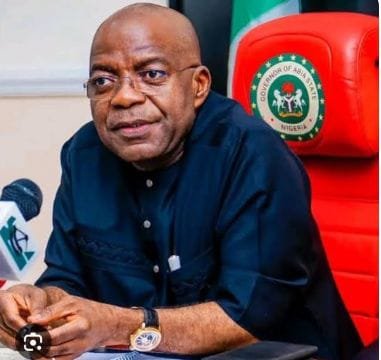
SOUTH-EAST FISCAL REALITY REVISITED: WHY ALEX OTTI’S ABIA LOOKS LESS LIKE INERTIA AND MORE LIKE DISCIPLINED REPOSITIONING
Thank you for this piece. It is thoughtful, but a fuller economic reading leads to a different conclusion. The South-East debt table is not just a story of who borrowed more or less between June and December 2025. It is a story of how states are choosing to absorb macroeconomic shock. Under conditions of naira volatility, inflation, high domestic borrowing costs, and tightening liquidity, the most sophisticated fiscal behavior is not always the most dramatic. Sometimes, the strongest signal is controlled movement. On that score, Abia deserves a fairer reading than “stable but static.” For the wider governance lens, see the World Bank’s work on institutional quality and public sector capability. �
Start with the figures themselves. Using the numbers in the comparative note, Abia’s domestic debt fell from ₦48.498bn to ₦48.410bn, a decline of just ₦88.03m, or 0.18%. Its external debt rose from $105.229m to $107.163m, an increase of $1.934m, or 1.84%. That is not the profile of a fiscally panicked state. It is the profile of a state that is holding its line while others are making sharper debt pivots. In a period where some states are swapping one kind of risk for another, Abia’s movement is minimal enough to suggest intentional restraint rather than administrative sleepwalking. The Debt Management Office’s subnational debt archive is the right starting point for reading these state-level patterns. �
Compare that with Anambra, whose domestic debt reportedly plunged from ₦26.670bn to ₦11.550bn, a reduction of ₦15.119bn or 56.68%, while external debt rose from $98.520m to $102.579m, up 4.12%. That is bold restructuring, yes, but boldness is not automatically superiority. It may reflect strong liability management, or it may reflect a more aggressive transition from domestic burden to external exposure. The point is not to diminish Anambra; it is to note that Abia is following a different fiscal philosophy. Anambra is rebalancing aggressively. Abia is stabilizing deliberately. Both are choices. But only one of them exposes the state less dramatically to exchange-rate transmission over a short horizon. That distinction matters in a country where exchange-rate pass-through has been brutal. The IMF’s institutional and macro-fiscal frameworks help explain why quieter adjustment can sometimes be the more prudent adjustment. �
Now look at Ebonyi. Its domestic debt reportedly declined from ₦14.635bn to ₦13.479bn, down ₦1.156bn or 7.90%, while external debt rose from $95.554m to $108.018m, a jump of $12.464m or 13.04%—the sharpest external increase in the region. That is not inherently reckless, but it is undeniably a higher-velocity risk migration. In plain language: Ebonyi reduced naira debt, but loaded more dollar risk. In a stable currency environment, that may be sensible. In Nigeria’s 2025 environment, that requires stronger hedging logic and stronger future revenue certainty. Abia, by contrast, added only $1.934m in external debt over the same period. That is a large analytical difference, and any robust commentary should say so plainly. �
Then there is Enugu, the region’s most indebted case in the comparative note. Domestic debt reportedly fell from ₦194.716bn to ₦157.603bn, a reduction of ₦37.112bn or 19.06%, while external debt dropped from $114.348m to $99.879m, down 12.65%. On the surface, that looks like strong consolidation. But your own note correctly says this must be read against a broader expansionary phase since 2023. That matters. Enugu may be in correction, but correction after expansion is not the same thing as steady discipline through turbulence. This is where Abia’s case becomes more compelling. Alex Otti’s Abia did not need a dramatic correction because it did not first pursue a dramatic overextension. In public finance, avoiding the excess that later requires applause-worthy reversal is often the more mature form of leadership. OECD governance materials consistently favor medium-term coordination and disciplined execution over headline volatility. �
Imo presents yet another model: domestic debt down from ₦90.506bn to ₦83.745bn, a fall of ₦6.761bn or 7.47%, while external debt rose from $107.673m to $117.077m, up $9.404m or 8.74%. Again, the issue is not whether this is good or bad in isolation. The issue is what it says about fiscal temperament. Imo appears to be substituting more decisively into external exposure than Abia. And this is precisely why the “Abia lacks transformation” thesis feels too neat. Transformation is not only about dramatic movement. It is also about which risks you refuse to amplify. In a fragile macro environment, the state that resists debt drama may, in fact, be the state practicing the deepest fiscal intelligence.
Put all five states side by side and the regional picture becomes sharper. Based on the figures supplied in the article, Abia’s domestic debt at ₦48.410bn sits far below Enugu’s ₦157.603bn and Imo’s ₦83.745bn, above Ebonyi’s ₦13.479bn and above Anambra’s ₦11.550bn after its sharp contraction. On external debt, Abia’s $107.163m is higher than Anambra’s $102.579m and Enugu’s $99.879m, slightly below Imo’s $117.077m, and just below Ebonyi’s $108.018m. What does that mean? It means Abia is neither the most indebted nor the least transformed by the numbers alone. It occupies a middle-risk, middle-burden position with unusually low short-term volatility. Calling that “inertia” may be rhetorically tidy, but economically it is too shallow.
History also matters here. States do not reform in abstraction. They reform from inherited weakness. Abia under Otti did not enter office in a vacuum; it inherited a state with credibility issues, infrastructure deficits, weak service delivery expectations, and a public finance culture that required reset. In such a context, the first victory is not flashy. It is restoration of order. Roads begin to move. Hospitals begin to function. schools re-enter the public conversation. basic institutions stop looking permanently abandoned. A debt table alone cannot capture that governance shift. To reduce transformation only to debt acceleration is to adopt an accountant’s lens where a statesman’s lens is required. The UN’s development framework is helpful here: sustainable progress is not merely about financing volume, but about governance capability and development alignment. �
Philosophically, there is another error in the original framing. It treats low debt movement as evidence of low ambition. But statecraft has never judged ambition only by how much you borrow. In fact, one of the oldest lessons in political philosophy is that prudence is not passivity. The disciplined ruler is not the one who spends most impressively, but the one who aligns means with ends and avoids placing tomorrow under unnecessary bondage. In modern public finance, that means resisting the temptation to convert every developmental desire into a debt instrument. By that test, Abia’s posture can also be read as moral seriousness in fiscal management.
This is why Alex Otti emerges from the data in a stronger light than the article allows. Before politics, he operated at the commanding heights of Nigerian banking, where capital structure, risk calibration, and institutional balance are not academic concepts but daily responsibilities. That background matters because it shapes temperament. A banker who has seen balance-sheet fragility up close is more likely to resist ornamental borrowing. He is more likely to ask not merely, “Can we borrow?” but, “What risk are we importing, and what revenue discipline supports it?” That kind of thinking is exactly what Abia’s low-volatility debt profile suggests. It is not accidental. It is formation.
Even on comparative governance grounds, the “Abia remains stable but exhibits limited fiscal transformation” line needs refinement. Stability itself is a transformation in a high-volatility federation when it is paired with visible governance correction. If domestic debt barely moves, external debt rises only marginally, and the state is simultaneously pursuing infrastructure rehabilitation and administrative re-ordering, then the real story may be this: Abia is attempting development without surrendering itself to debt theatrics. That is not glamorous, but it is often how durable governance begins.
A more balanced conclusion, therefore, would be this: Anambra appears to be the region’s most aggressive rebalancer; Ebonyi the fastest external-risk accumulator; Enugu the most indebted but currently correcting; Imo the clearest substitution case; and Abia the most fiscally cautious reformer among the larger transition states. That is a much fairer reading of the same regional landscape. It gives each state its due without turning caution into weakness or drama into sophistication.
In the end, the South-East debt story is not a morality play with one winner and four losers. It is a test of governance instincts under pressure. And in that contest, Abia under Alex Otti deserves more credit than it is getting. Others may be borrowing louder. Abia may be governing smarter.
AProf Chukwuemeka Ifegwu Eke