
WHEN AN INDEX BECOMES A WEAPON: WHY THE “ABIA WORST IN NIGERIA” THESIS IS FLAWED, REDUCTIVE, AND POLITICALLY LOADED
The headline is designed to wound before it informs. “Abia Ranked Worst In Nigeria On Audit Transparency With 9% Score” is not merely a report of a ranking; it is a rhetorical device. It compresses a highly specific institutional index into a sweeping political verdict and then invites the public to treat that verdict as a total judgment on governance under Governor Alex Otti. That is not careful civic analysis. It is the politics of insinuation masquerading as accountability.
Let us begin with the central fact. Yes, the Paradigm Leadership Support Initiative (PLSI) has a Subnational Audit Efficacy Index, and material in circulation says Abia scored 9% in the 2025 edition. PLSI’s own SAE materials and related reposts indicate this score and raise concerns about audit processes, legislative follow-through, and related accountability gaps.
https://plsinitiative.org/sae-indexes/�
https://www.facebook.com/PLSInitiative/posts/-the-unveiling-of-the-subnational-audit-efficacy-sae-index-2025-report-in-abujak/1354062493419993/�
https://saharareporters.com/2026/04/06/abia-ranked-worst-nigeria-audit-transparency-9-score-fenrad-demands-urgent-reforms
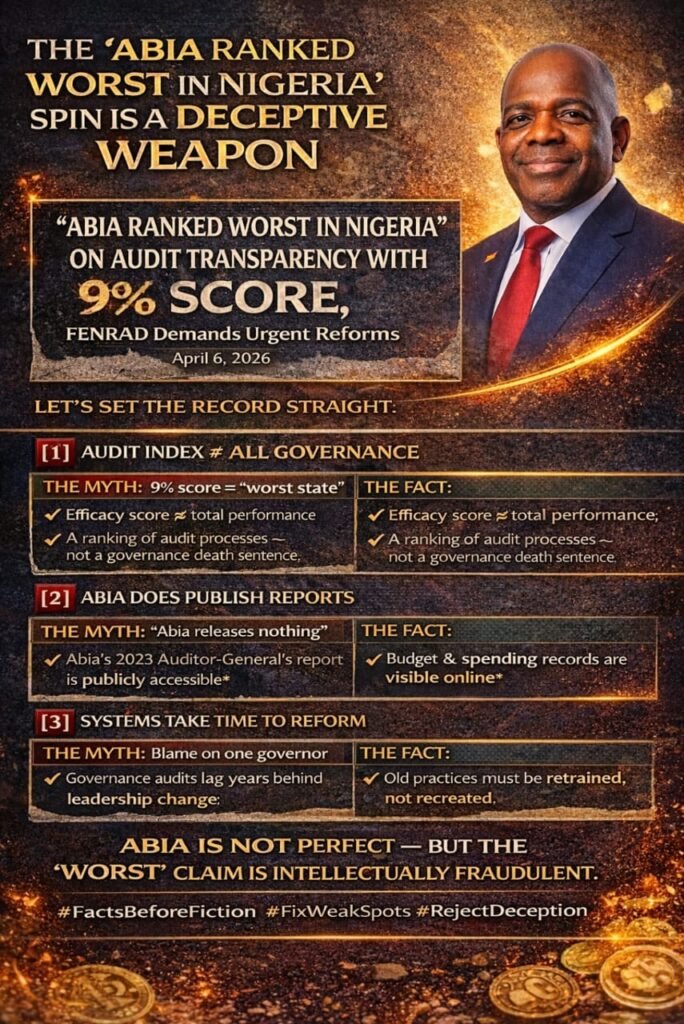
But here is the first deception in the thesis: audit efficacy is not the same thing as total governance performance.
An audit-efficacy score is not a corruption conviction. It is not a judicial finding of theft. It is not proof that projects do not exist. It is not evidence that money has disappeared. It is a measure—however useful—of how well a state’s audit ecosystem, publication culture, institutional autonomy, and legislative follow-up are functioning according to the index’s criteria. To turn that into “Abia is worst in Nigeria” in an all-encompassing moral sense is not precision. It is sensational compression.
The second problem is even more embarrassing for the thesis: Abia’s 2023 Auditor-General’s report is publicly accessible online.
That matters because the political spin suggests an atmosphere of pure darkness, opacity, and total non-publication. Yet the Auditor-General’s report for the year ended 31 December 2023 is available through publicly reachable channels, including World Bank-hosted documents and references within PLSI’s own Abia narrative material.
https://documents1.worldbank.org/curated/en/099092724092515148/txt/P1741141a6b4dd03e1b90d1dce8e2345f05.txt�
https://plsinitiative.org/wp-content/uploads/2025/03/Abia_Narrative.pdf
In fact, the 2024 PLSI Abia narrative itself states that the 2023 report of the Auditor-General for Abia State is publicly accessible, even while criticizing other weaknesses such as the non-publication of a Citizens’ Accountability Report and weak Public Accounts Committee follow-through. That distinction is crucial. The narrative is not “nothing exists.” The narrative is “some institutional components are weak or incomplete.” That is a serious governance issue, yes—but it is not the apocalyptic darkness being sold by activists and partisan amplifiers.
https://plsinitiative.org/wp-content/uploads/2025/03/Abia_Narrative.pdf
This leads to the third flaw: the article confuses systemic institutional lag with the personal moral failure of one governor.
Political science warns us against this exact error. Institutions have memory. They do not reset themselves magically on inauguration day. Audit cultures, PAC effectiveness, MDA compliance habits, internal control systems, and publication protocols are built or weakened over years. The Auditor-General’s own 2023 report—covering a transition year—notes that many contractual agreements and supporting documents from MDAs were not made available to the Auditor-General’s office at the time of writing, and that internal audit reporting from MDAs was weak. That is a structural governance problem, not a single-day invention of Alex Otti.
https://documents1.worldbank.org/curated/en/099092724092515148/txt/P1741141a6b4dd03e1b90d1dce8e2345f05.txt�
And the same 2023 Auditor-General’s report also records something the headline-writers conveniently ignore: budget implementation and performance improved in the year under review, and many capital projects were either executed or ongoing, especially after June 2023. That does not mean all is perfect. It means the public deserves the whole truth, not the politically useful half.
https://documents1.worldbank.org/curated/en/099092724092515148/txt/P1741141a6b4dd03e1b90d1dce8e2345f05.txt�
There is a fourth distortion: the narrative pretends that Abia publishes nothing. That is plainly false. Abia’s budget ecosystem is visible on Open States, which hosts approved estimates and budget implementation reports, including Abia’s 2025 budget implementation reports. One may argue that publication is not enough, that updates must improve, or that procurement transparency needs strengthening. Those are fair arguments. But “no transparency” is not the same as “insufficient transparency,” and serious civic language must know the difference.
https://openstates.ng/abia/data?search_term=Budget+Implementation�
https://openstates.ng/abia/dataset/2184/abia-state%20fourth%20quarter%20budget%20implementation%20report%20%28bir%29%20for%20the%20year%202025�
https://s3.eu-west-2.amazonaws.com/openstates.ng.storage/documents/dataset_ABIA%20STATE%20QUARTER%20TWO%20BUDGET%20IMPLEMENTATION%20REPORT%20FOR%20THE%20YEAR%202025.pdf�
The fifth weakness is historical and constitutional. Under Section 125 of the 1999 Constitution, state audit functions are routed through the Auditor-General, and legislative oversight depends heavily on the Public Accounts Committee.
PLSI’s own Abia narrative criticizes the PAC’s effectiveness, saying there was no evidence that the committee had started meaningful consideration of the 2023 audit report and that mechanisms for tracking implementation of resolutions appeared weak. That is a legislative-institutional problem as much as it is an executive-governance challenge. Yet the article and its amplifiers flatten all responsibility into one politically useful target: Otti. That is not law. That is propaganda by simplification.
https://plsinitiative.org/wp-content/uploads/2025/03/Abia_Narrative.pdf�
https://documents1.worldbank.org/curated/en/099092724092515148/txt/P1741141a6b4dd03e1b90d1dce8e2345f05.txt�
The sixth and perhaps most shameless bias is what the thesis leaves out: governance is not reducible to one index.
Abia under Otti has publicly available budget documents; a publicly accessible 2023 Auditor-General’s report; visible capital works; and a fiscal publication trail that critics themselves constantly mine for attacks. If the state were operating in total opacity, these critics would not be quoting budget headings, audit concerns, and expenditure tables every week. Their own argument accidentally proves the opposite of what they want: there is enough public financial material available for them to build daily narratives from it. The better argument would be “improve the audit ecosystem further,” not “there is nothing here except darkness.”
https://openstates.ng/abia/data?search_term=Budget+Implementation�
https://documents1.worldbank.org/curated/en/099092724092515148/txt/P1741141a6b4dd03e1b90d1dce8e2345f05.txt�
Philosophically, this is a classic case of category error. A state may be reforming roads, power, health, and revenue systems while still lagging in audit-publication maturity or PAC responsiveness. That is not contradiction; that is how institutional reform actually works. The philosopher’s test here is simple: never mistake an important part for the whole. The audit regime matters. But it is still one part of governance. To convert one weak score into a total condemnation of a reforming administration is to abandon reason for political theatre.
There is also a deeper intellectual dishonesty in how the article frames “worst.” In history and political theory, rankings are often abused by actors who want normative shock value without explanatory discipline. “Worst” sounds definitive. But worst on what, measured by whom, using which criteria, over which period, with what institutional inheritance, and against what baseline? That is where sober civic reasoning begins. The article, by contrast, wants the emotional benefit of the word “worst” without the methodological burden of unpacking it.
To be clear, none of this means Abia should ignore the index. It should not. If PLSI and FENRAD are saying the state needs stronger audit autonomy, better PAC follow-up, more timely publication, and deeper citizen-facing accountability tools, that should be taken seriously.* In fact, the strongest pro-Otti position is not denial but proportion: fix the weak spots, but reject the dishonest extrapolation. Use the ranking as a governance diagnostic, not as a partisan death certificate.
That is the water-tight conclusion. The article is not strong because it raises accountability concerns. It is weak because it inflates them beyond what the evidence can bear. It conflates audit efficacy with total transparency, total transparency with total governance, and total governance with the moral worth of one administration. That chain of reasoning is not just sloppy. It is ideologically loaded.
Governor Alex Otti is taking the audit-efficacy critique as a call to deepen reform. But the public should refuse the more malicious thesis being smuggled in behind it—that this one score proves Abia is a fiscal wasteland under a governor of empty slogans. The evidence does not support that. What it supports is something more mature and more truthful: Abia has real institutional gaps that require reform, but the “worst in Nigeria” grand narrative is overstated, politically weaponized, and intellectually unserious.
That is the difference between accountability and agitation.
And it is a difference Abians should not allow anyone to erase.
AProf Chukwuemeka Ifegwu Eke