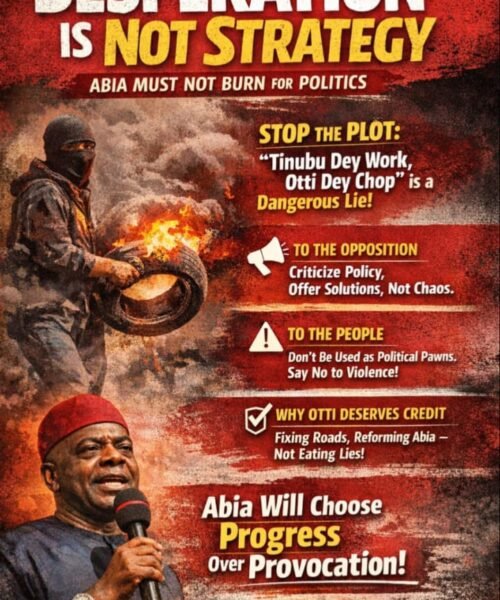

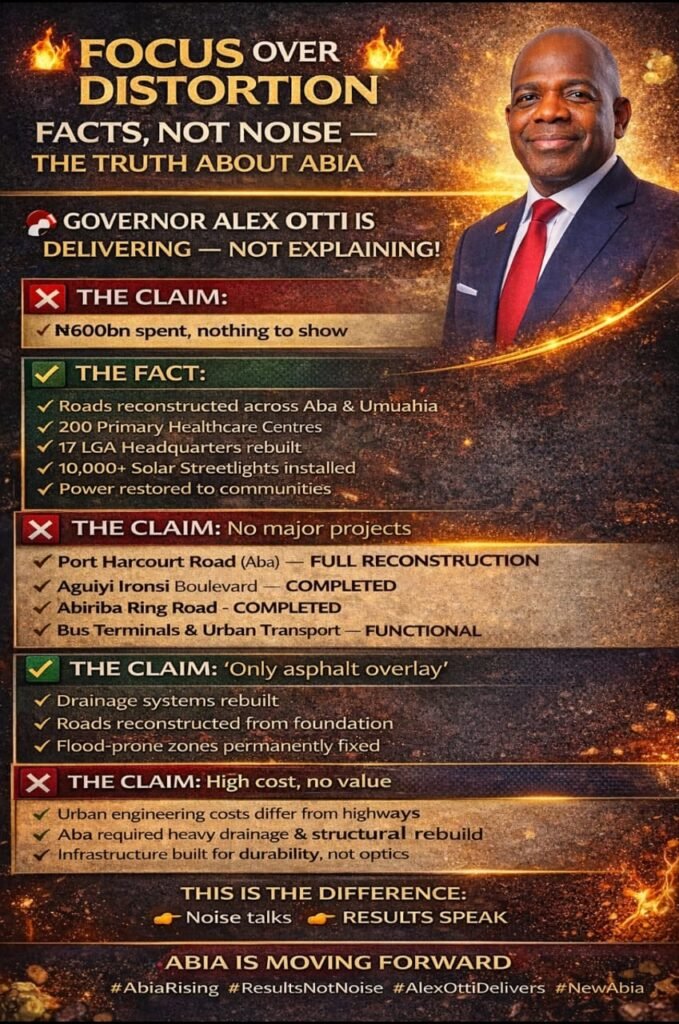
A FACT-BASED RESPONSE TO Eke O Ako’s MISLEADING CLAIMS ON ABIA GOVERNANCE
First, let us separate emotion from evidence.
Public discourse must be anchored on facts, timelines, and verifiable outputs, not exaggeration or selective interpretation.
1. ON THE ₦600BN CAPITAL EXPENDITURE CLAIM
The assertion that “₦600bn has been spent with less than ₦200bn visible” is analytically weak and misleading.
Capital expenditure in a modern subnational economy includes:
Road reconstruction (not just asphalt topping)
Drainage systems and erosion control
Power infrastructure (e.g., Geometric Power integration roads and networks)
Healthcare upgrades (200 PHCs + general hospitals)
Education (221 schools + smart schools)
Land acquisition & compensation (airport, industrial park, medical city)
Institutional rebuilding (courts, LG headquarters, government complexes)
Fact: A large portion of capital spending is not always immediately visible as “new structures”—it includes substructure works, compensation, and system upgrades.
2. “NO MAJOR PROJECTS” CLAIM — FACT CHECK
This claim collapses under basic verification.
Visible, Verifiable Deliveries Include:
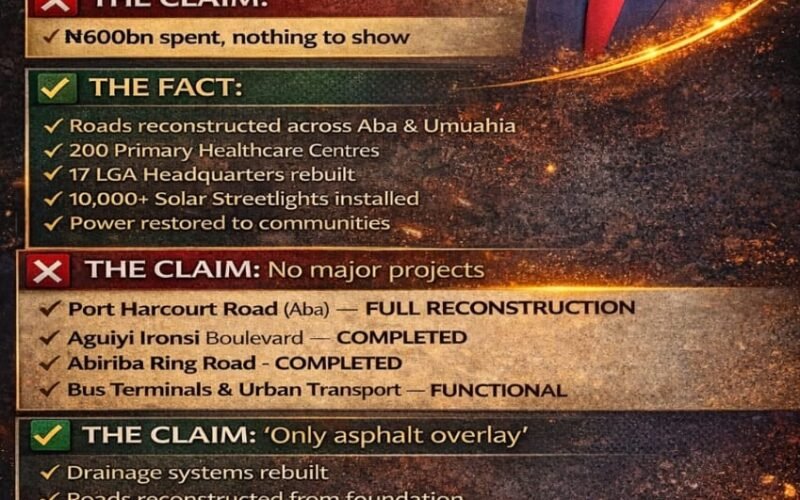
Reconstruction of Port Harcourt Road (Aba) – long abandoned, now functional
Aguiyi Ironsi Boulevard (Umuahia)
Abiriba Ring Road & regional connectors
17 LGA Headquarters reconstruction
200 Primary Healthcare Centres across 184 wards
70 Bus Terminals & Shelters
10,000+ solar streetlights installed statewide
Restoration of electricity in 33 communities (Ukwa West)
Conclusion: The claim of “no major project” is factually incorrect.
3. “ONLY ASPHALT OVERLAY” — TECHNICAL MISREPRESENTATION
This is a common but flawed argument.
Road engineering involves:
Sub-base reconstruction
Drainage correction
Structural reinforcement
Full-depth reclamation (in many Aba roads)
For instance:
Port Harcourt Road was not an overlay—it was a full reconstruction project
Several Aba roads involved drainage redesign and complete rebuild
Fact: Calling all works “overlay” is technically inaccurate and deliberately reductive.
4. ON COST PER KILOMETRE COMPARISONS
Comparing Abia road costs with:
Enugu–Port Harcourt Expressway
Lagos–Calabar Coastal Highway
…is methodologically flawed.
Why?
Federal projects benefit from economies of scale
Terrain, urban density, drainage complexity differ
Aba roads, for example, require heavy drainage intervention, not just surfacing
Conclusion: These comparisons are not apples-to-apples and therefore unreliable.
5. PROCUREMENT & TRANSPARENCY CLAIMS
It is valid to demand transparency—but let’s stay factual:
Procurement processes exist within statutory frameworks
Many contracts are executed under emergency infrastructure recovery models (especially in Aba)
Transition gaps in digital portals do not equate to absence of procurement
Reality: The argument confuses portal visibility with institutional existence.
6. “NO IMPACT ON LIVING STANDARDS” — FALSE GENERALISATION
Evidence contradicts this:
Improved urban mobility (Aba & Umuahia road networks)
Increased power access (Geometric Power ecosystem)
Expansion in health access (PHCs across wards)
Teacher recruitment (5,000+ employed)
Medical workforce expansion (~700 professionals)
Fact: These are direct welfare improvements, not abstract claims.
7. RURAL NEGLECT CLAIM
This is selective perception, not statewide reality.
Projects exist in:
Ukwa West (power restoration, civic centre, roads)
Arochukwu, Ohafia, Isiukwuato (road networks ongoing)
Abiriba axis (ring road + regional connectivity)
Conclusion: Development is phased, not absent.
8. ON “NO SIGNATURE PROJECT”
This is subjective—but even by strict standards:
Geometric Power integration & enabling infrastructure
Abia Medical City (ongoing)
Airport project (ongoing)
Industrial Park (ongoing)
These qualify as long-term signature investments, not short-term optics.
9. ON GOVERNANCE STYLE & “DICTATORSHIP” CLAIM
Strong disagreement or political dissatisfaction does not equal dictatorship.
Media criticism exists openly
Opposition voices are active
Public discourse is ongoing
Fact: Democracy includes criticism AND governance authority.
FINAL POSITION
This debate should not be reduced to:
Social media rhetoric
Selective interpretation
Emotional exaggeration
It should be about verifiable progress vs realistic expectations.
Truth is simple:
Abia is not perfect—but it is moving.
And movement, backed by visible infrastructure and institutional rebuilding,
is the foundation of transformation.
CLOSING LINE
Criticism is welcome.
Distortion is not.
Facts must lead the conversation. 🔥
As always!
AProf Chukwuemeka Ifegwu Eke