
ALEX OTTI’S POWER GAMBIT: WHY ABIA’S ENERGY PUSH IS MORE THAN A TREND
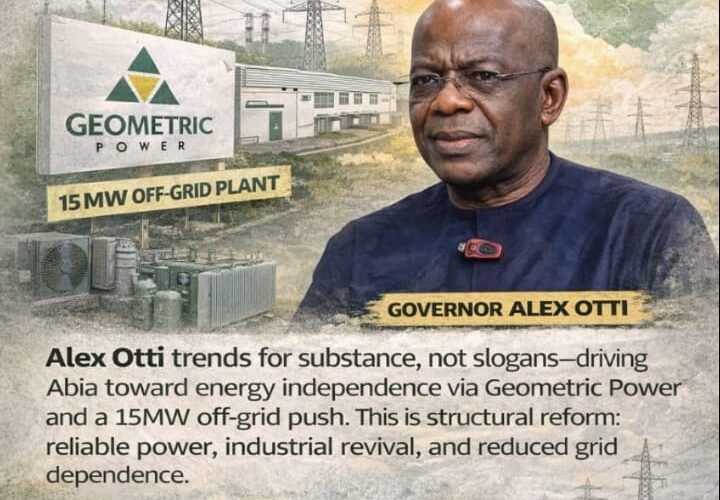
Governor Alex Otti is trending today for the right reason: not for a slogan, not for a quarrel, but for a serious structural gamble to change how Abia gets electricity. Recent reports say his administration is pushing toward an eventual break from dependence on Nigeria’s collapsing national grid, using the existing Geometric Power/Aba ring-fenced model, a proposed additional 125MW turbine, and a separate 15MW off-grid plan for Abia State University and its surrounding communities. That is not routine politics. That is an attempt to redraw the economic map of the state.
To understand why this matters, one must begin with a simple fact: Abia is not starting from fantasy. The Aba Integrated Power Project, developed by Geometric Power, is already real. The plant was commissioned in February 2024, and reports described it as an integrated power system designed to generate and distribute electricity outside the conventional national-grid arrangement for the Aba ring-fenced area. In plain terms, Otti is not selling theory; he is trying to scale a model that has already moved from aspiration to operation.
That is why the current conversation is strategically important. According to recent reporting, Otti said the eight local governments in the Aba ring-fence are already detached from the national grid, while the state is working on extending independent electricity solutions to the remaining areas. He reportedly tied that ambition to plans for an additional 125MW gas turbine that could help power Umuahia and support a wider state-level energy exit from the grid. If achieved, this would be one of the boldest subnational power plays in Nigeria in years.
The significance of the 15MW off-grid plant should not be underestimated either. Reports indicate that the project is meant for Abia State University, Uturu, and adjoining communities, with the aim of guaranteeing stable power for the institution and reducing dependence on the national supply chain. In a country where public universities are repeatedly crippled by erratic electricity, that kind of targeted embedded-power plan is not cosmetic. It is developmental. Reliable power can reshape research capacity, student welfare, digital learning, water systems, and the investment attractiveness of an entire educational corridor.
This is also where Otti’s move becomes bigger than electricity. It is an industrial policy choice. Stable electricity is not merely about keeping bulbs on. It is about reviving production, extending business hours, lowering generator costs, improving hospital operations, reducing losses for manufacturers, and making industrial clusters viable again. The Geometric model was always economically significant because Aba is one of Nigeria’s most commercially active urban zones. If Otti succeeds in broadening that model, he would be doing more than solving a utility problem; he would be laying the backbone for industrial competitiveness.
There is also a legal and institutional side to this story that strengthens the case. In March 2025, Otti signed the Abia State Electricity Bill into law, a step that formally empowered the state to regulate its own electricity market under the new constitutional and statutory environment that allows subnational participation in power. That means today’s headlines are not floating in empty air. They sit on a legislative base already put in place by the government. In governance terms, that matters: reform is more credible when law precedes expansion.
Alex Otti
Critics will say the plan is ambitious. They are right. It is ambitious. But ambition is not a weakness when it is tied to infrastructure already on ground, legal preparation already completed, and negotiations reportedly already underway. The real test will not be whether the announcement trends for 24 hours; it will be whether the state can secure the added generation capacity, finance expansion prudently, and execute transmission and distribution upgrades without collapsing into the usual Nigerian cycle of announcement without delivery. Still, even that criticism must concede one thing: this is at least the language of structural reform, not mere ribbon-cutting politics.
Abia is not trending because of manufactured noise. It is trending because its governor is tying his political reputation to one of the hardest things a subnational government can attempt in Nigeria: energy autonomy. If he pulls it off, the implications will be profound—lower business costs, stronger investor confidence, better urban productivity, and a sharper economic distinction between Abia and states still trapped in total dependence on the national grid. Quietly or loudly, that is the kind of move that can redefine a governorship.
AProf Chukwuemeka Ifegwu Eke